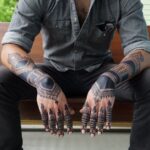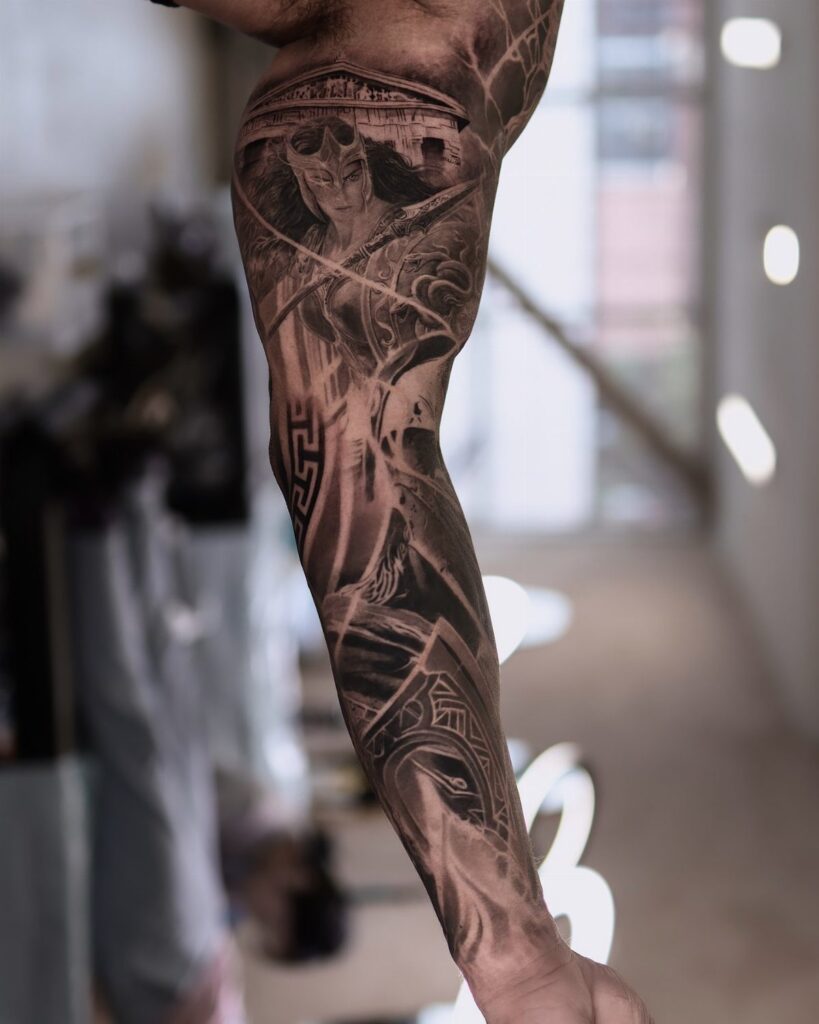
A full sleeve runs shoulder to wrist in one connected piece and takes multiple sessions spaced weeks apart, with healing at about 2 weeks per sitting.
The choice comes down to whether you want one unified theme or a patchwork approach that lets you add tattoos over time.
Japanese sleeves draw on centuries of koi and wave imagery, geometric work locks in hard angles and repeating patterns, and patchwork collections let you add pieces over time without mapping the whole arm up front.
1. Full Sleeve Tattoo
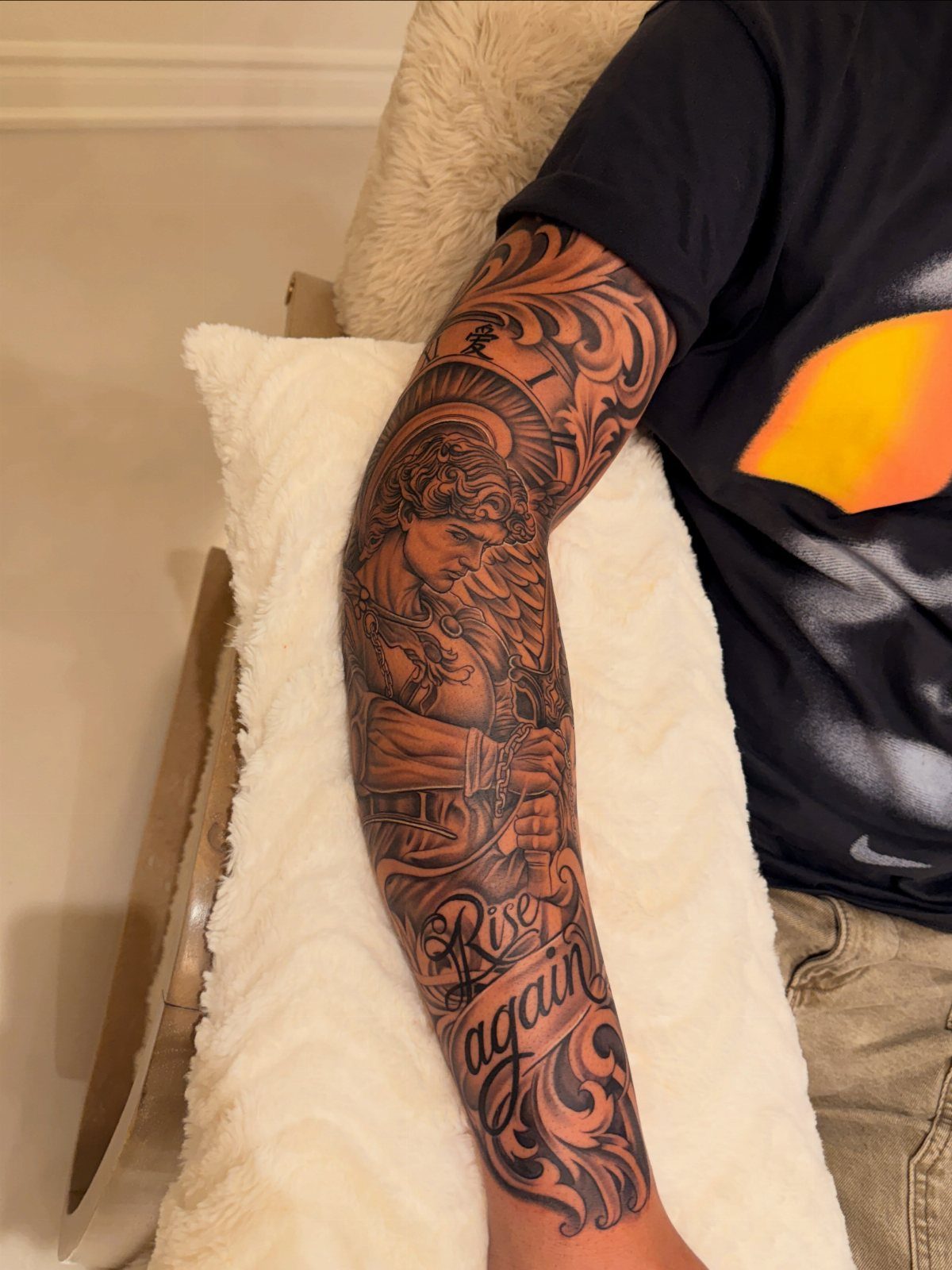
The design runs from shoulder to wrist in one connected piece. The design wraps the entire arm, so you get a complete visual field that holds together from any angle.
Healing takes about 2 weeks per session, and you’ll need to protect it from sun and friction while the color sets.
The commitment is real, but a full sleeve gives you room to build something that reads as one idea instead of a collection of separate tattoos.
2. Japanese Sleeve Tattoo
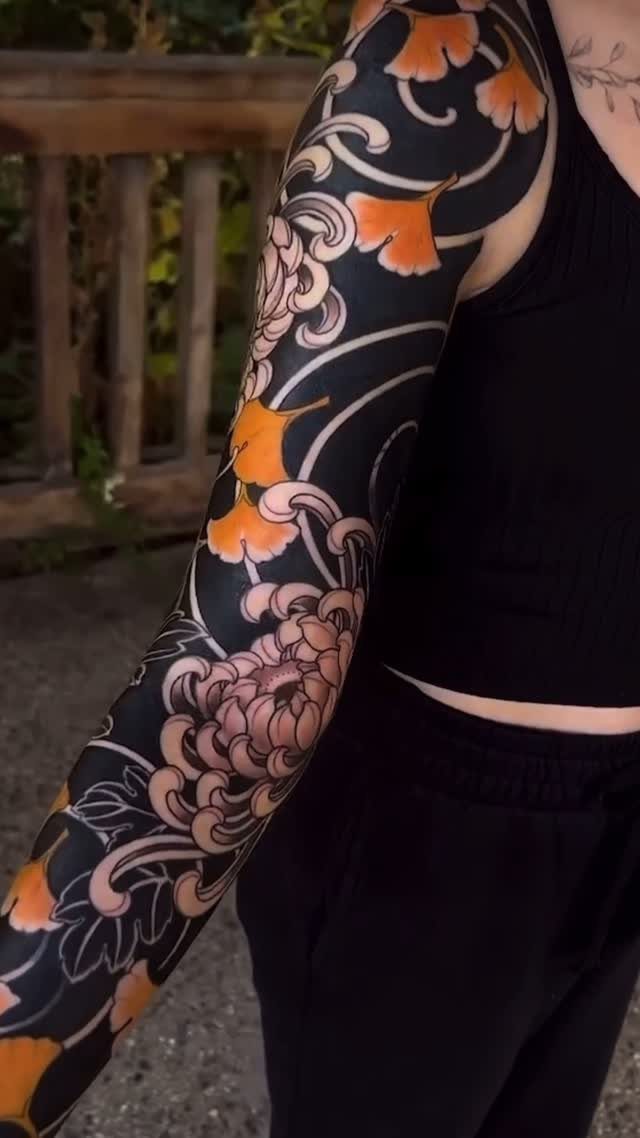
Japanese sleeves pull from centuries of tattooing tradition: koi, dragons, cherry blossoms, waves and guardian masks arranged in compositions that balance movement and negative space.
The style uses bold color fills, strong black outlines and backgrounds that let the main figures stand out.
These designs carry specific meanings.
A koi swimming upstream signals perseverance, peonies represent prosperity, and chrysanthemums mark longevity. I like the way the symbolism layers without needing text to explain it.
Most artists trained in this style work from reference books of classical ukiyo-e prints. Sessions run long because the color saturation and detail density take time to place correctly.
3. Traditional Tattoo Sleeve
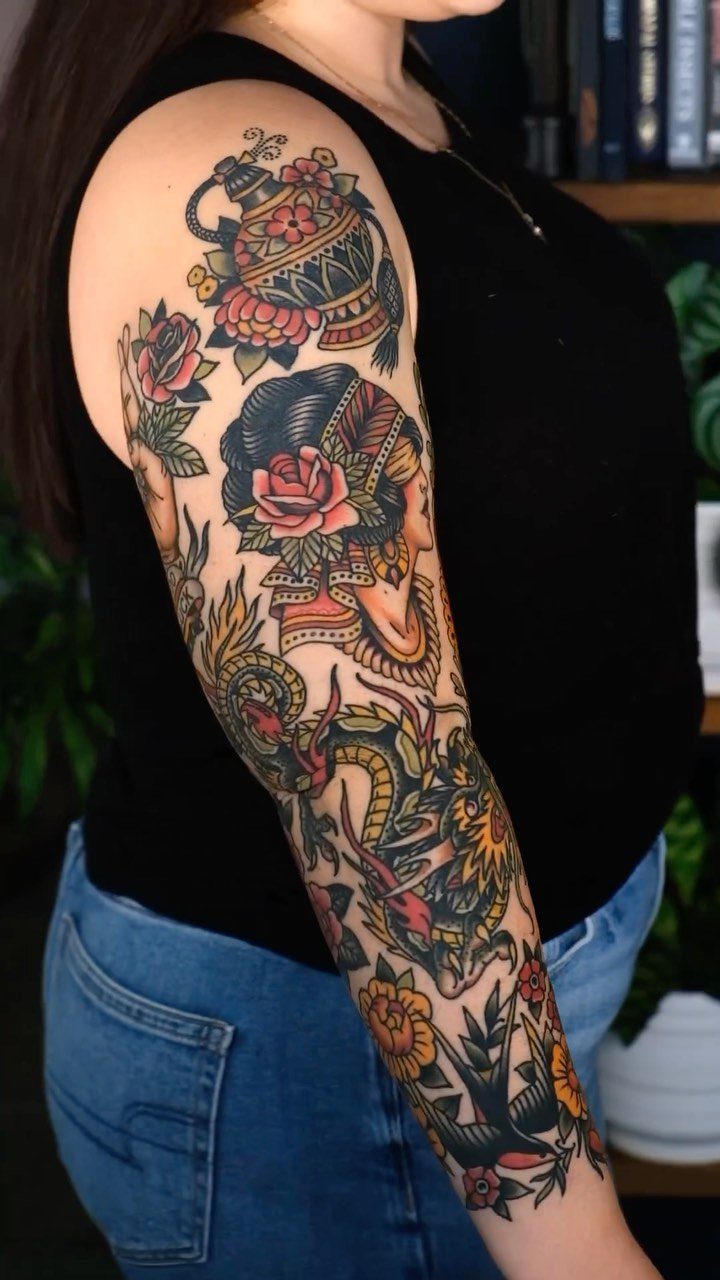
Traditional sleeves use thick black outlines, a limited color palette and the iconic motifs that defined American tattooing in the early twentieth century. You see roses, daggers, eagles, pin-up portraits, anchors and ships arranged in panels or stacked vertically.
The style holds up because thick lines and high-contrast color don’t blur or fade as fast as fine detail. Red, green, yellow and black stay readable decades later, which matters when you’re covering an entire arm.
Artists working in this style often charge per tattoo rather than hourly.
4. Flow of Sleeve Tattoos
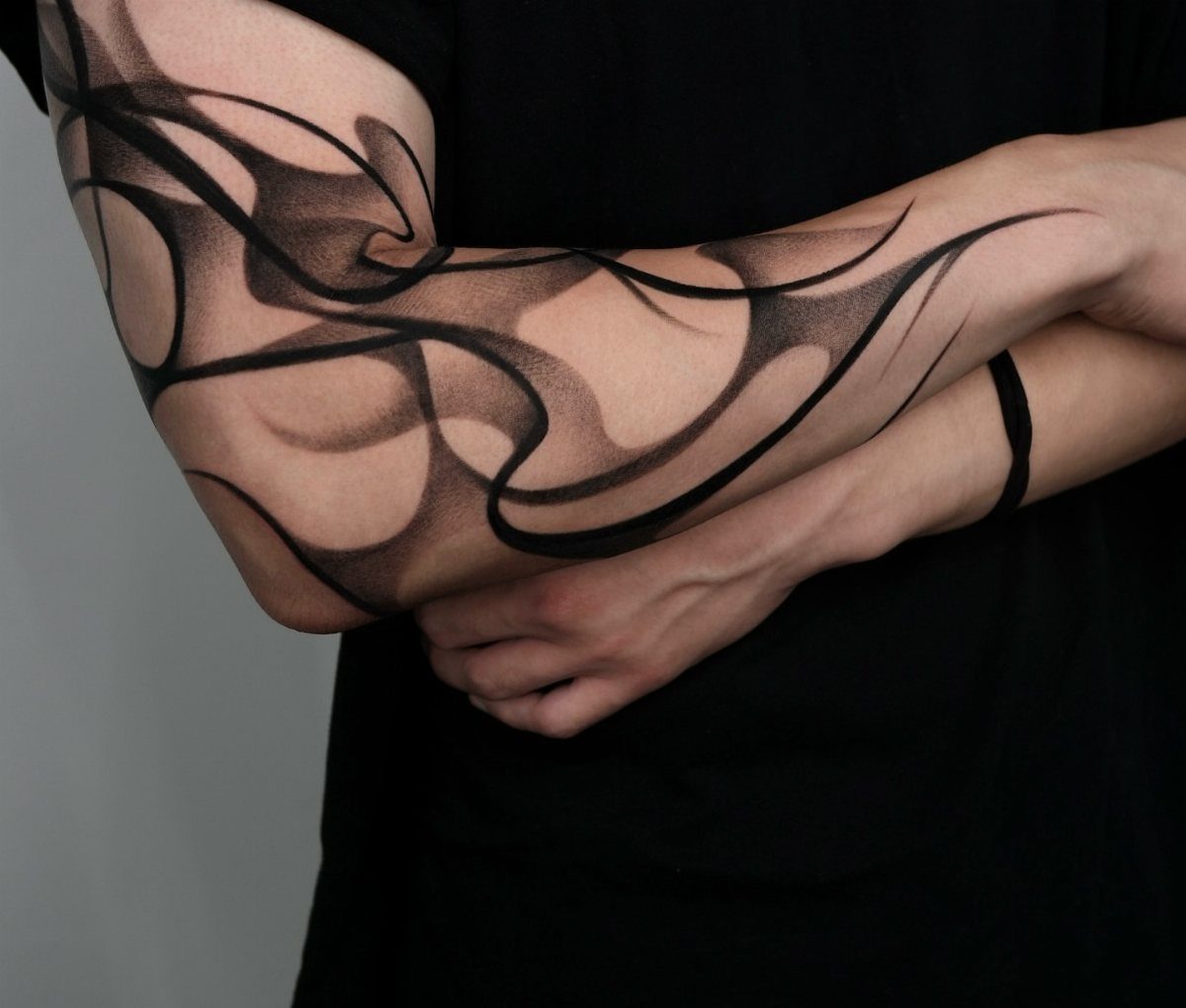
Flow means your design follows the arm’s natural curves instead of sitting flat against them. A sleeve with good flow reads smoothly when your arm hangs at your side, bends at the elbow, or rotates at the wrist.
Place the heaviest visual weight on the outer arm where it’s most visible, and let lighter elements wrap toward the underside.
Avoid hard horizontal lines that cut the arm in half. Instead, use diagonal movement or organic shapes that guide the eye around the contour.
I recommend bringing reference images to your consultation and asking the artist to sketch the layout directly on your arm. You’ll catch awkward breaks or flat spots before the needle starts.
5. Geometric Sleeve Tattoo
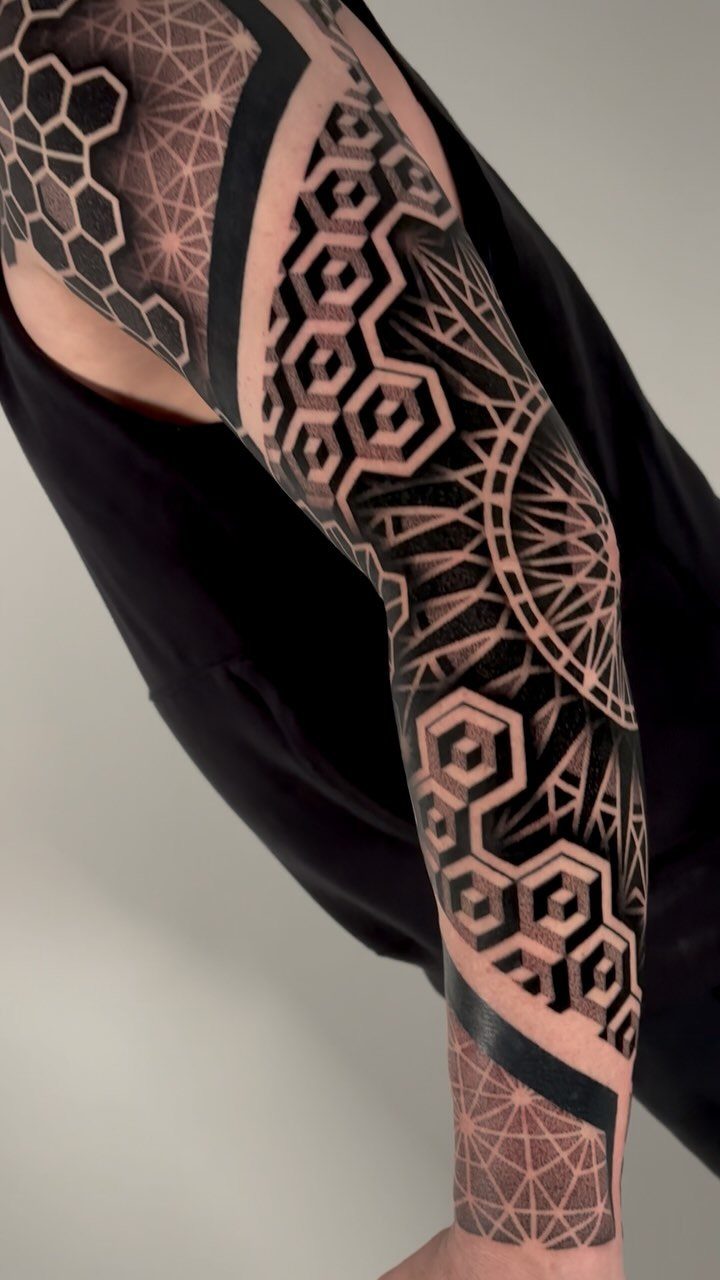
Geometric sleeves build from repeating shapes, mandalas, sacred geometry and hard-edged linework. The precision matters: a circle that isn’t perfectly round or a line that wobbles reads as a mistake, not a style choice.
This style suits people who want a modern, architectural look without organic imagery. Hexagons, triangles and interlocking polygons create structure, and you can layer dot work or stippling inside the shapes for depth.
Find an artist who specializes in technical line work and ask to see healed photos. Black ink on geometric tattoos shows every imperfection, so you need someone whose lines stay crisp over time.
6. Realism Portraits Full Sleeve Tattoo
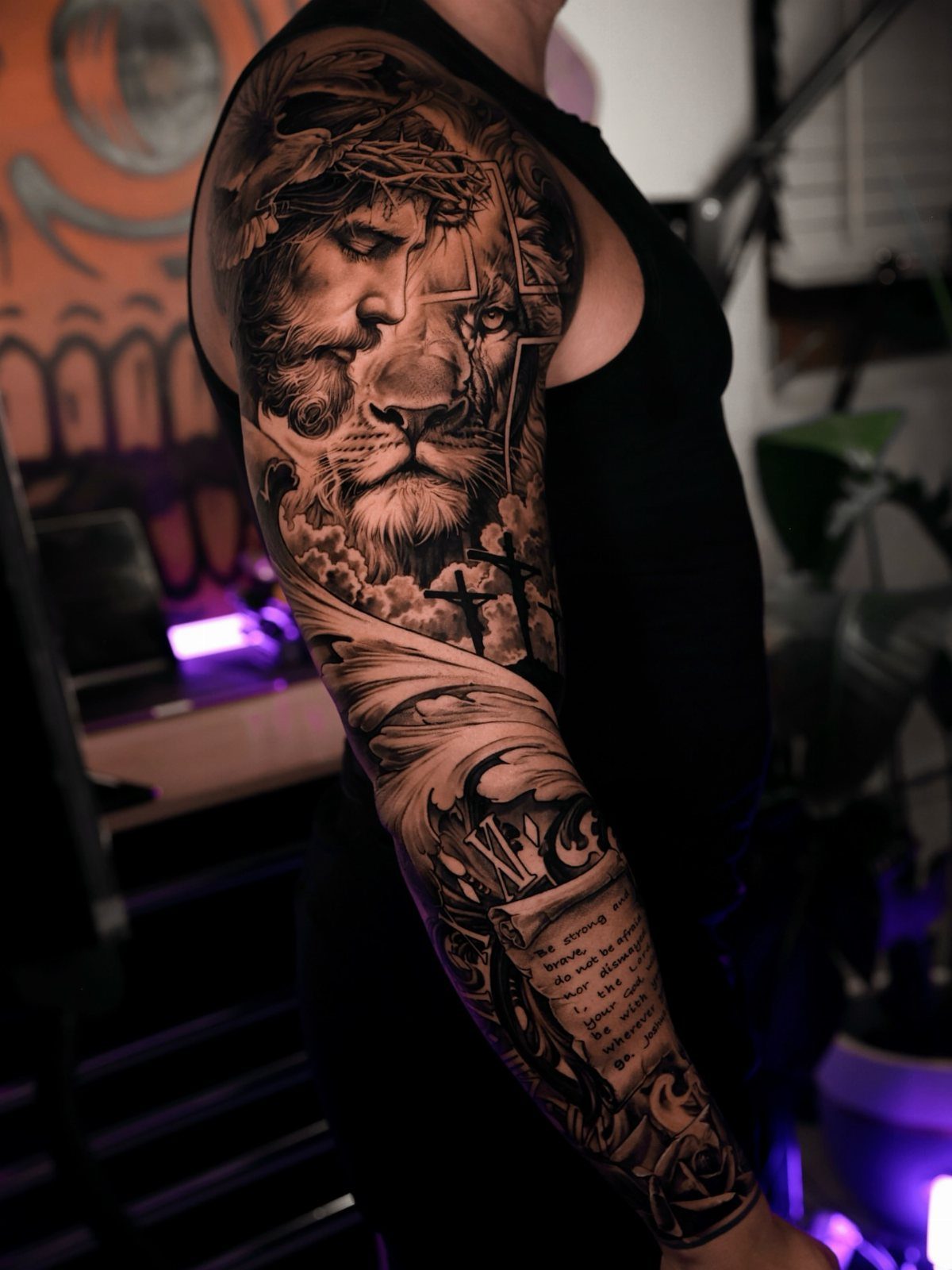
Realism sleeves recreate photographs in grayscale or full color, capturing skin texture, fabric folds and light the way a camera would. Portraits of family members, religious figures or historical icons work because the detail holds meaning beyond decoration.
This style demands an artist with a strong drawing background. Proportion errors in a realistic face are obvious, and poor shading makes the image look flat or cartoon-like instead of lifelike.
Sessions run longer than traditional work because the artist builds each layer of shading in multiple careful passes.
7. Floral Sleeve Tattoo
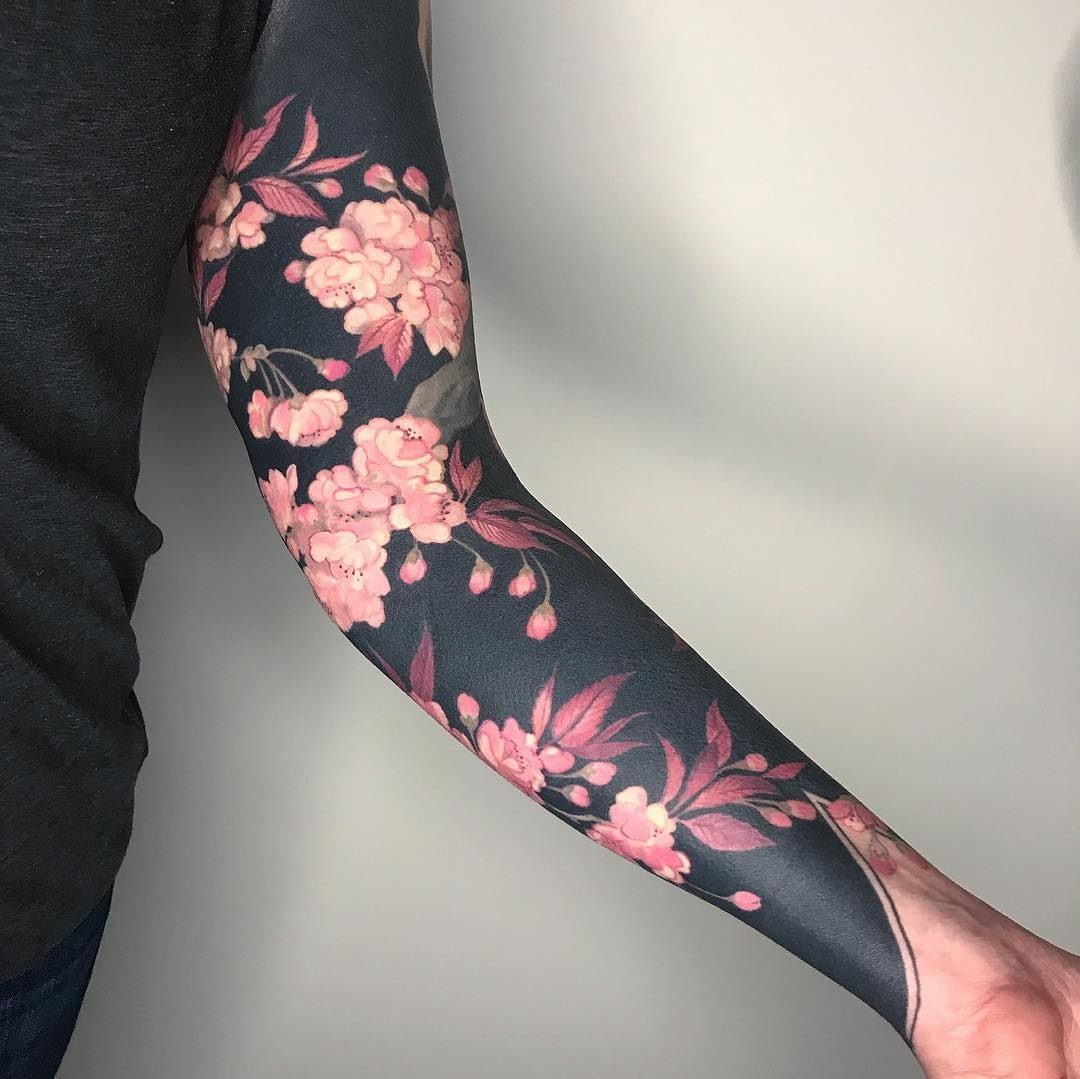
Flowers let you work with color, negative space and organic shapes that soften the hard geometry of an arm.
Cherry blossoms, roses, peonies and lotus flowers are common because they carry symbolic weight and layer well with leaves, vines or water.
You can ink a floral sleeve in saturated color or keep it monochrome. Color adds vibrancy but fades faster in direct sun, so plan on touch-ups every few years if you want the saturation to hold.
Botanical designs suit people who want a sleeve that feels less aggressive than skulls or predators. The style reads softer but still covers completely.
8. Animal Sleeve Tattoo
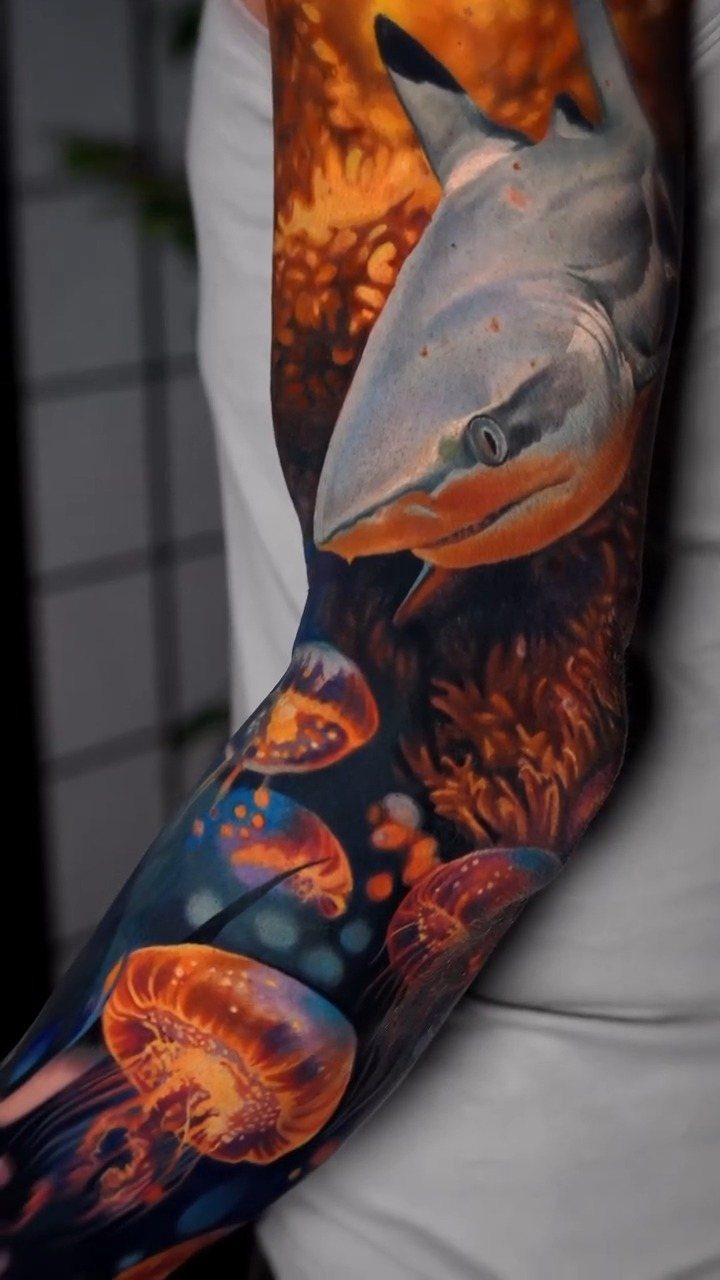
Animals give you a focal point with built-in movement and symbolism. Predators like wolves, bears and big cats signal strength, while ocean creatures like sharks, jellyfish and octopuses let you build around water and flow.
Realism works well here because fur texture, scales and muscle definition add depth. Black and grey keeps the focus on form, but color brings out bioluminescence in jellyfish or the warm tones in a tiger’s coat.
Pick an animal that means something to you beyond how it looks. A sleeve is permanent, and a design with personal weight holds up better than one chosen for aesthetics alone.
9. Patchwork Sleeve Tattoo
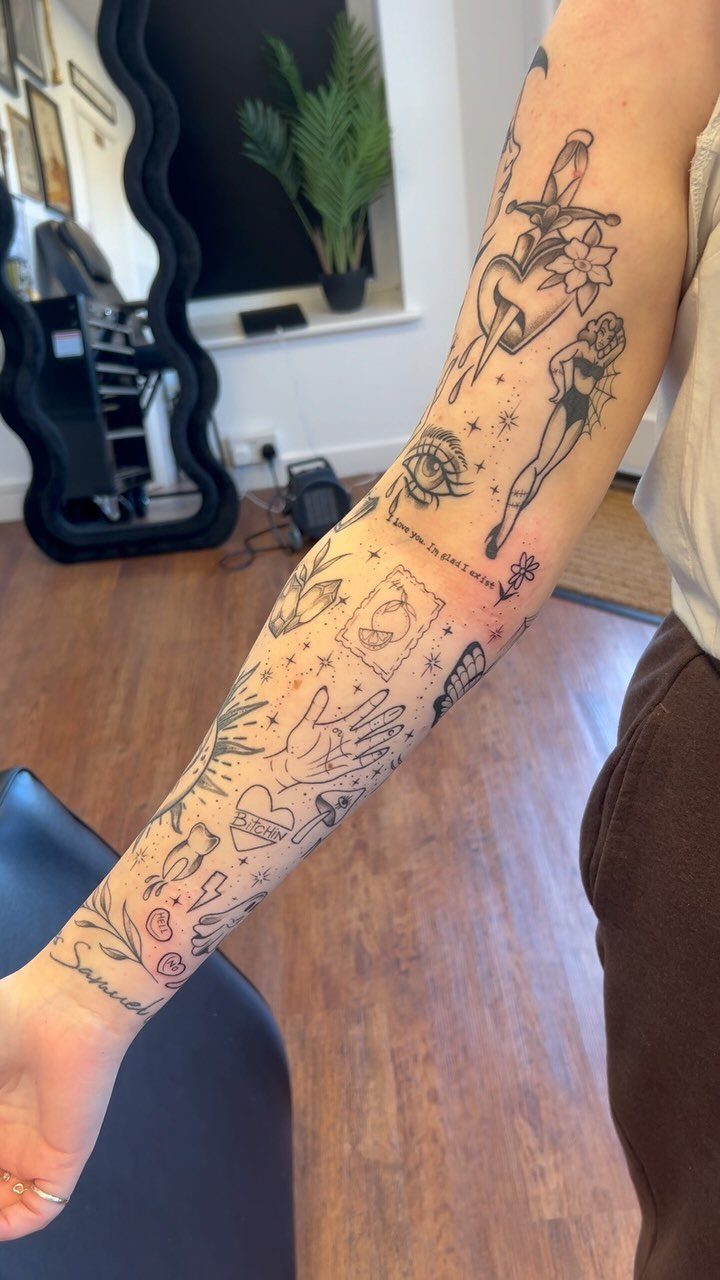
Patchwork sleeves collect separate tattoos over time instead of planning one unified design. Each piece stands alone, and the gaps between them stay visible or get filled with small connectors like stars, dots or script.
This approach suits people who want flexibility. You can add a tattoo when you have the money or find an idea worth inking, and you’re not locked into one artist or one style.
The downside is visual cohesion. A patchwork sleeve can look intentional if the sizing and placement stay consistent, but it can also read as random if the styles clash or the spacing feels awkward.
10. Mythology and Fantasy Sleeve
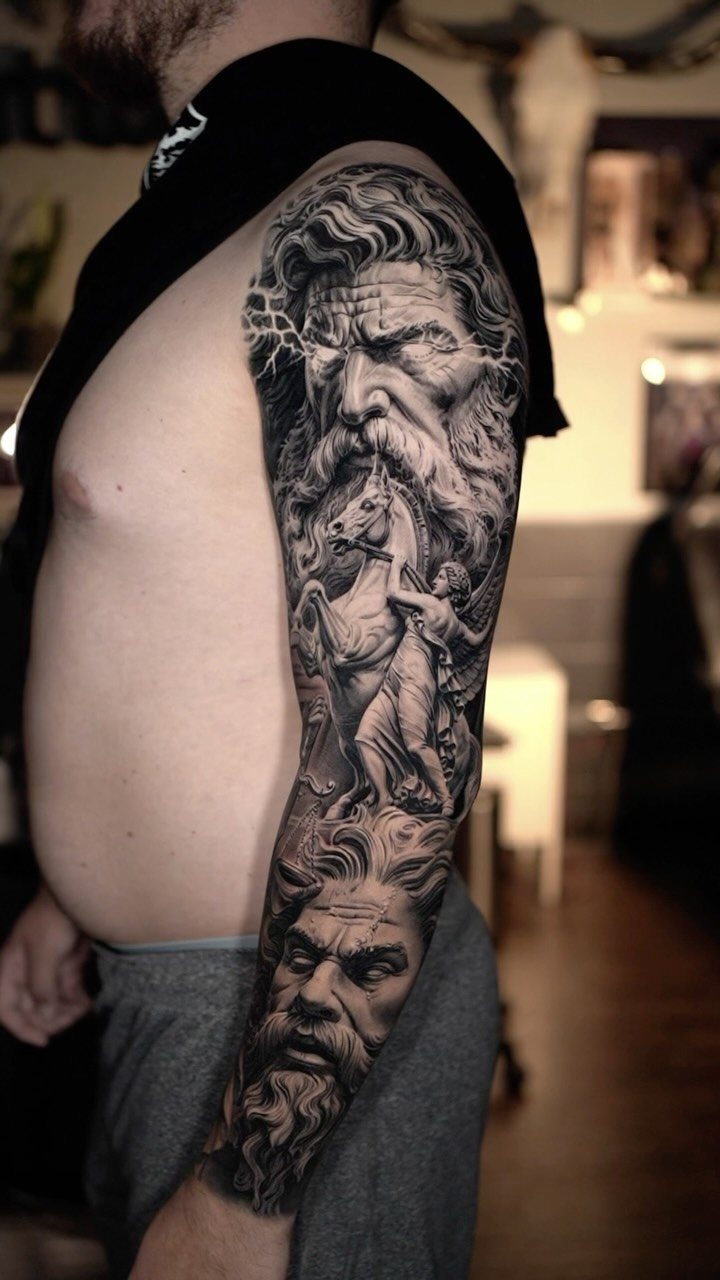
Mythology sleeves pull from gods, monsters and legendary scenes: Greek titans, Norse runes, Celtic knots or fantasy creatures like phoenixes and griffins. The imagery carries narrative weight, and you can build a composition that tells a story across the arm.
Black and grey suits this style because it keeps the focus on detail and shading. Faces, armor and creatures need strong contrast to read clearly, and too much color can flatten the depth.
Sessions take longer because the level of detail is high. Facial features, fabric textures and mythological symbols require precision, so expect multiple sittings to complete the arm.
11. Cultural and Tribal Sleeve
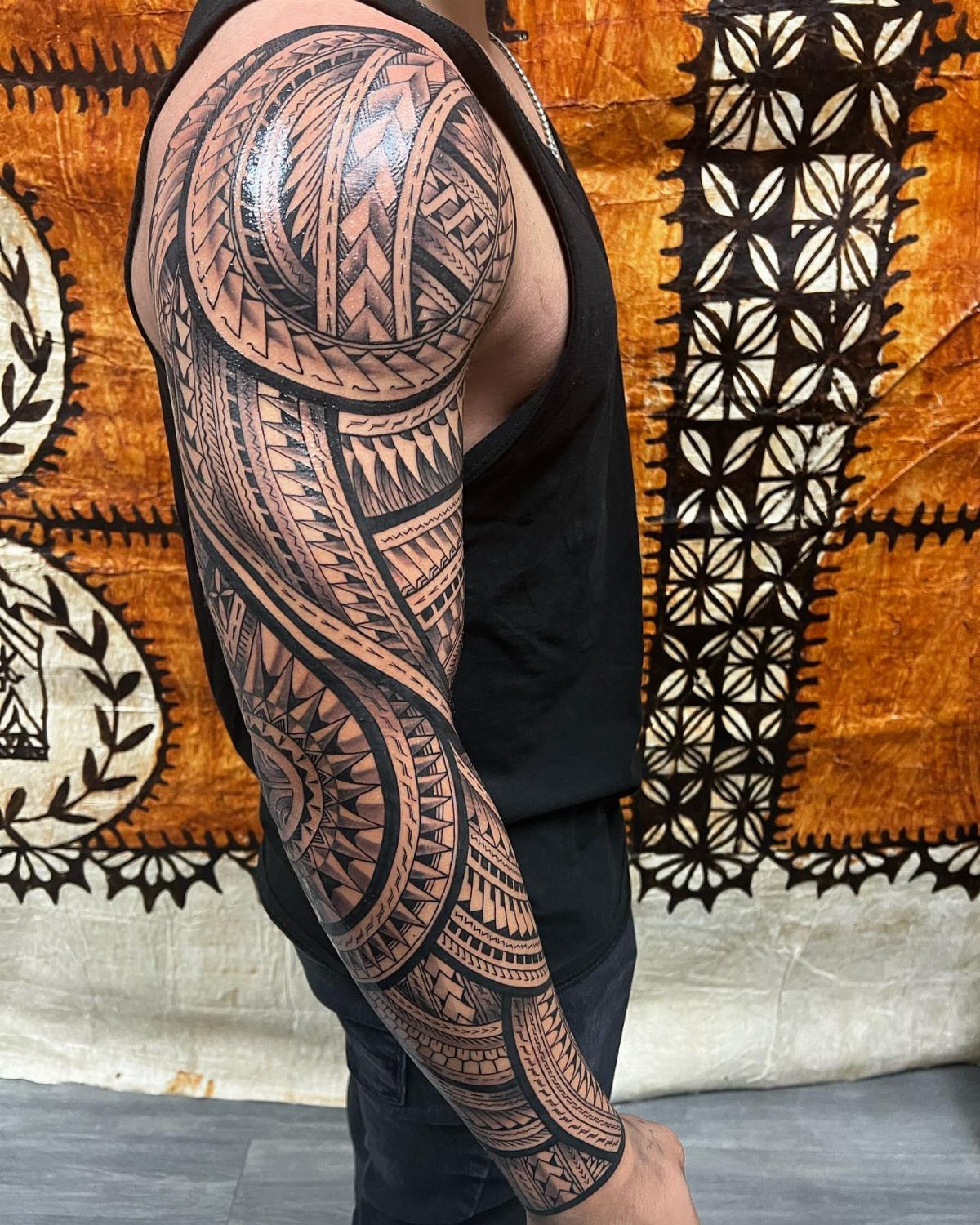
Tribal sleeves use bold black patterns rooted in specific cultural traditions: Polynesian, Maori, Samoan or Filipino designs that carry genealogical or spiritual meaning. The geometric shapes and negative space create high contrast that holds up over time.
If you’re not from the culture, understand what the symbols mean before you commit. Some patterns are reserved for specific achievements or family lines, and wearing them without that connection can be disrespectful.
Find an artist who specializes in the tradition you’re interested in. Freehand placement and symmetry matter here, and someone who knows the iconography will keep the design authentic.
12. Chicano and Street Culture Sleeve
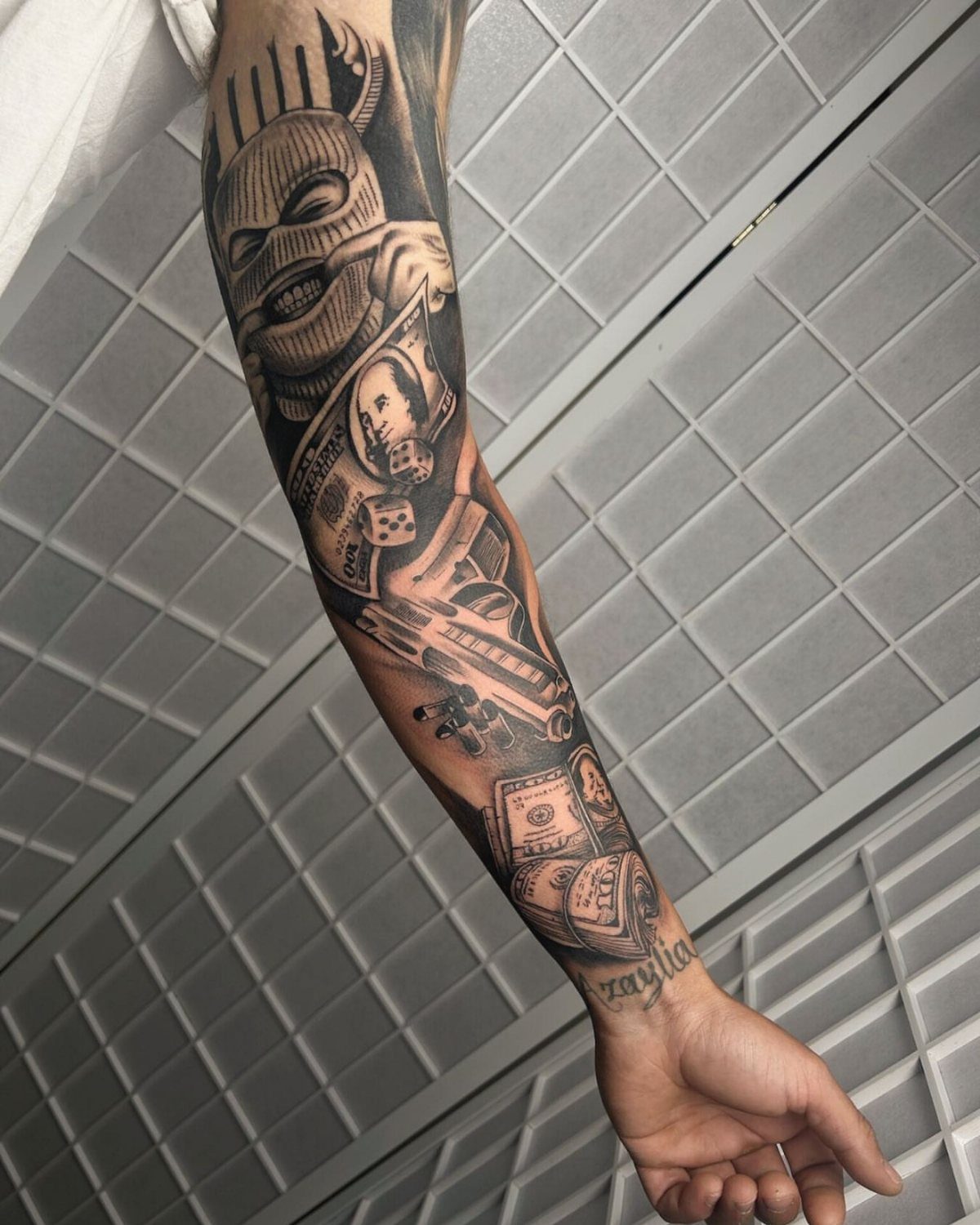
Chicano sleeves use black and grey realism to depict street life, religious iconography, script and portraiture. You see lowriders, dice, money, roses, praying hands and masked figures arranged in a composition that balances fine detail with bold contrast.
The style came out of Los Angeles in the mid-twentieth century and carries specific visual language. Script sits along the forearm or wrist, often spelling out names, dates or phrases in Old English or calligraphy lettering.
This sleeve reads best when the shading is smooth and the black stays saturated. Find an artist experienced in Chicano realism because the style depends on soft gradients and deep blacks that don’t muddy over time.
13. Urban Decay and Apocalyptic Sleeve
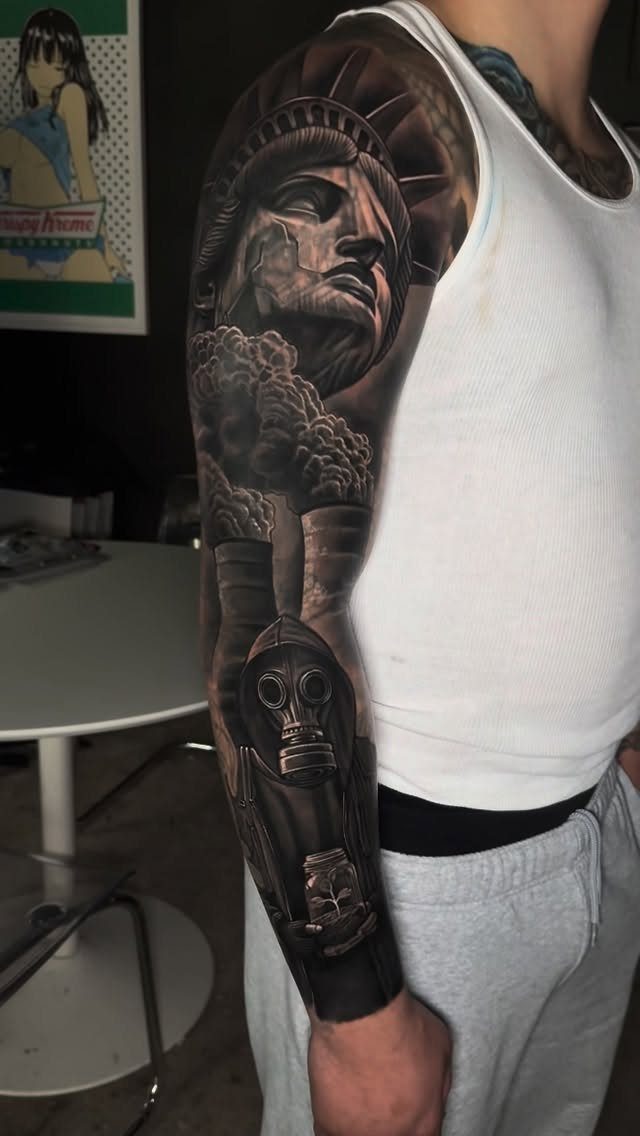
Urban decay sleeves combine gas masks, crumbling monuments and smoke in black and grey realism. The Statue of Liberty appears damaged or weathered, paired with industrial imagery that signals collapse or survival.
The style suits people drawn to post-apocalyptic aesthetics or political commentary. Gas masks and smoke add movement without needing organic shapes, and monochrome keeps the tone dark.
Black and grey shading does the heavy lifting here.
Smoke needs soft gradients to look like it’s drifting, and architectural detail in stone or metal requires precise line work. Find an artist who can handle both smooth transitions and sharp edges in the same composition.
14. Time and Motivational Script Sleeve
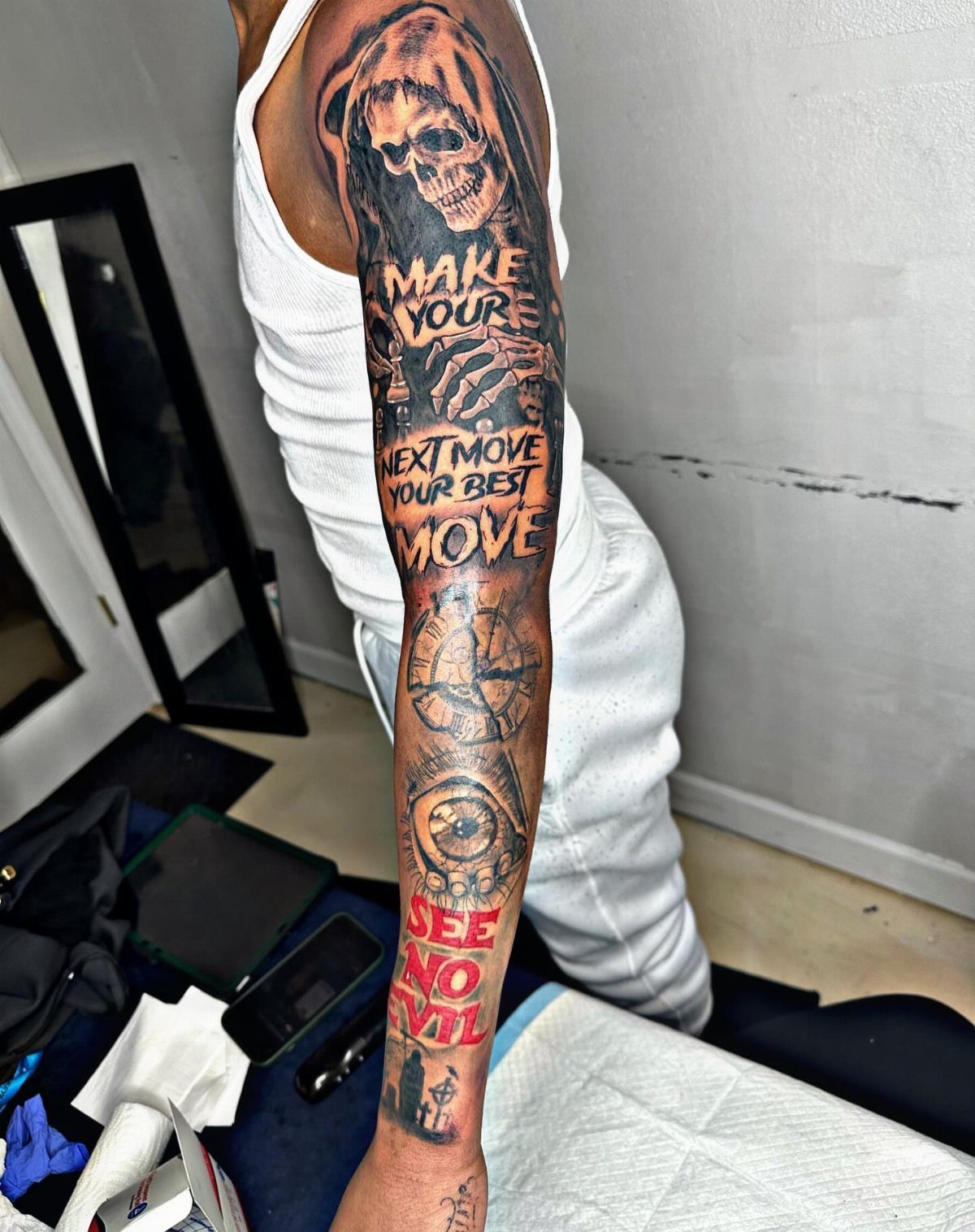
Script sleeves pair motivational text with symbols of time, mortality and direction. Clocks, compasses and skulls anchor the composition, while phrases in bold lettering wrap the forearm or bicep.
The text matters as much as the imagery.
Choose something that holds personal weight, not a generic quote you found online. Old English, block letters or calligraphy all work, but the style should match the rest of the sleeve.
Legibility drops when script curves too tightly around the arm.
I recommend keeping longer phrases on the flatter sections of the forearm where letters can sit horizontal. Save single words for the wrist or inner bicep.
15. Angelic and Architectural Sleeve
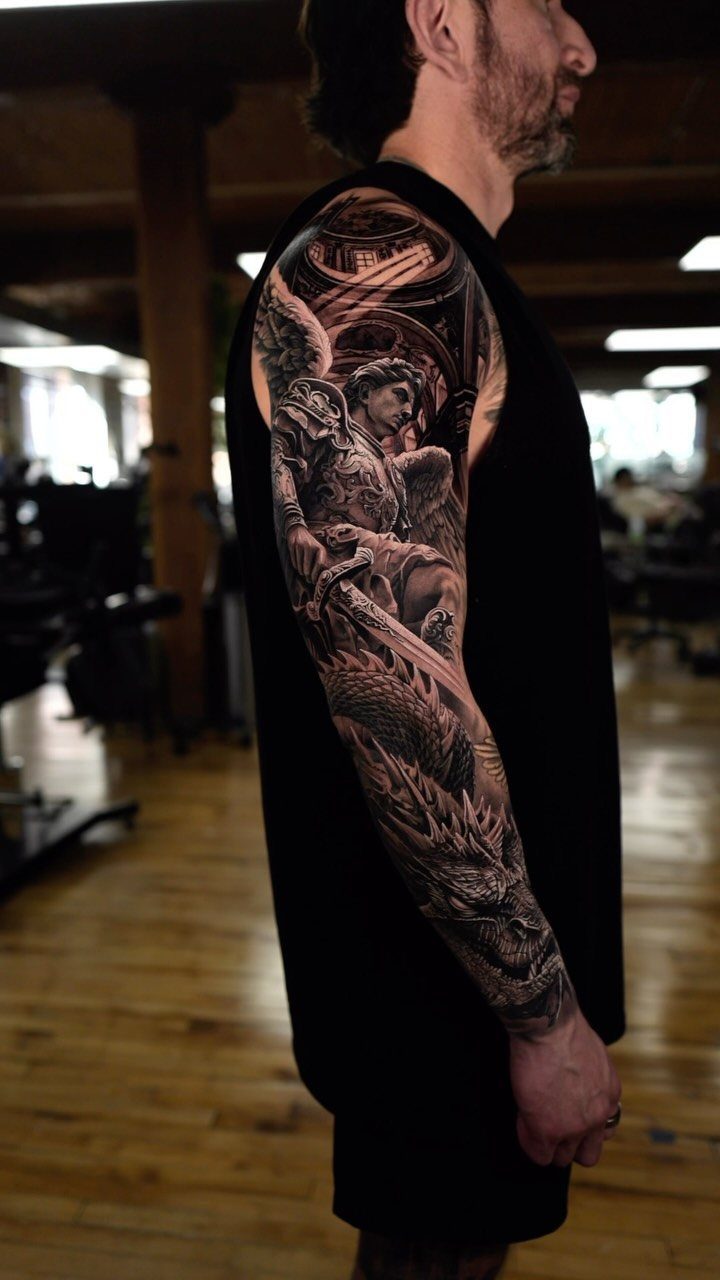
Angels in armor or wielding swords give you a religious or mythological figure with built-in drama. Classical architecture in the background adds depth and frames the angel without crowding it.
Columns, arches and stone textures work because they contrast with the softness of wings and fabric. The angel stays the focal point, and the architecture recedes into grey tones that support rather than compete.
This sleeve needs an artist comfortable with human anatomy and perspective. Wings, draped cloth and stone all demand different shading techniques, and poor execution makes the angel look stiff or the architecture flat.
Planning Your Sleeve Tattoo
Start with the central idea before you sit down with an artist.
A sleeve that pulls together one theme, Japanese imagery or realism portraits or mythology, reads as intentional. A collection of unrelated designs can work as patchwork, but if you want cohesion, the concept needs to lock in first.
Mock-up testing on your actual arm catches problems with flow, places the heaviest elements where they’re most visible, and shows you how the design wraps when your arm bends or rotates.
Pick an artist whose portfolio matches the style you’re after. Someone who specializes in geometric line work won’t be the right fit for Chicano realism, and technical precision in one style doesn’t transfer to another.
Look at healed photos, not fresh ink, to see how their work holds up over time.
Aftercare for Sleeve Tattoos
Your artist will give you aftercare instructions after the session.
Follow them exactly. Keep the tattoo clean, apply the lotion or ointment they recommend, and avoid soaking it in baths, pools or hot tubs while it heals.
The first 3 days bring inflammation and some weeping. Between days 4 and 14, the skin will peel and itch.
Don’t scratch it, and don’t pick at the flaking skin. Use a fragrance-free lotion to keep it from drying out.
After 3 to 4 weeks, the surface has healed, but the deeper layers are still setting.
Stay out of chlorinated water and keep direct sun off the tattoo. Once it’s fully healed, wear SPF 50 or higher every day to prevent the color from fading.
Pain Management During Tattooing
Pain shifts depending on where the needle sits. The outer bicep, forearm and shoulder cap register around 3 to 4 out of 10 because there’s muscle and distance from bone.
The inner forearm and wrist bone climb to 5 or 6, and the inner bicep near the armpit or the elbow ditch hit 8 to 9.
Expect inflammation and some fluid in the first 3 days. Use fragrance-free lotion and resist the urge to scratch.
Long term, daily SPF 50 or higher keeps the color from degrading.
Frequently Asked Questions
How much does a full sleeve tattoo cost?
Most people spend $2,000 to $8,000 for a full sleeve, with the final number shaped by your artist’s rate and how detailed you go.
Artists charge $150 to $300 per hour, and a full sleeve takes 25 to 40 hours spread across multiple sessions. Detail-heavy styles like realism or Japanese work push the price higher because they require more time and precision.
How long does it take to heal a full sleeve tattoo?
Surface healing takes 2 to 3 weeks after each appointment, though the full sleeve won’t be completely healed until 6 months out from your last session.
Sessions are spaced a month apart to let each section recover, and the deeper skin layers take 3 to 4 weeks to set completely. Protect it from sun and chlorinated water during that time.
Should I get my sleeve done by the same tattoo artist?
One artist keeps the style and flow consistent across the whole arm, which matters if you’re building a unified composition.
Multiple artists work if you want a patchwork sleeve that collects different styles over time. Pick based on whether you want cohesion or variety.