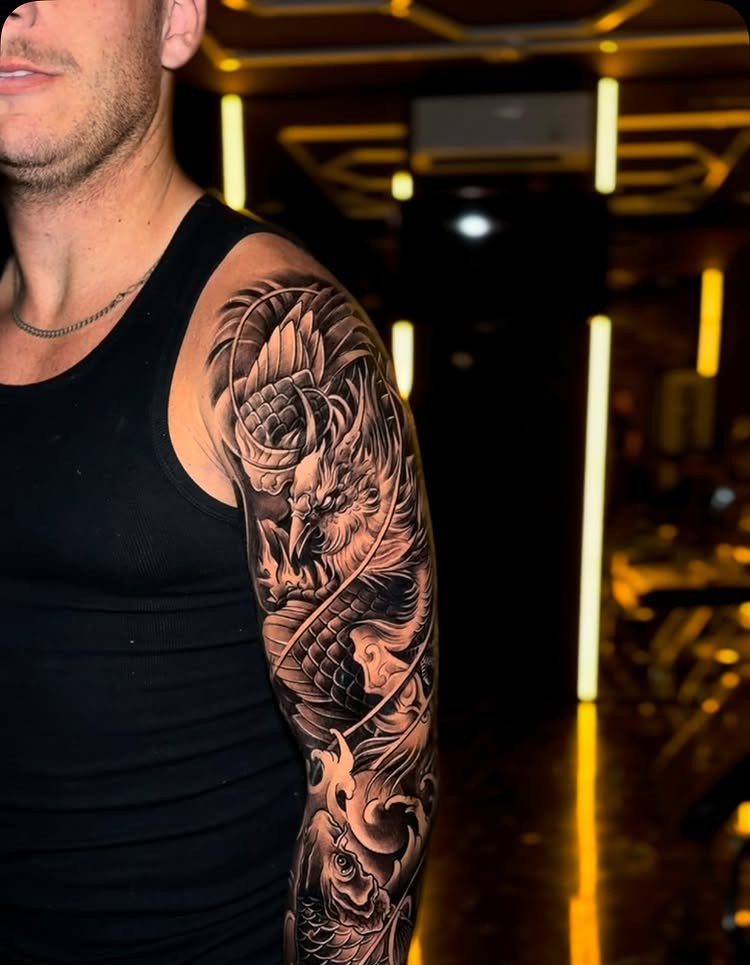
A sleeve can run anywhere from $500 to over $10,000 depending on the artist, location and design complexity, with big city tattooers and celebrity names pushing the upper end of that range.
Your sleeve can follow tight rules or let you mix whatever you like: a Japanese piece keeps dragons and waves in set positions, geometric builds symmetry across multiple sessions, and traditional holds its ink longer than fine line because more pigment makes it into the skin.
Patchwork gives you a way to add one tattoo now and another later without mapping the whole arm first.
1. Traditional Sleeve
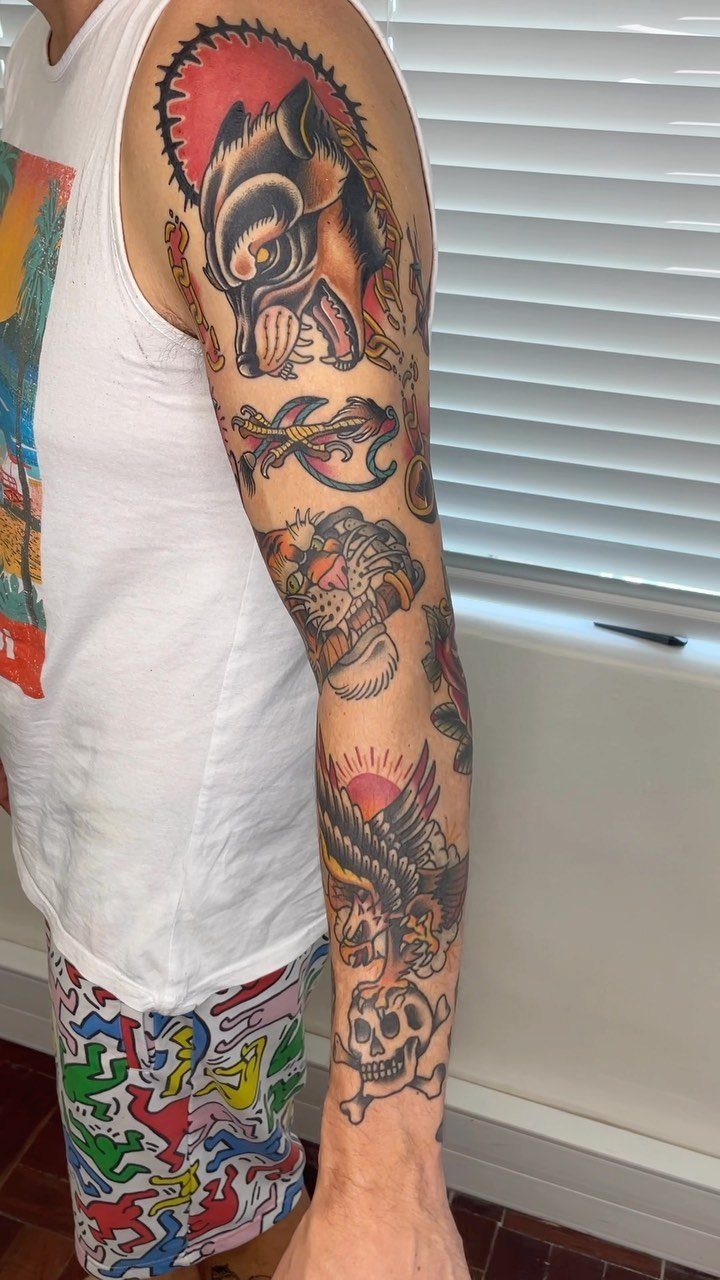
Bold imagery from American traditional tattooing, stacked across the full arm without a single overarching story tying them together.
Anchors sit next to skulls, wolves appear above roses, and each piece holds its own meaning while the heavy black outlines and limited color palette keep everything reading as one sleeve.
This style forgives additions. The traditional format makes room for additional pieces later without reworking what’s already there.
The saturated colors and thick lines hold up better over decades than delicate linework does, so the sleeve ages cleanly.
2. Patchwork Sleeve Tattoo
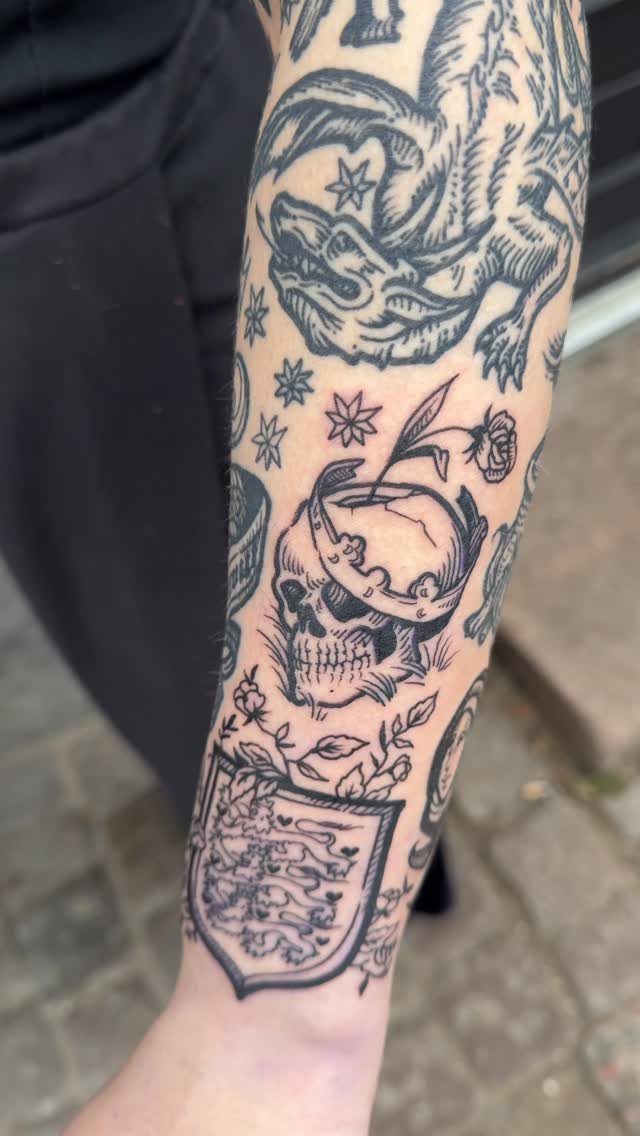
Individual tattoos collected over months or years, each one standing alone but positioned close enough that the arm fills in gradually. No background connects them, and no single narrative runs through the pieces.
This approach lets you commit to one tattoo at a time instead of planning an entire sleeve up front. You can add a new piece when you’re ready, without needing every design locked in from the start.
Spacing matters. Leave enough room between pieces so future additions don’t crowd the arm, but keep them close enough that the sleeve reads as intentional rather than random.
The style works best if you stick to a consistent ink weight or subject matter across pieces. All black and gray, or all animals, or all florals keeps the arm cohesive even without a unifying background.
3. Geometric Sleeve
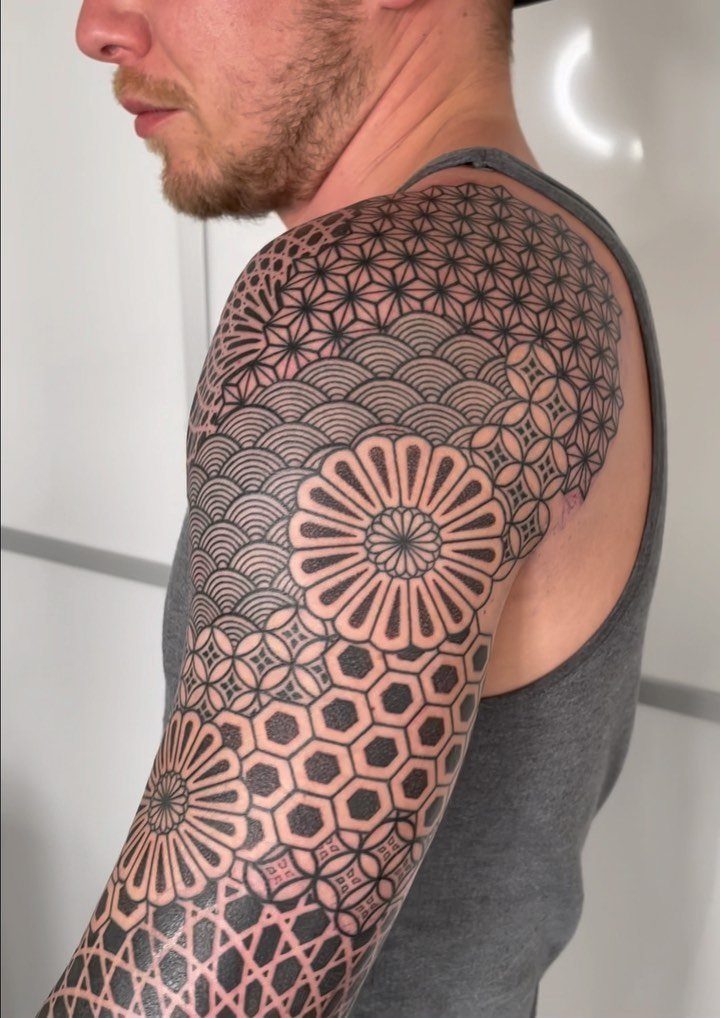
Repeating shapes, tight symmetry, and clean black lines arranged into patterns that wrap the arm in strict order. Mandalas, hexagons, and triangles stack and rotate to fill the sleeve, often combined with floral elements or dotwork to soften the edges.
Precision is non-negotiable here. Look for someone who specializes in geometric work and check their portfolio for consistency across large pieces, since small errors in alignment or spacing become obvious when patterns repeat.
Geometric sleeves photograph cleanly because of the high contrast patterns, but they take longer per session than traditional or patchwork styles. Each line needs to land perfectly, so sessions run long for a single section.
Plan the layout digitally before starting. Most artists use stencils generated from digital mockups to keep symmetry locked across multiple sessions.
4. Black and Gray Sleeve
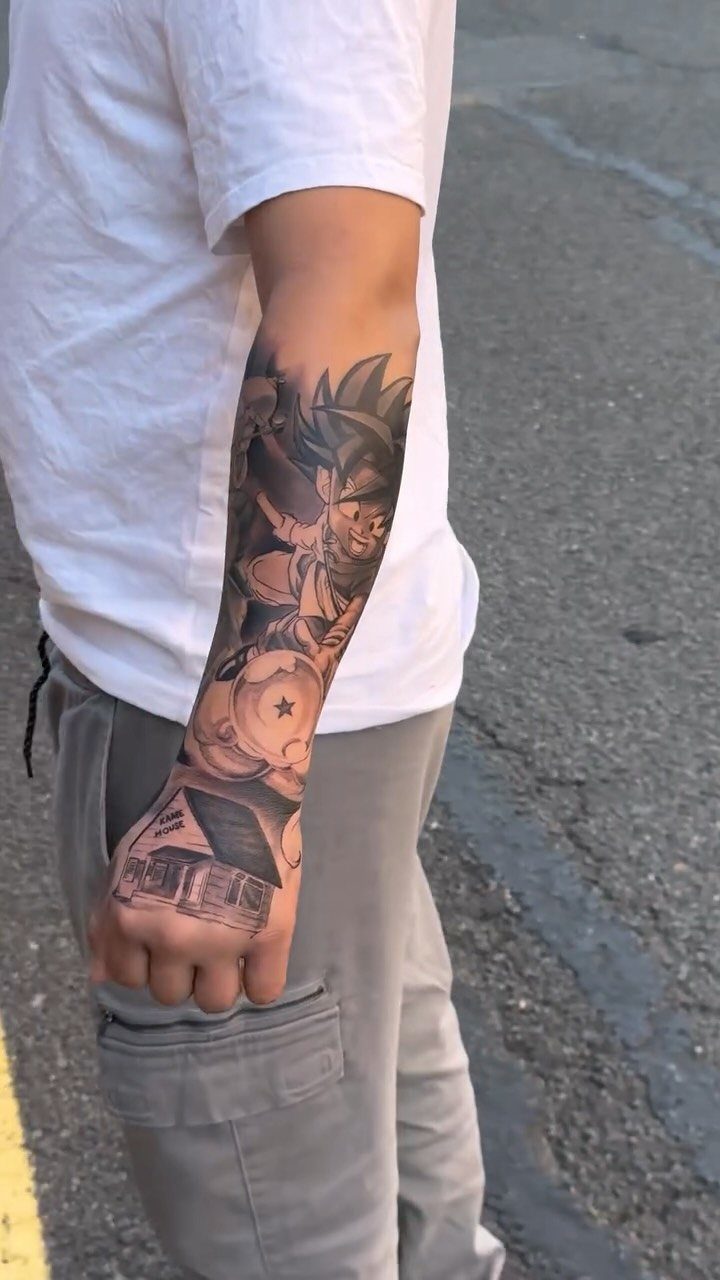
Realism without color, built entirely from black ink diluted to different shades of gray. Portraits, characters, and scenes take shape through shading alone, relying on contrast and soft gradients to create depth.
This style suits storytelling. A single scene can stretch across the forearm, or multiple portraits can stack from shoulder to wrist, each one capturing a moment or a character in lifelike detail.
Black and gray ages more predictably than color. The ink spreads slightly over time, but you avoid the fading and color shift that happens with reds, yellows, and blues.
Sessions run long because shading takes time. Expect the full sleeve to take multiple sittings spaced weeks apart to let the skin heal between passes.
5. Japanese Sleeve
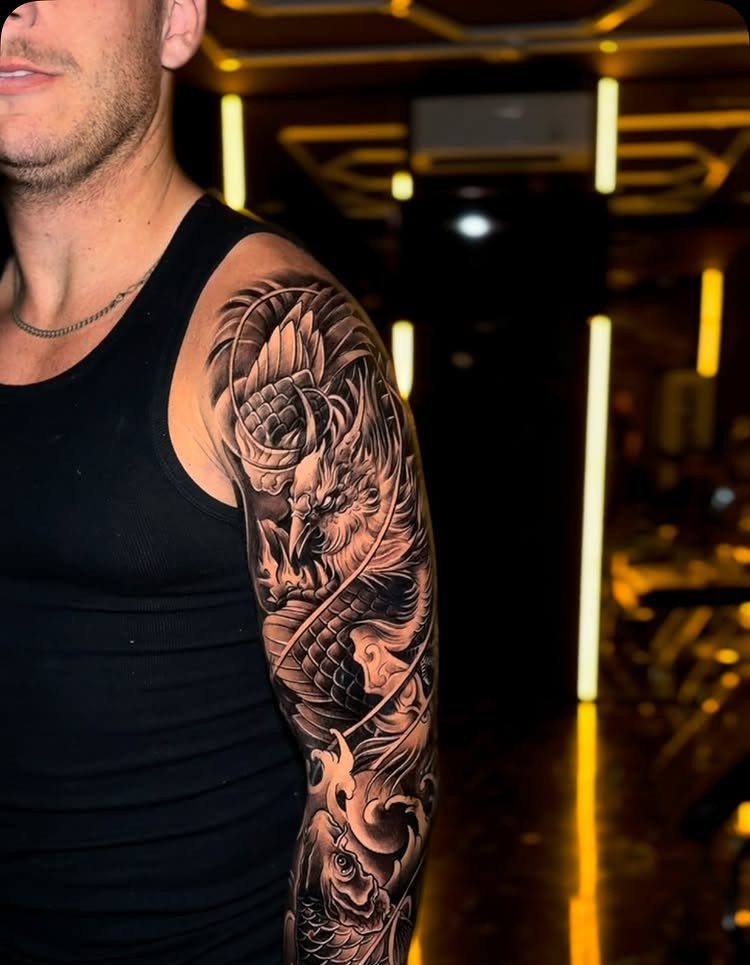
Dense compositions pulled from Japanese tattooing traditions, where dragons coil around the arm, koi swim through waves, and cherry blossoms fill the negative space.
Every inch gets worked, with smoke, wind bars, or water connecting the larger elements into one continuous scene.
The style follows specific rules.
Dragons face certain directions, waves break in particular ways, and placement of florals follows seasonal symbolism. A good artist trained in this tradition will guide those choices so the sleeve reads correctly.
Color is traditional here, but black and gray versions exist. Full color requires more sessions and touch-ups over time, while black and gray simplifies the process without losing the composition’s impact.
Japanese sleeves cover more skin and involve more detail than most Western styles.
6. Viking Sleeve Tattoo
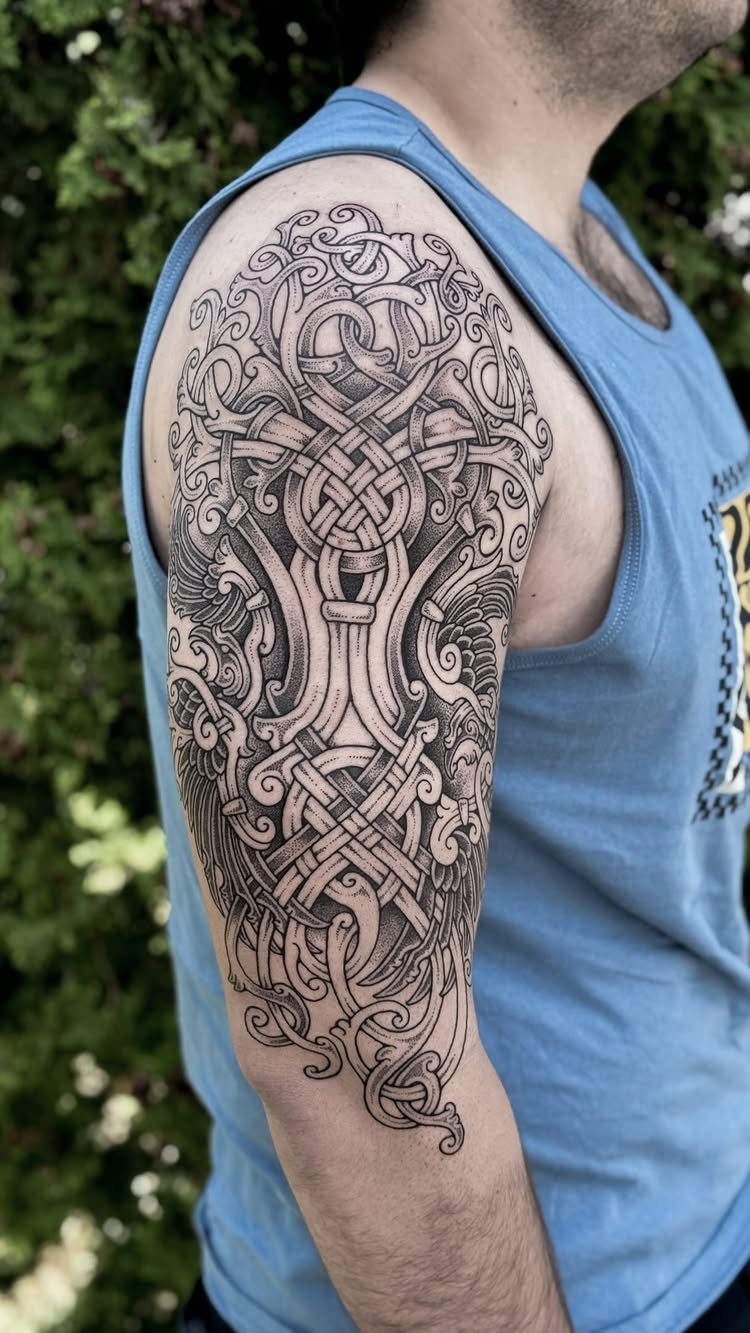
Knotwork, runes, and Norse imagery arranged into a sleeve that references Viking history. Interlocking patterns wrap the arm, often combined with ravens, axes, or helmets to anchor the design.
Knotwork is unforgiving.
Lines that cross and weave need to stay consistent in width and spacing, so small mistakes become visible quickly. Look for someone who has done Celtic or Norse knotwork before and ask to see healed examples.
Black ink dominates this style, though some pieces add gray shading to create depth in the overlapping strands. Color is rare and usually reserved for accents like a single red rune or highlighted metalwork on a helmet.
Sessions tend to be shorter than realism or Japanese work because the linework is precise but less time-intensive than shading large areas. Expect multiple sessions, with total coverage taking longer depending on how much detail and fill the design includes.
7. Full Sleeve Tattoo
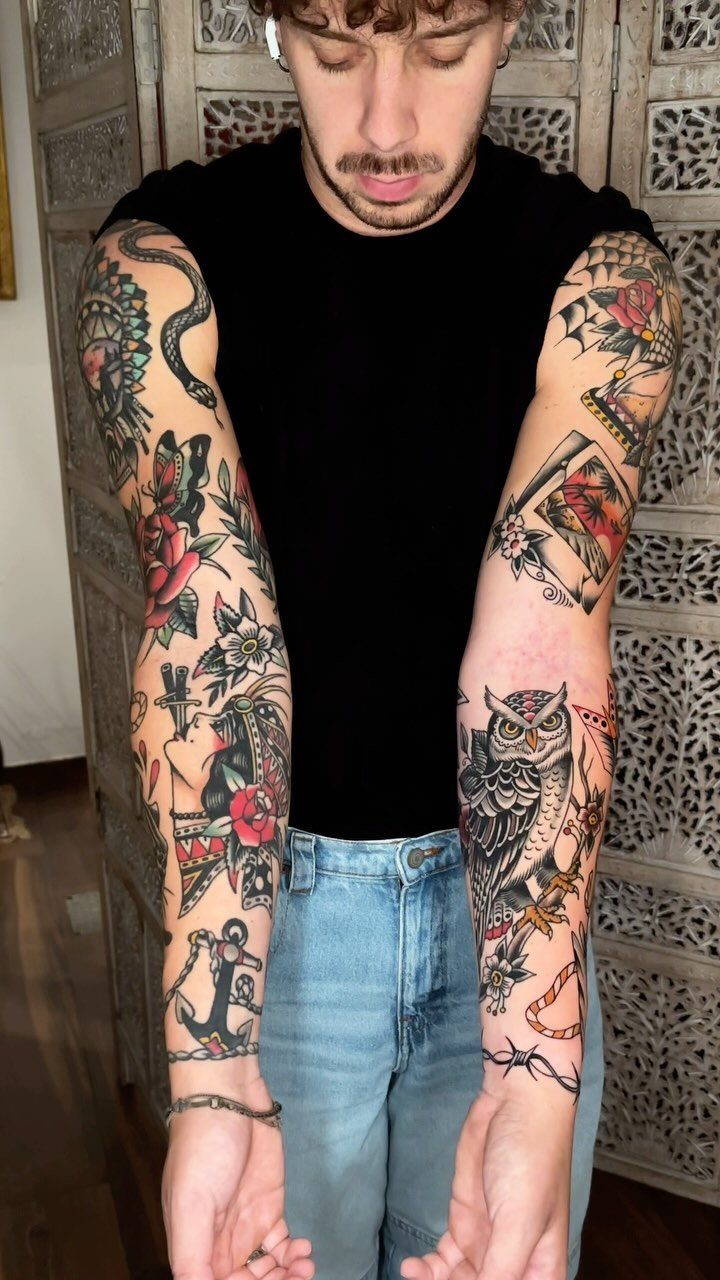
Continuous coverage from shoulder to wrist, with no bare skin showing through. The design wraps the entire arm in one planned composition, whether that’s a single scene, multiple connected images, or a background that ties separate elements together.
Planning takes longer than any other sleeve type because the full layout needs to work before the first session. Most artists sketch a rough map of how images will flow around the arm, then refine it over a few consultations.
Budget for multiple sessions with healing time between each one. Full sleeves cost more than half sleeves or forearm-only pieces, but you’re paying for complete coverage and the cohesion that requires.
8. Floral Sleeve Tattoo
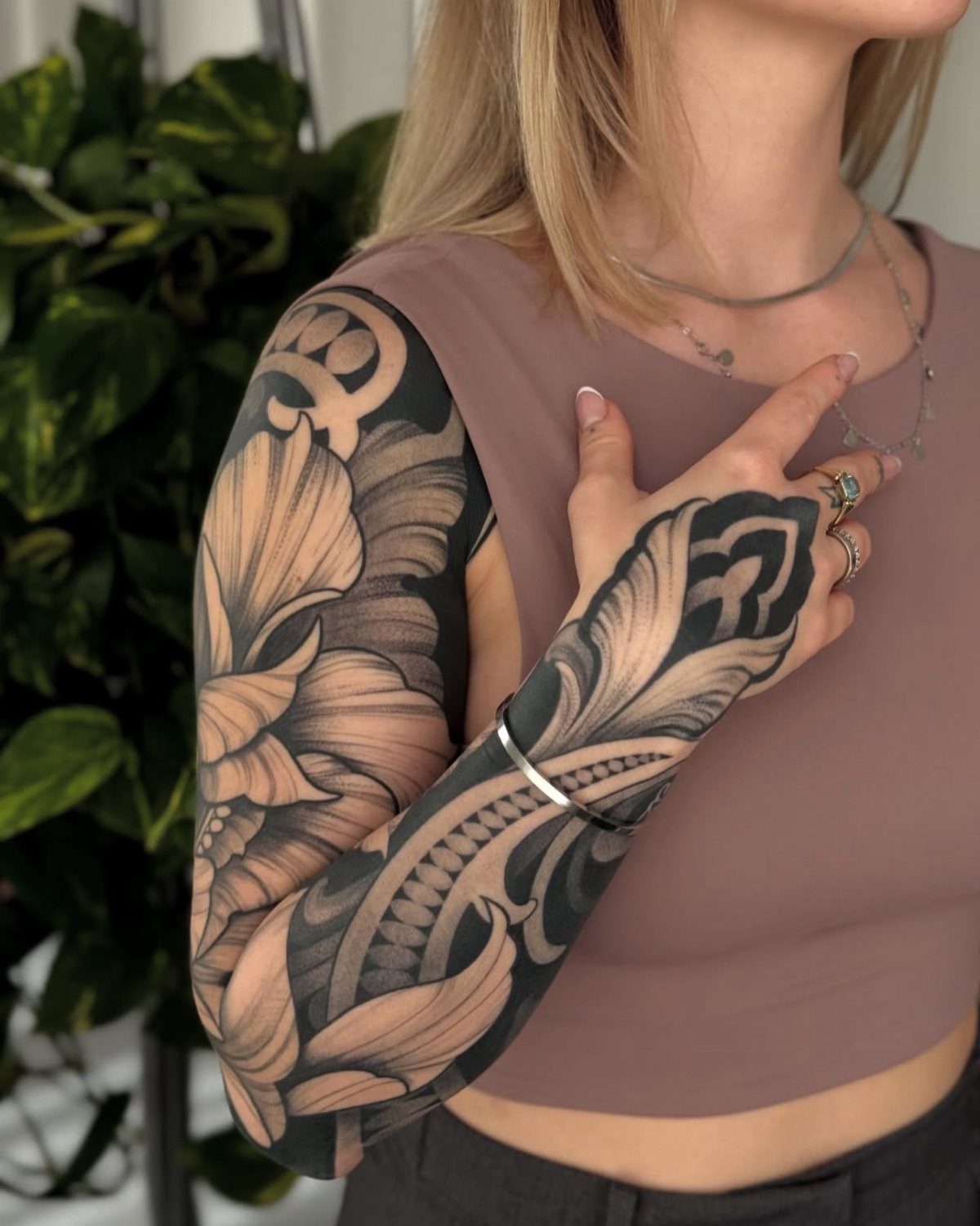
Roses, peonies, and lilies stacked from shoulder to wrist, with leaves and stems filling the gaps between blooms.
The flowers can wrap around the arm in black and gray or color, and the composition stays soft even when the coverage is dense.
This style ages well if the artist uses enough contrast between the petals and the background. Light shading without dark outlines can blur over time, so ask to see healed examples of floral work before booking.
Women choose this more often than men, but the design itself has no gender limit. Scale and placement matter more than the flowers themselves.
9. Animal Sleeve Tattoo
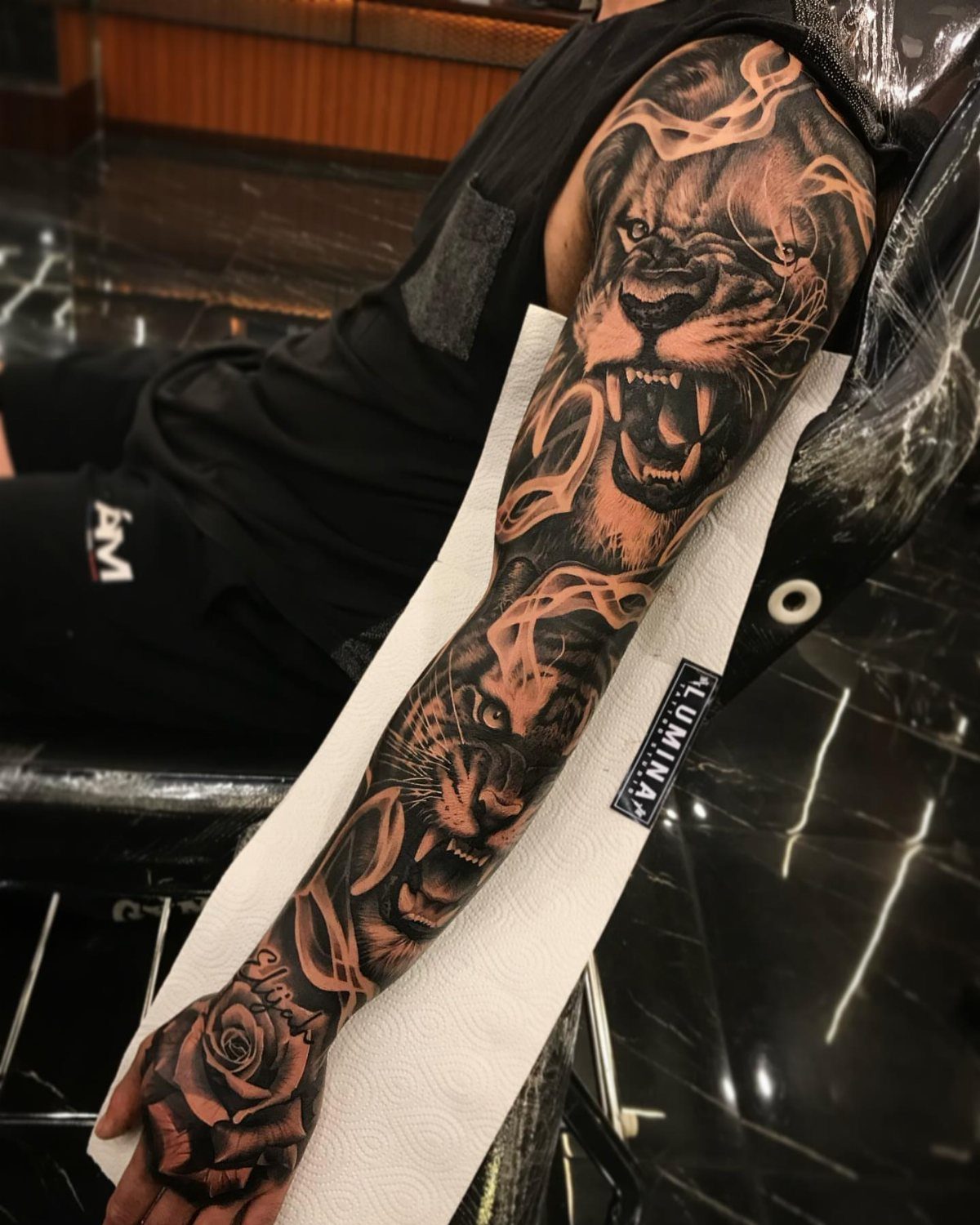
Lions, wolves, eagles, or bears rendered in realism or stylized black and gray, often paired with natural elements like forests or mountains.
The animal can dominate the entire sleeve or share space with other figures, but it stays the focal point.
Realism requires an artist who can capture muscle structure and fur or feather texture. Look for portfolios with multiple animal pieces, not just one, and check how the details hold up in healed photos.
Forearm placement works best for single animals because the viewer sees the full face when your arm hangs naturally. Upper arm or full sleeve lets you add background or secondary animals without crowding the composition.
10. Tribal Sleeve
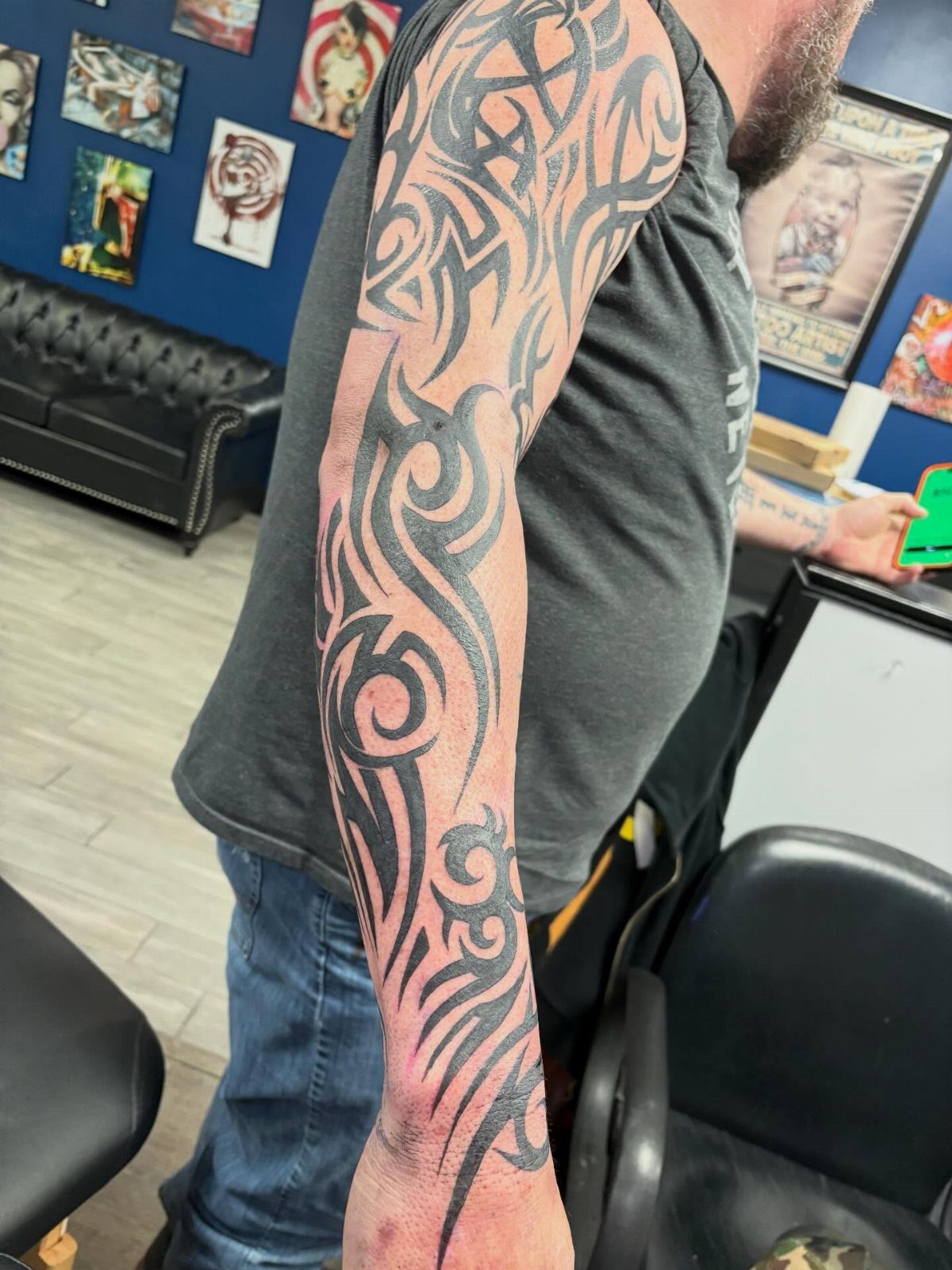
Swirling black patterns that follow the muscle lines of the arm, rooted in Polynesian, Maori, or other indigenous tattooing traditions.
The design uses negative space and bold shapes to create movement, with each curve placed to match the arm’s natural contours.
This style requires an artist familiar with the specific tradition you’re referencing. Tribal patterns carry cultural meaning, and copying them without understanding that context risks appropriation.
The black ink holds up cleanly over decades because there’s no shading to fade or blur. Sessions are faster than realism but still require precision, since uneven lines stand out against the bold shapes.
Tribal works best on defined arms because the patterns follow muscle structure. Thinner arms can still carry the design, but the curves won’t sit the same way.
11. Dragon Sleeve
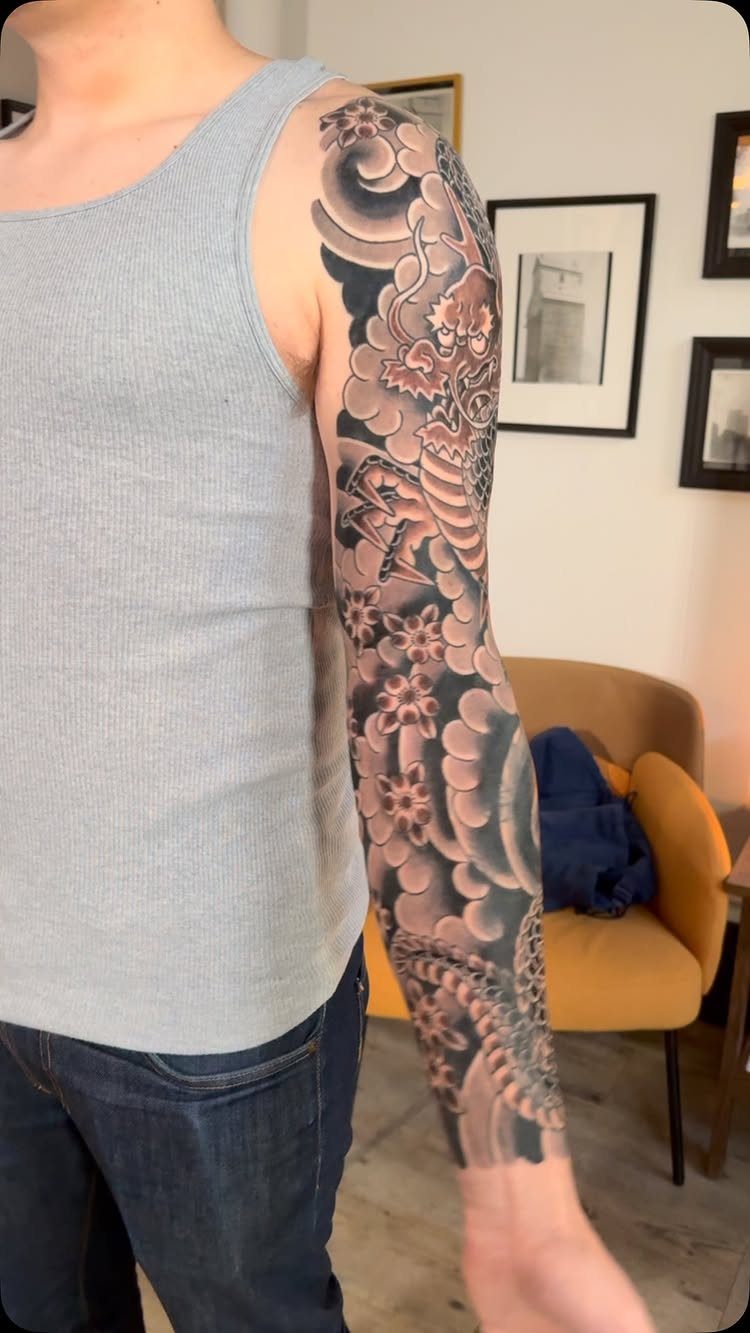
A single dragon coiling from shoulder to wrist, with scales, claws, and wings filling the arm. The design can follow Japanese traditions with clouds and waves, or lean into Western fantasy styles with sharper, more angular features.
Japanese dragons stretch horizontally and wrap the arm in flowing curves. Western dragons sit upright and take up more vertical space, which changes how the composition flows around the forearm.
Color adds impact here, but black and gray keeps the focus on the scales and linework. Full color requires more sessions and fades faster in areas exposed to sunlight, like the forearm and hand.
Dragons suit full sleeves because the body length fills the space naturally. Half sleeves work if the dragon coils tighter, but you lose some of the movement that makes the design read well.
12. Nature Sleeve
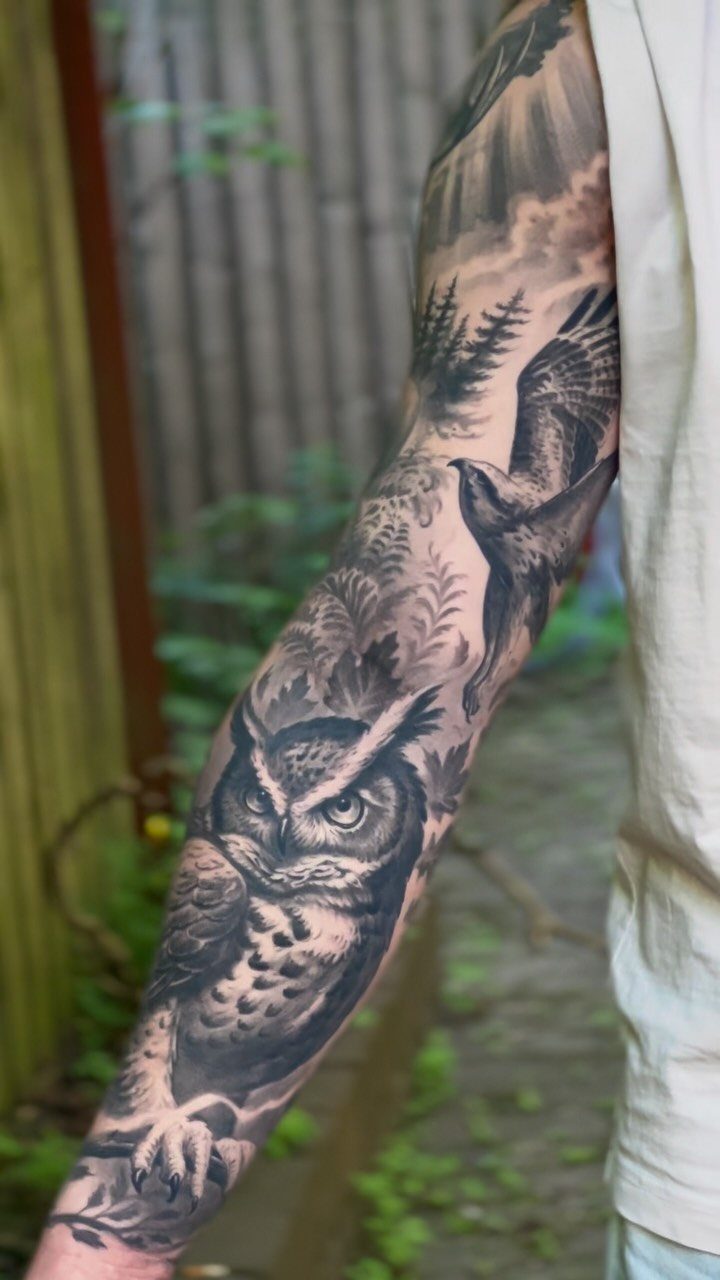
Forests, mountains, rivers, and wildlife combined into one scene that wraps the arm. Trees grow up the forearm, birds fly across the bicep, and animals appear in the underbrush, all connected by natural elements like mist or water.
Black and gray keeps the focus on composition and depth, with shading used to separate layers of the scene. Color works if you want specific seasons or lighting, but it takes longer and requires more touch-ups as it fades.
This style suits storytelling because you can add personal elements like a specific mountain range, a favorite animal, or a tree species that holds meaning. The scene stays cohesive as long as all the elements belong to the same environment.
Plan for longer sessions than geometric or traditional work. Realism in nature requires detailed shading, and scenes with multiple animals or landscapes take time to layer correctly.
13. Fine Line Sleeve
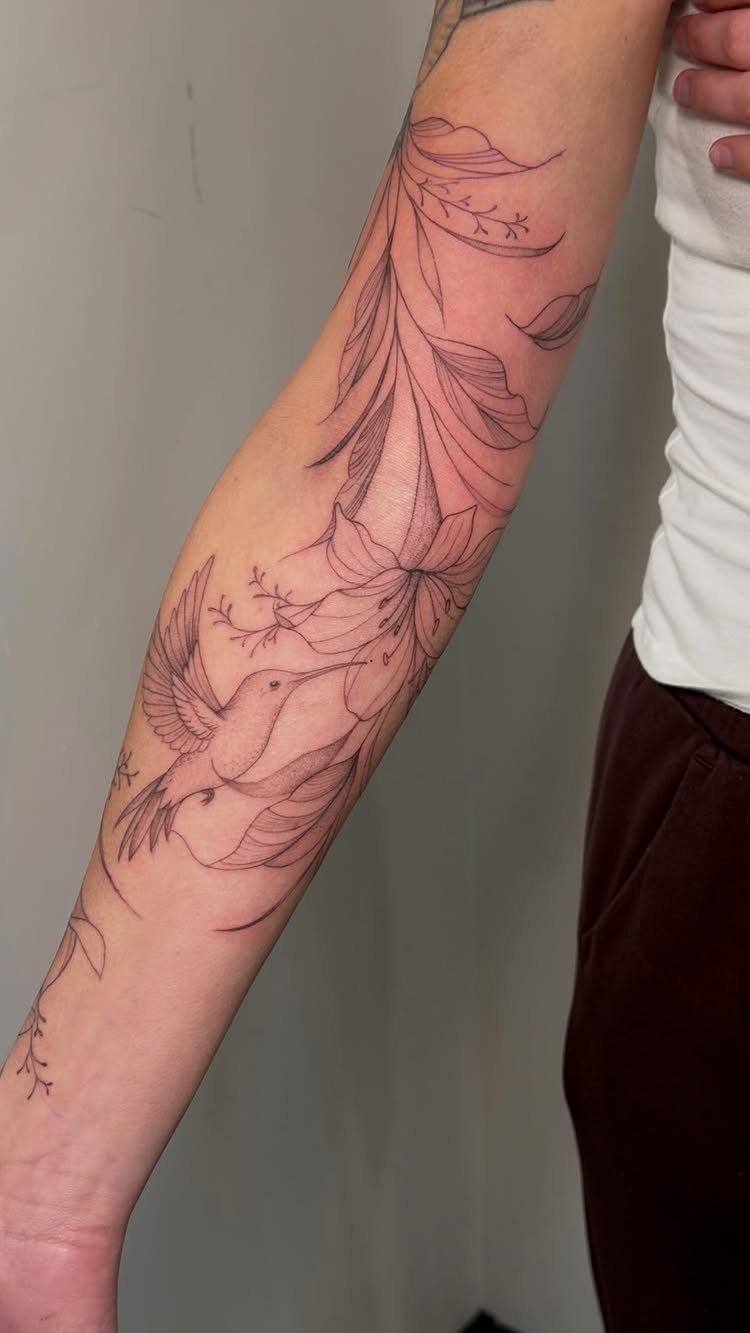
Thin, single-needle lines that create a delicate, sketch-like appearance across the entire sleeve. Shading drops back or disappears entirely, letting the delicate lines do the work without the weight of traditional ink.
This style suits smaller motifs repeated across the arm, like botanicals, insects, or abstract line drawings. Dense compositions can work, but the delicate lines need space to stay readable as the ink settles over time.
Fine line fades faster than bold traditional work because there’s less ink deposited in the skin. Touch-ups every few years keep the lines crisp, especially on areas that see sun exposure like the forearm.
Choose an artist who specializes in this technique and works with single needles regularly. Poor execution shows immediately in shaky lines or inconsistent width.
14. Watercolour Sleeve Tattoo
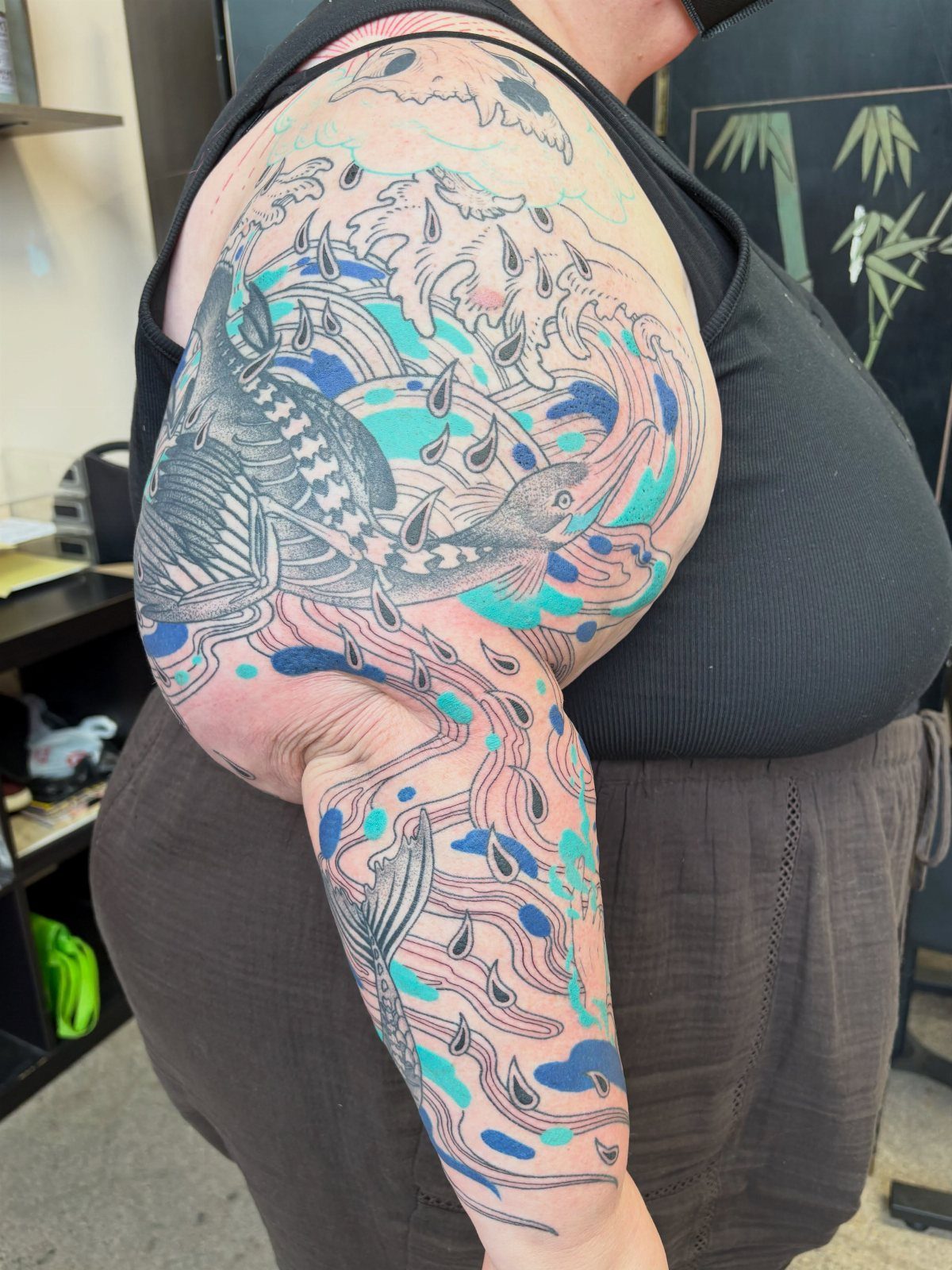
Bursts of translucent color applied around or behind black linework, mimicking the soft-edged washes of watercolor painting. The color bleeds intentionally beyond the lines, creating a loose, painterly effect that contrasts with the sharp black outlines.
The style works best when anchored by strong black elements. Without solid linework or silhouettes, the color washes blur into each other as the tattoo heals and ages.
Watercolor fades faster than solid color because the ink is applied in lighter layers to get that translucent look.
Expect the bright splashes to soften within a few years, and plan for touch-ups if you want to maintain the initial vibrancy.
Not every artist does watercolor well. Look for portfolios with healed examples, not just fresh work, so you can see how the color holds up over time.
15. Disney Sleeve Tattoo
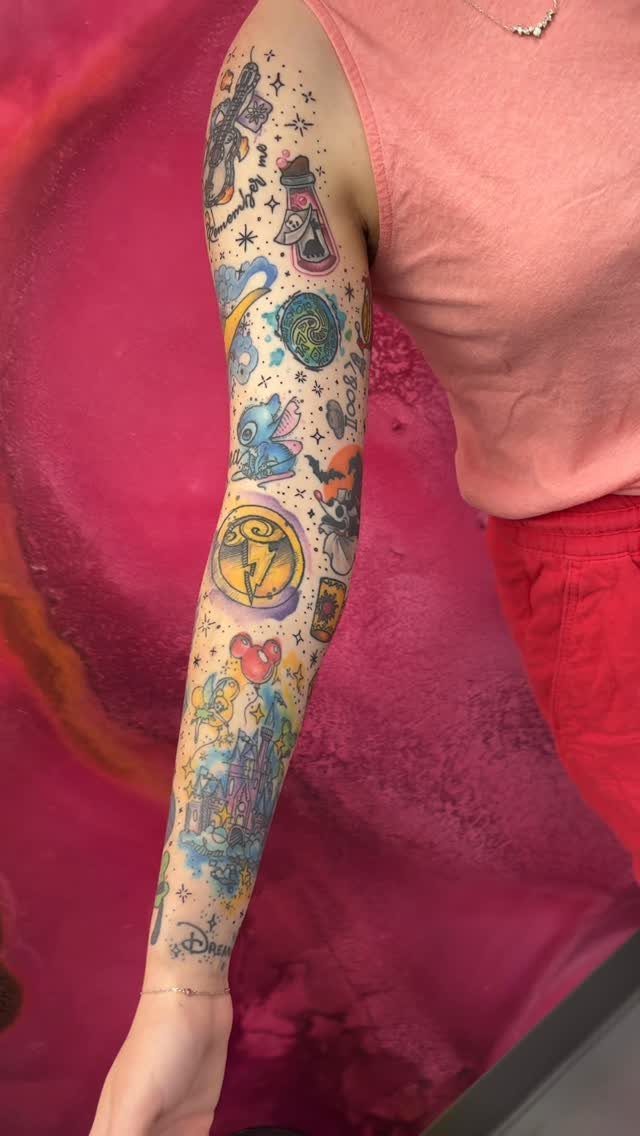
Characters, castles, and scenes from Disney films arranged into a full sleeve that celebrates childhood favorites or connects to specific stories.
Mickey, princesses, villains, and theme park landmarks all appear frequently, either clustered together or connected by backgrounds like stars, magic effects, or park elements.
Color brings these characters to life and matches their on-screen versions, but it requires more sessions and fades faster than black and gray. Black outlines with selective color keeps the workload manageable while still capturing the recognizable look.
This style suits anyone who grew up with Disney or wants to carry that nostalgia visibly. The designs read clearly because the characters are so well known, which makes identification instant even from a distance.
16. Marvel Sleeve Tattoo
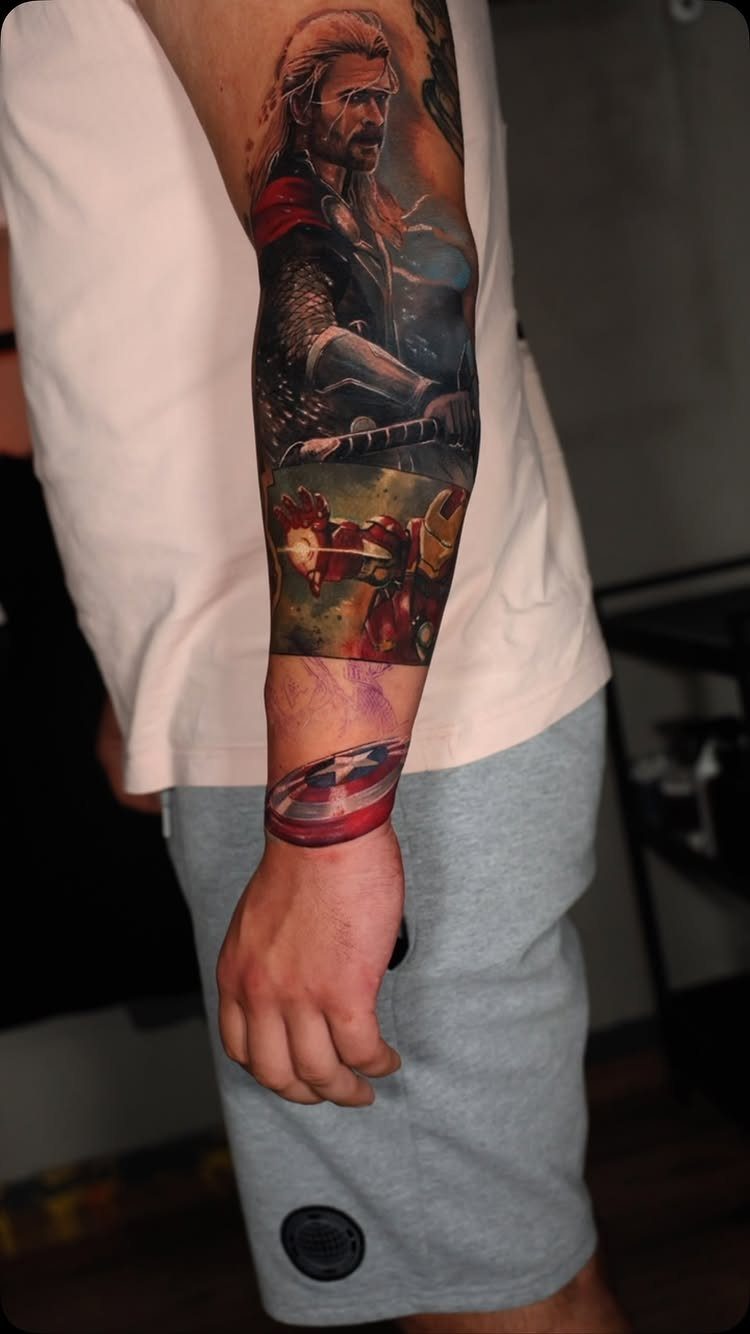
Superheroes, villains, and iconic symbols from Marvel comics and films arranged into a full sleeve. Characters like Thor, Iron Man, Spider-Man, and Captain America dominate, often combined with their weapons, shields, or signature elements like lightning or repulsor beams.
Color is standard here because it matches the costumes and makes each character instantly recognizable. The bright reds, golds, and blues require multiple sessions and fade over time, especially on the forearm where sun exposure is constant.
Composition matters more than in single-character tattoos because you’re fitting several figures onto one arm. Plan the layout with your artist so each character gets enough space to read clearly without crowding the others.
Sessions add up quickly. One creator finished this type of sleeve in 3 sessions, but that depends on how much detail and how many characters you include.
How to Plan a Tattoo Sleeve
Pick one theme or visual thread before you commit to anything permanent.
A sleeve built around Japanese imagery, realism portraits, or botanical elements holds together better than random ideas scattered across the arm, even if each piece looks good on its own.
Start with an anchor piece in the most visible area, usually the forearm or upper arm.
Once you commit to a sleeve, the first piece you put down locks in the style, line weight and spacing that every other piece will need to match.
A composition that looks balanced when your arm hangs straight might feel lopsided when you bend it, so good placement accounts for how the muscles shift and how the viewer actually sees the tattoo in daily life.
Book a consultation before the first session. The artist needs to understand your vision and translate it into something that flows naturally across the full length of your arm.
Sleeve tattoos are usually a collaboration between a tattoo artist and customer to demonstrate a personal and unified artistic theme.
Cost of a Sleeve Tattoo
A full sleeve costs anywhere from $500 to over $10,000 depending on where you live, who you book, and how complex the design gets.
Big city artists with long waitlists charge more than someone working in a smaller town, and celebrity tattooers push the upper end of that range.
Some artists quote a flat rate for the entire project, while others charge by the hour.
Hourly pricing depends on how fast the artist works and how still you can sit, since movement slows the process and adds time to the bill.
If your artist lives out of state, add travel costs to the total.
Fixed pricing gives you a clear number up front, but hourly rates can work better if the design changes as you go.
Healing and Aftercare
Every session in a sleeve requires the same aftercare as a single tattoo, so proper healing between sittings matters as much for your skin as it does for the finished work.
Most infections, blowouts and color issues announce themselves in the first 2 weeks. Wash it gently, keep fragrance-free lotion on it through the day, and skip pools, salt water and steam rooms until the skin closes completely.
UV light does more damage to tattoo ink than anything else, and fine line or realism work fades even faster because the ink lives closer to the skin’s surface.
Put SPF 50 or higher on any healed sleeve before you go outside, even for short trips.
Watch for redness that creeps past the tattooed skin, swelling that gets worse instead of better, or any smell coming from the area. Call your artist or a doctor if any of those appear.
Frequently Asked Questions
How much will an arm sleeve tattoo cost?
A full sleeve can start around $500 if you’re working with a shop in a smaller city, but expect to pay several thousand with a well-known artist in a place like New York or Los Angeles.
The final number depends on your location, the artist’s hourly rate, how complex the design gets, and whether you’re paying a flat project fee or per session. Travel costs add up if you’re booking someone outside your area.
How painful is an arm sleeve tattoo?
The pain comes less from the location itself and more from how many hours you spend under the needle.
A full sleeve takes 20–40 hours or more spread across multiple sessions, and sitting through that much work tests your tolerance regardless of where the tattoo sits.
Some spots like the inner bicep or elbow ditch hurt more than others, but the cumulative time is what wears on most people.
Is $10,000 too much for a tattoo sleeve?
No, if you’re booking a well-known artist in a major city with high demand and a long waitlist.
That price reflects an artist’s hourly rate and the time a detailed design needs across several sessions. At the top of the range you’re paying for in-demand artists or complex pieces that need many hours to complete.
How long does a tattoo sleeve take?
A full sleeve typically requires 20–40 hours split across 5–12 sessions, with healing time between each one stretching the process over months or even a couple of years.
A half sleeve usually takes 2 to 5 sessions to finish, while a quarter sleeve might wrap in 1 or 2. Fine line and geometric designs need more time per session because the precision required slows down how fast the artist can work.





