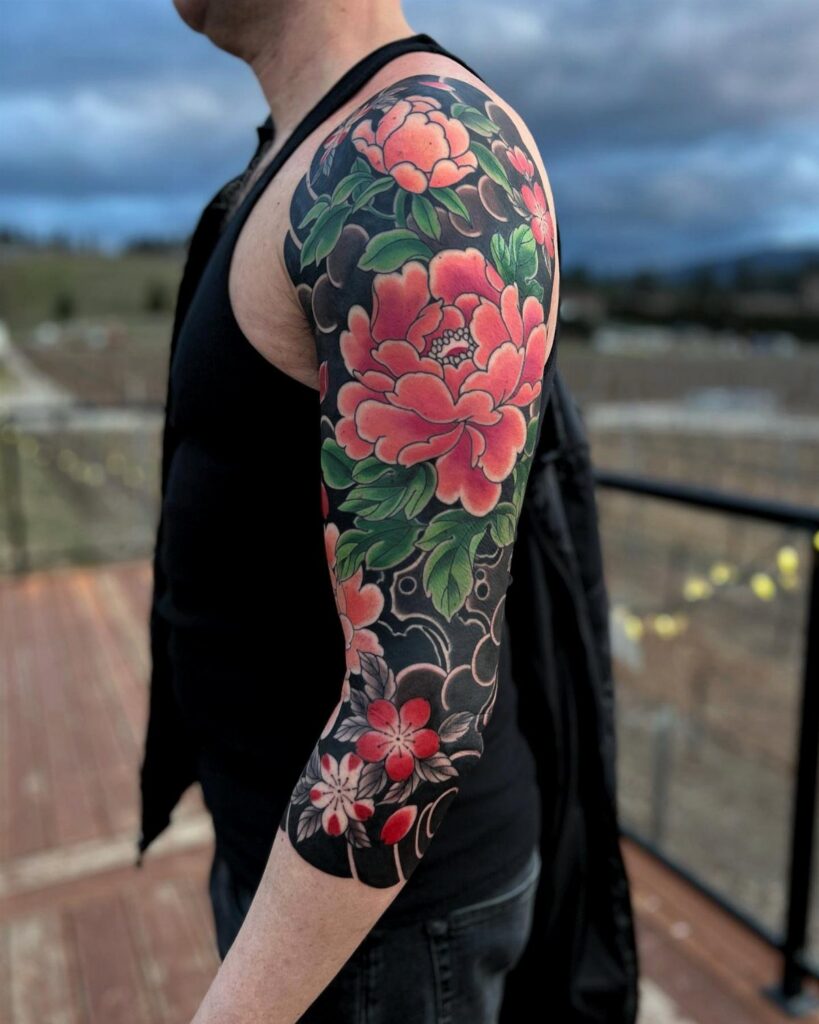
Dragons and phoenixes stretch across a full sleeve, koi fish and cranes work as standalone pieces on the forearm or calf, and smaller symbols like clouds or wind bars finish in a single session.
A dragon or tiger reads on the forearm, a hannya mask fits the shoulder blade, and a hikae chest piece stops short of the collar and hides under a regular shirt.
Samurai armor, Hannya masks and koi swimming upstream carry the traditional meanings, though most men choose the subject for how it fills the space rather than for the symbolism alone.
1. Japanese Dragon Tattoo
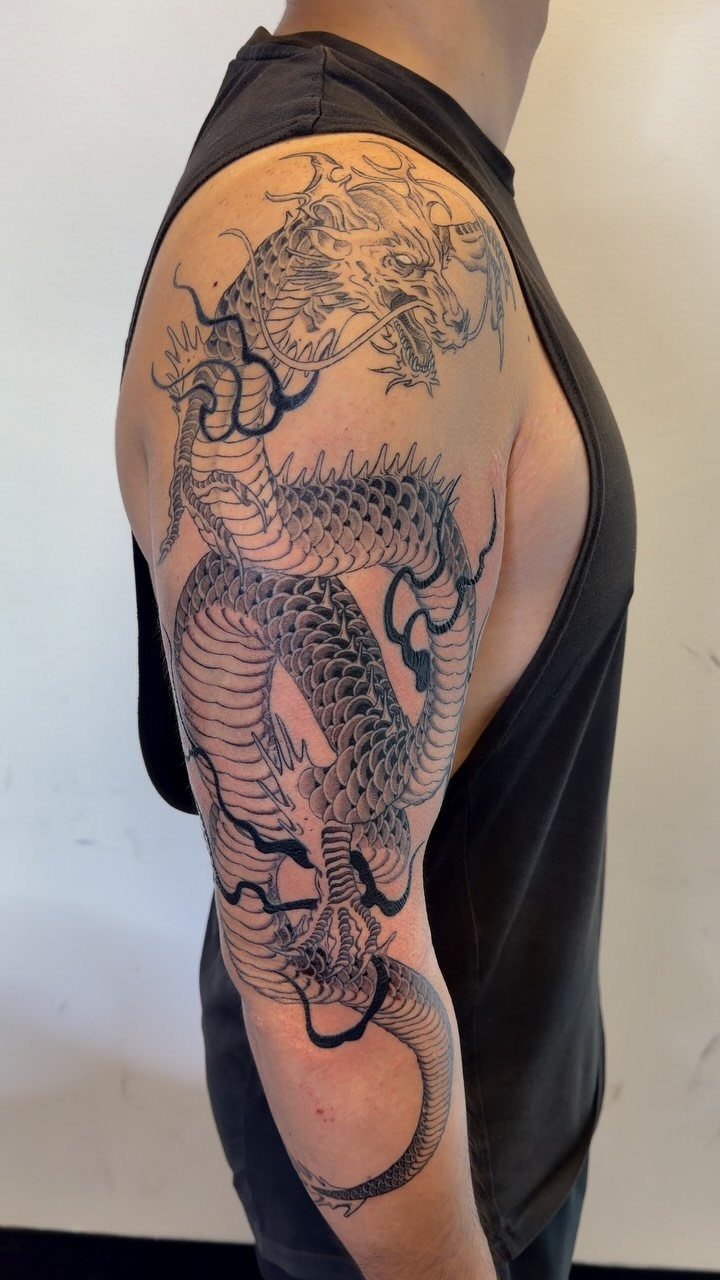
A Japanese dragon follows the muscle from shoulder to bicep, the long body curving with the shape of the arm in a way few other subjects can match.
The design reads as power without needing color: monochrome shading gives you all the detail in the scales and the snarl, and it ages cleaner than a palette that might fade unevenly.
Strength and wisdom are the traditional meanings, though most men I talk to choose it because it covers the space with movement. The dragon’s body can extend as far as you want later, down the arm or across the chest.
2. Japanese Tiger Tattoo
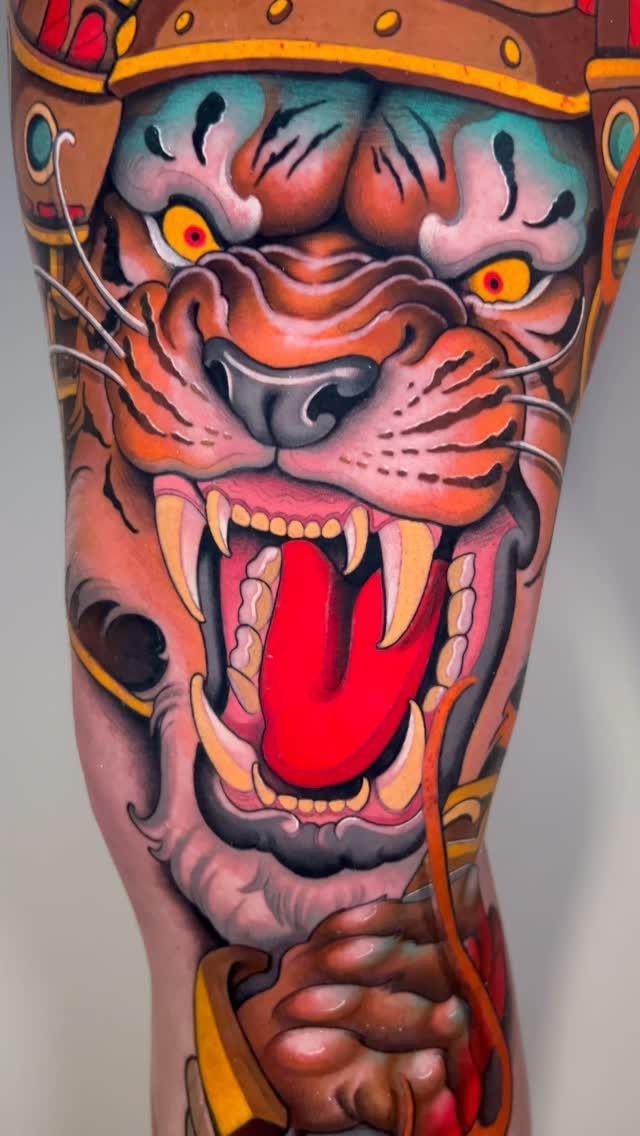
The tiger’s open mouth and the armor plating around its head turn this into something bold without softening it with too much background.
Courage and protection are the old meanings, and the roaring expression reinforces both. Placement on the leg gives room for a full head without cramping the whiskers or the teeth.
The style works well as a standalone piece or as part of a larger leg sleeve when you decide to add waves or peonies later.
3. Japanese Koi Fish Tattoo
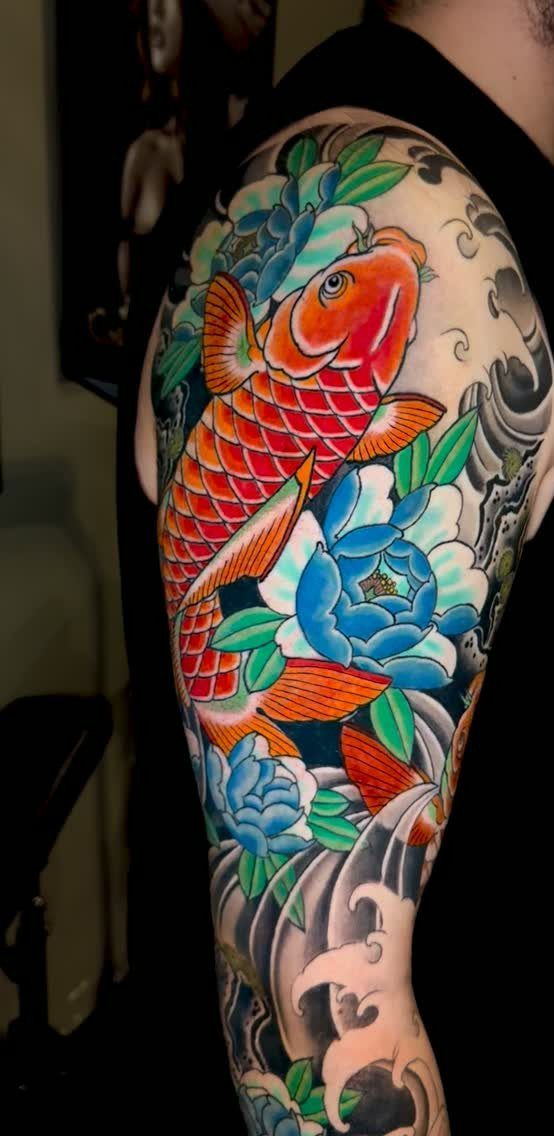
The fish itself can represent perseverance, and the direction it swims matters in traditional work: upstream suggests struggle, downstream suggests you’ve already overcome it.
The artist noted this piece represents the client and his 3 brothers, which is one way to bring personal meaning into a design that already carries symbolic weight.
Placement on the upper arm and shoulder leaves room to extend the water and flowers down the forearm if you want a full sleeve later.
4. Japanese Snake Tattoo
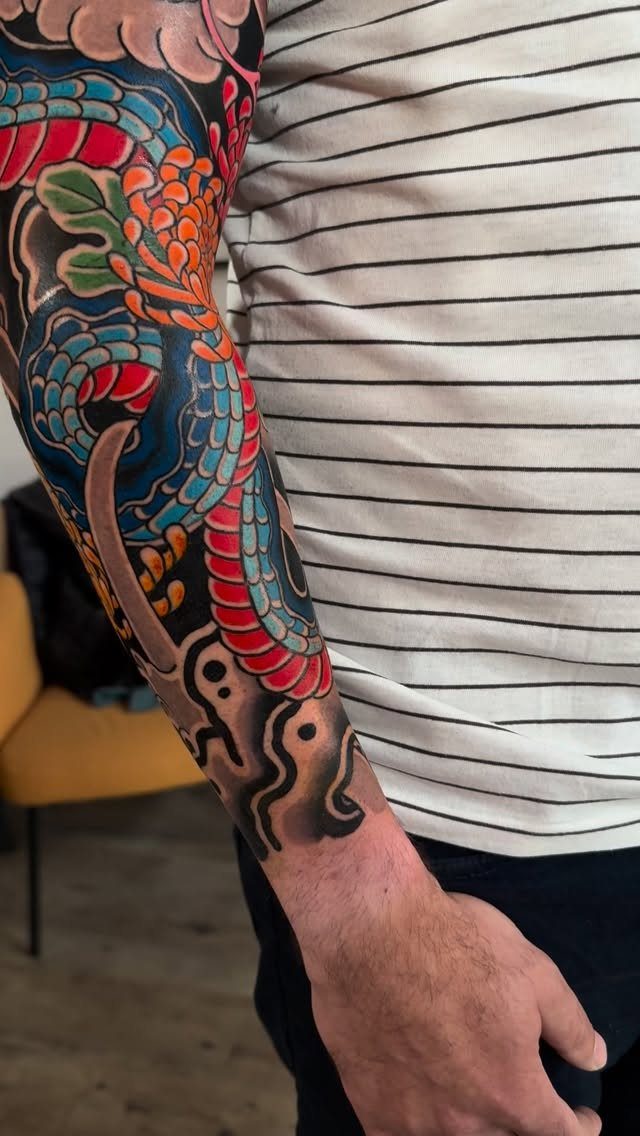
A snake in red and blue scales with orange flowers fills the forearm in a way that reads as Japanese without relying on a dragon or koi.
The coiled body follows the shape of the arm naturally, and the color contrast between the scales and the petals keeps both elements visible.
Wisdom and transformation are the traditional meanings, though the snake also works as a symbol of rebirth.
The artist completed this over 2 days back to back, which is typical for a forearm sleeve with this much color saturation. Healing between sessions would stretch the timeline, but finishing it in one trip keeps the shading consistent.
5. Japanese Samurai Tattoo
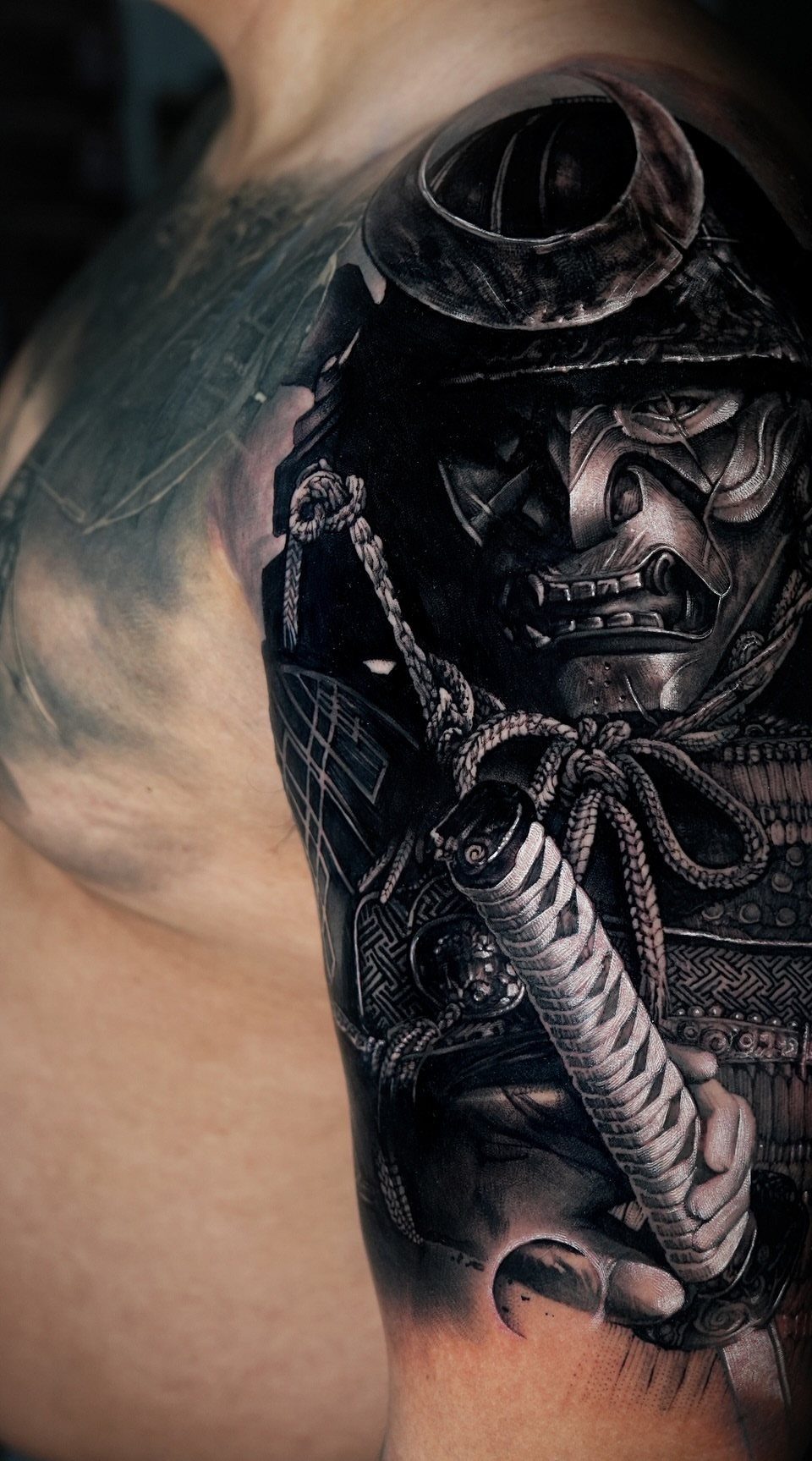
A samurai in full armor with a katana is a figure that stands for honor and discipline without needing an explanation.
The black and grey work keeps the focus on the detail in the helmet and the blade, and the shoulder placement lets the warrior sit upright the way the subject deserves.
Loyalty is the other traditional meaning, and the samurai’s posture reinforces it.
6. Japanese Hannya Mask Tattoo
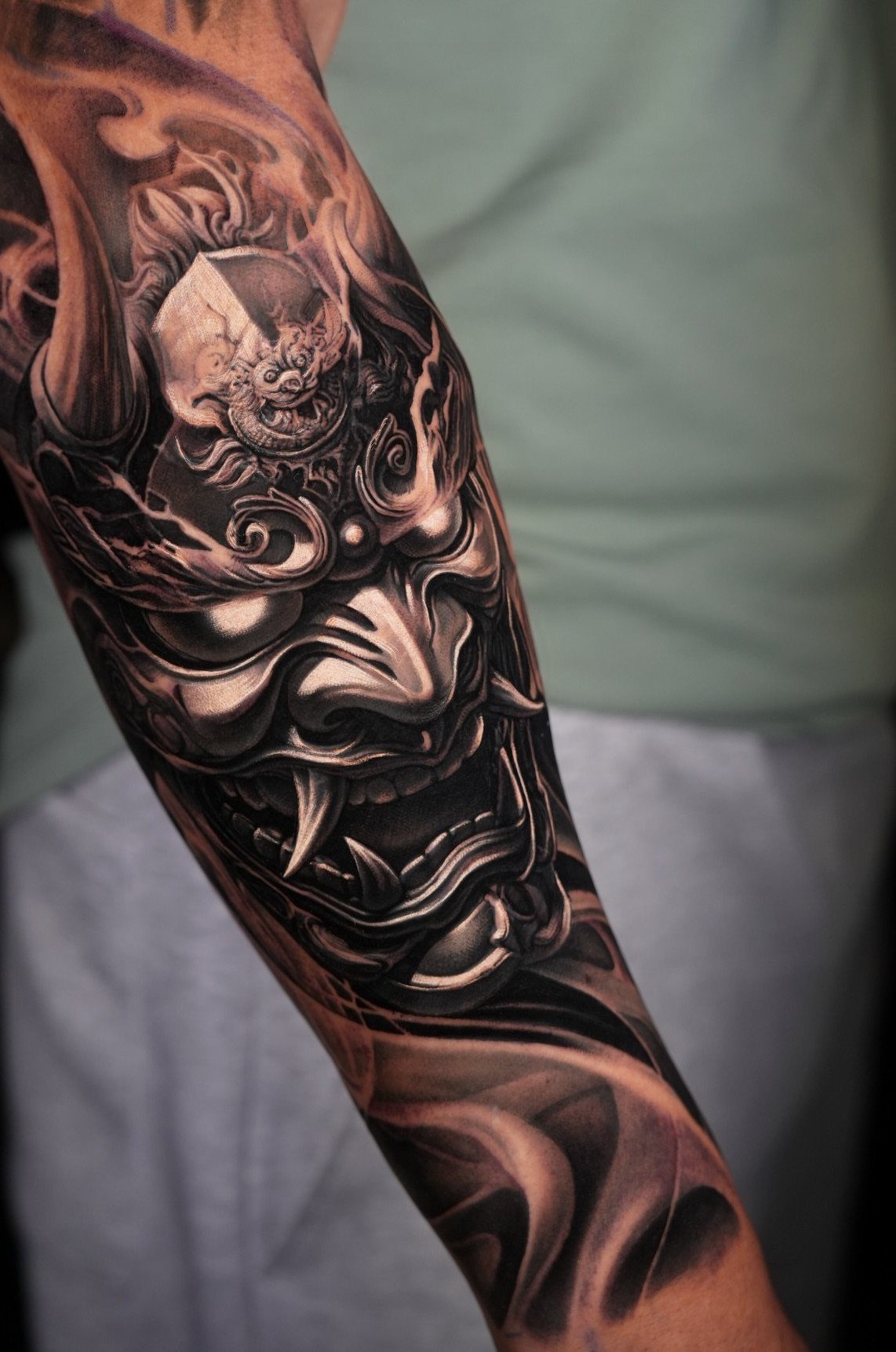
Monochrome shading gives you all the shadow work in the face without the distraction of color, and the smoke curling around it softens the edges without weakening the expression.
Transformation is the other meaning, since the mask represents a woman who became a demon.
Forearm placement keeps the face visible and upright, which matters more here than it does with a dragon or a flower. The design works on its own or as part of a sleeve that could extend up into the bicep.
7. Japanese Flower Tattoo
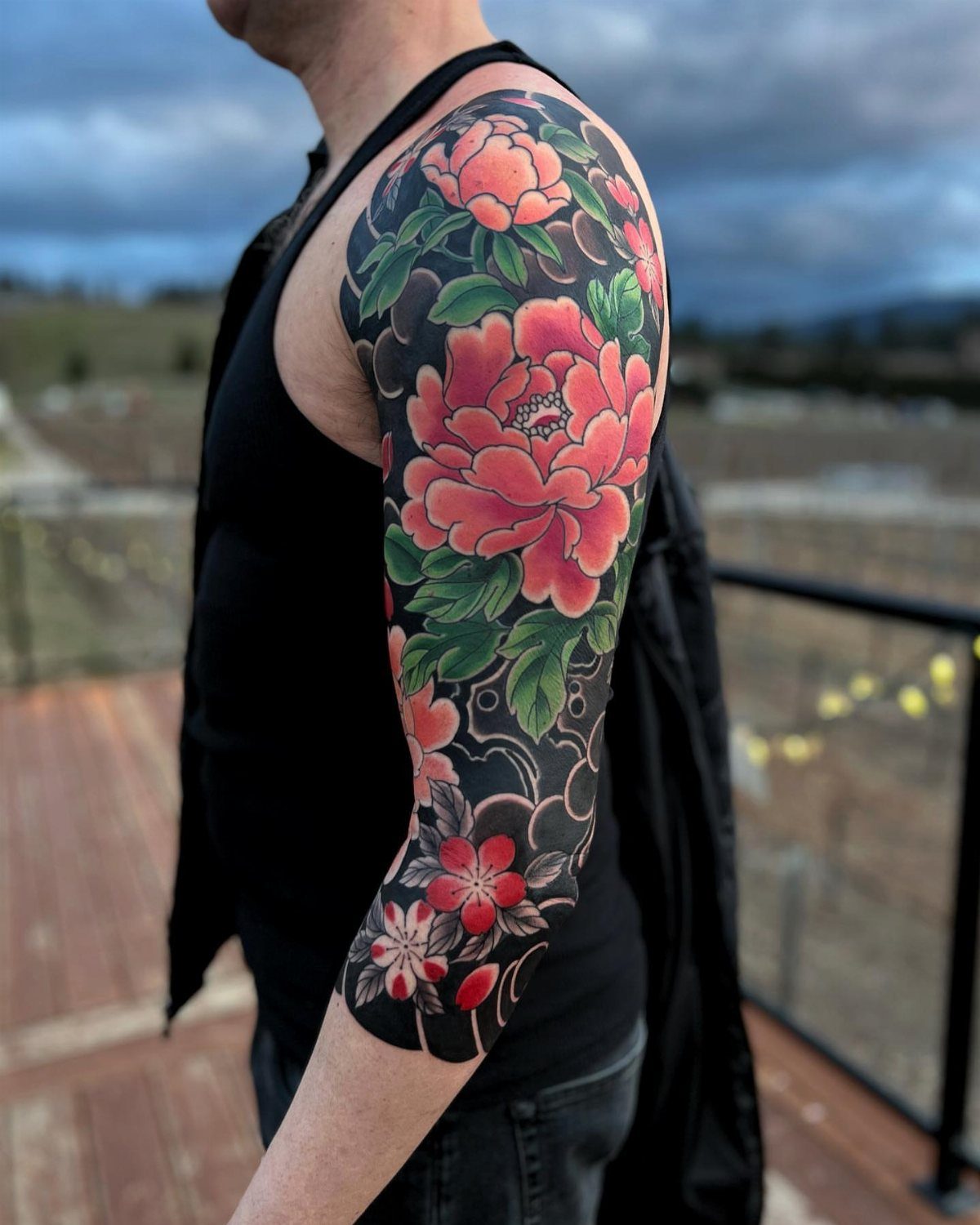
Peonies and cherry blossoms work together in Japanese tattooing because they represent different seasons and meanings while sharing a color palette.
Red and pink petals with green leaves give you a full sleeve that reads as traditional without needing a dragon or a warrior to anchor it.
Cherry blossoms represent beauty and the passage of time, while peonies stand for prosperity and bravery.
The mix lets you cover a large area with flowers alone, and the organic shapes fill the arm naturally. Color saturation like this typically takes multiple sessions to finish and heal properly.
8. Japanese Phoenix Tattoo
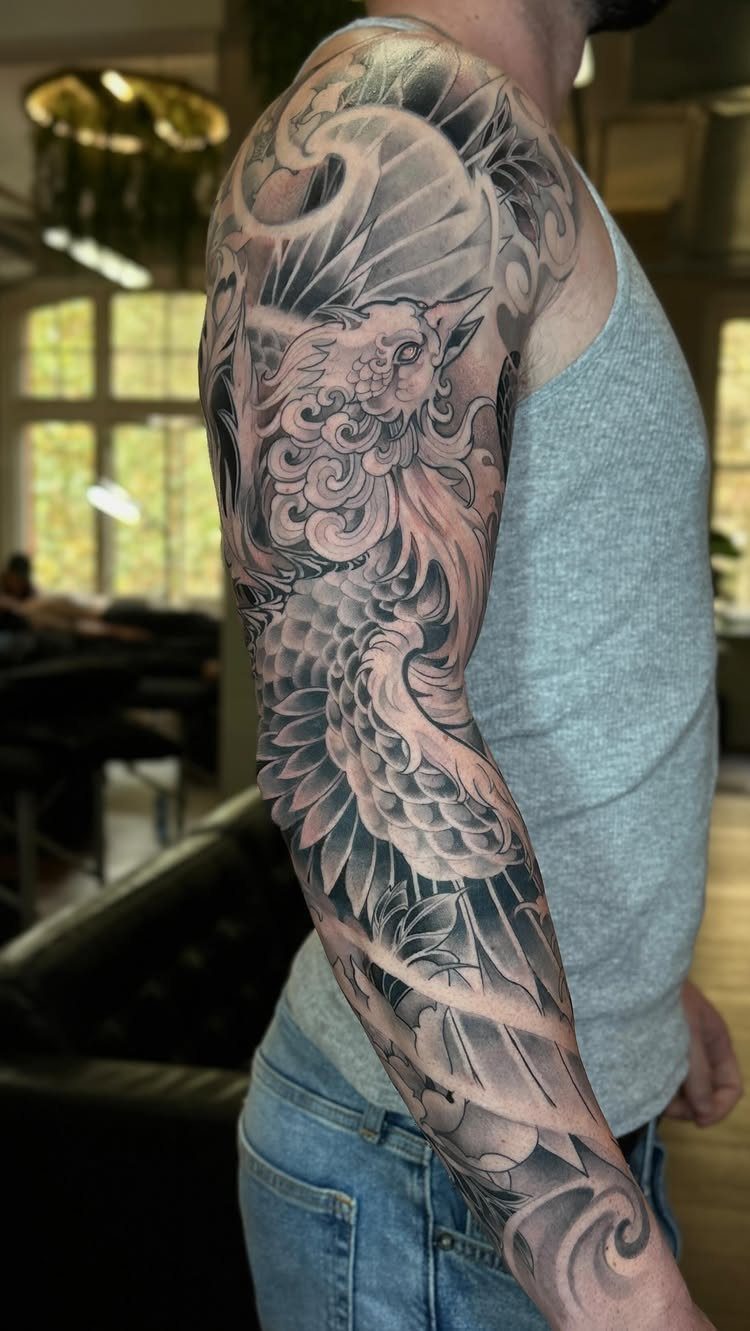
Black and grey work gives the phoenix all its detail in the feathers and the wings without the color that might fade over years.
The bird covers the shoulder and upper arm in one sweep, and the monochrome shading keeps the focus on the form rather than on a palette.
The phoenix marks transformation, and those spread wings make the message unmistakable.
Shoulder placement lets the head sit upright and the tail feathers extend down the bicep if you want to add more later. The style ages well because there is no color to maintain.
9. Japanese Wave Tattoo
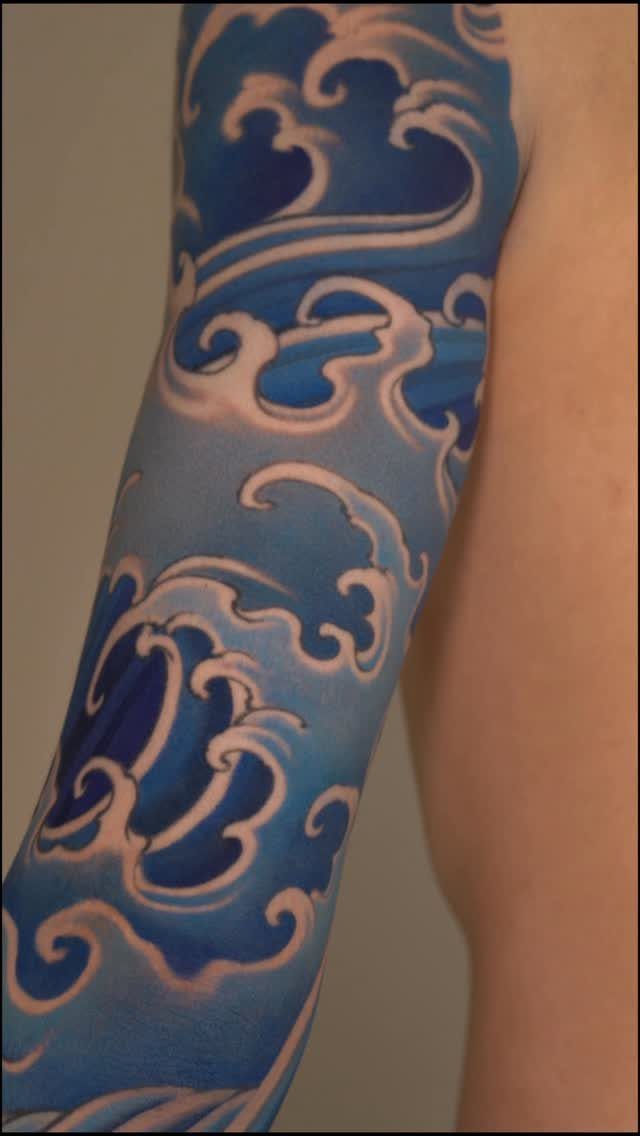
Waves in blue and white fill the arm with movement in a way that works on its own or as background for koi, dragons or flowers later.
Waves bend with the forearm’s natural taper, and the play of light against dark holds up at any viewing distance.
They mean strength and flux in the old stories, but practicality wins: waves fill a panel without fighting the body.
A full sleeve like this usually takes 2 to 3 sessions depending on how much detail goes into the foam and the shading. The style holds up well over time because the shapes are bold and the palette is simple.
10. Japanese Lotus Tattoo
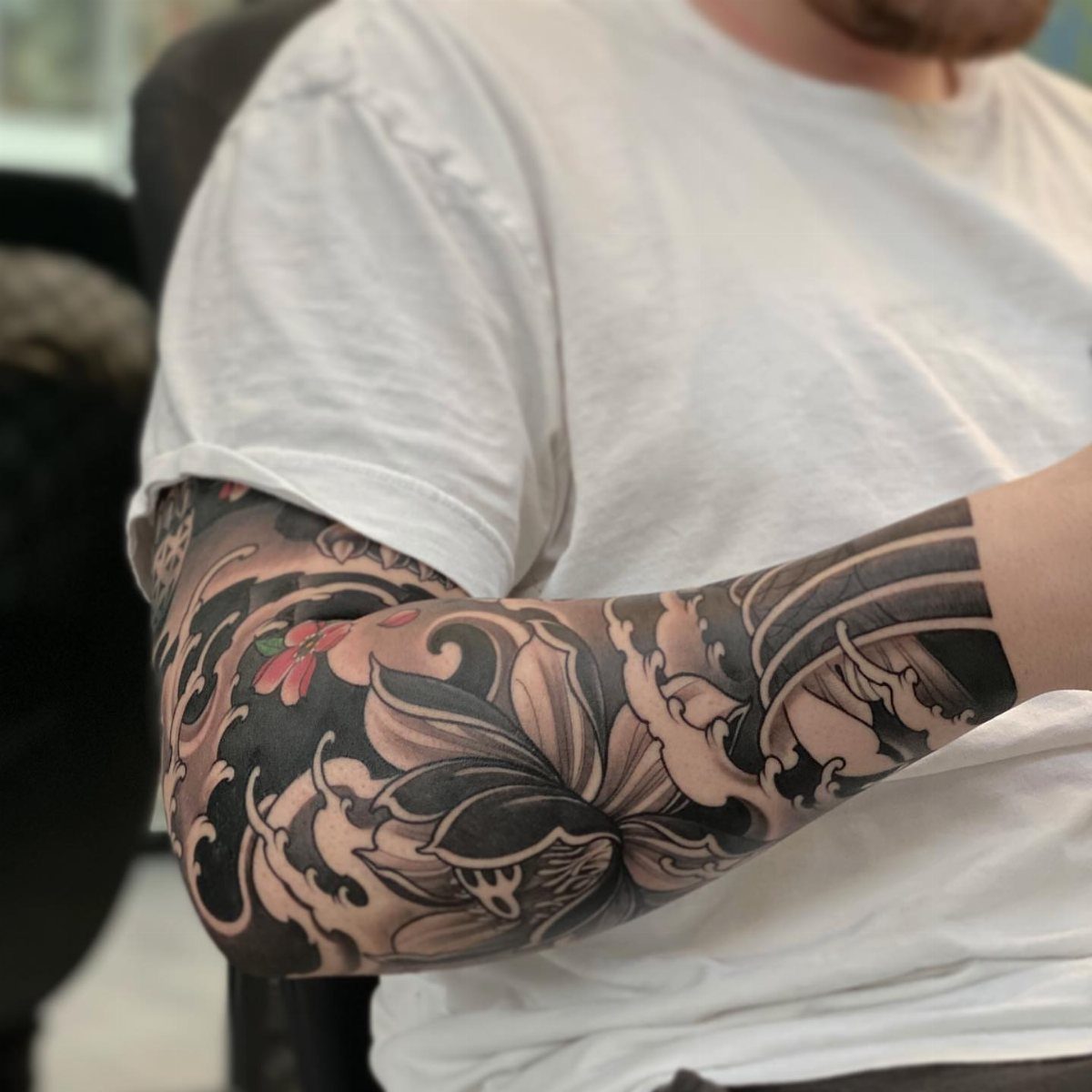
A lotus with red accents and wave patterns underneath gives you the flower and the water in one piece, which keeps the design grounded in Japanese tradition.
Black and grey shading with selective color draws attention to the petals without overwhelming the arm.
The flower stands for enlightenment and moral clarity, especially when shown breaking the surface.
Forearm placement keeps the flower visible and leaves room to extend the waves or add background elements later. The mix of monochrome and color ages better than a fully saturated sleeve because the red stays sharp while the shading mellows.
11. Japanese Octopus Tattoo
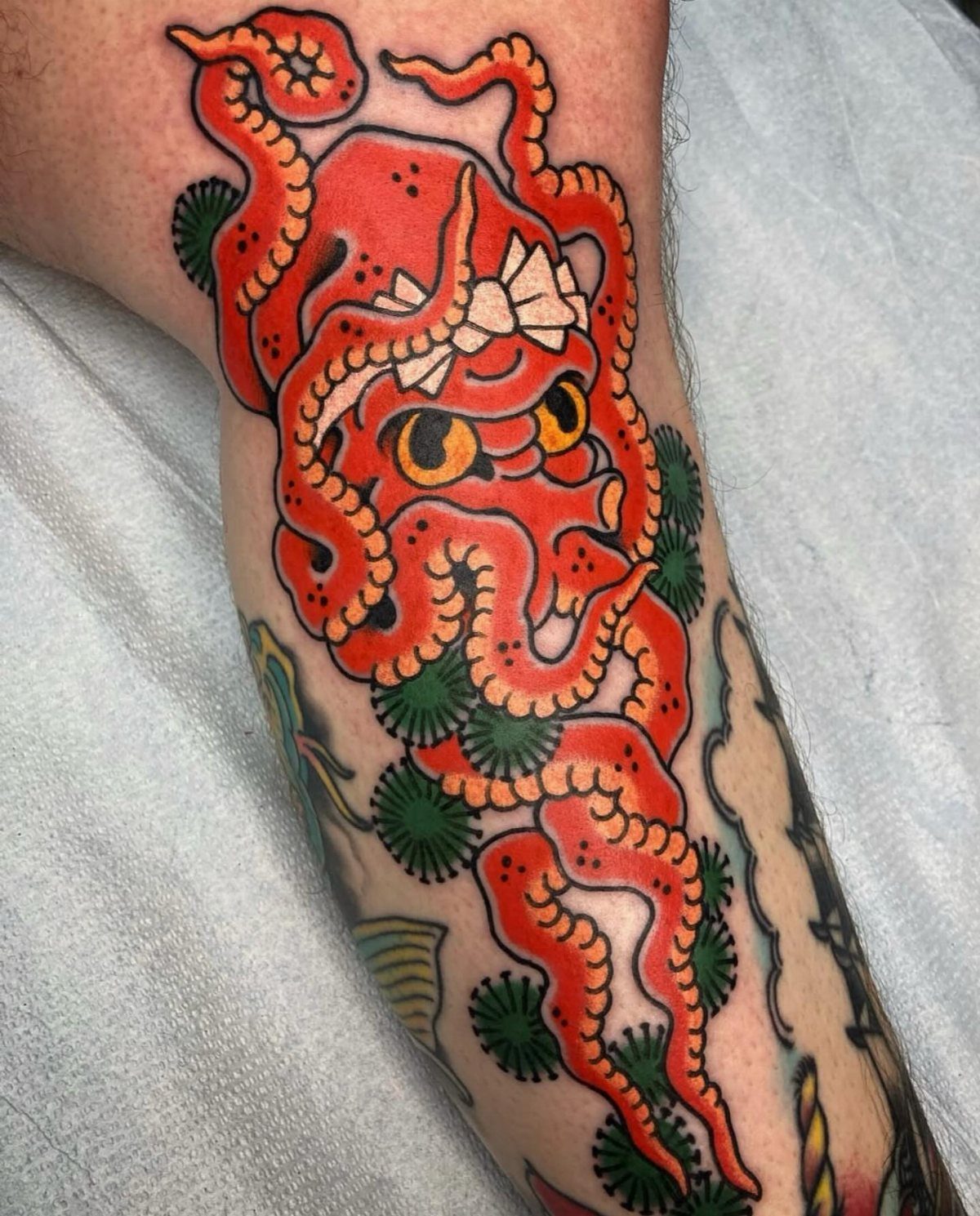
Red octopus with green floral accents on the leg is a choice that stands out from the usual dragons and koi without leaving Japanese tradition.
The tentacles curl around the calf in a way that follows the muscle, and the bow adds personality to a design that could otherwise read as aggressive.
Intelligence and adaptability are the meanings, though the octopus also represents mystery. Leg placement gives you room for a large subject without committing the arm or chest, and the color saturation here likely took 2 sessions to finish.
12. Japanese Wind Bars Tattoo
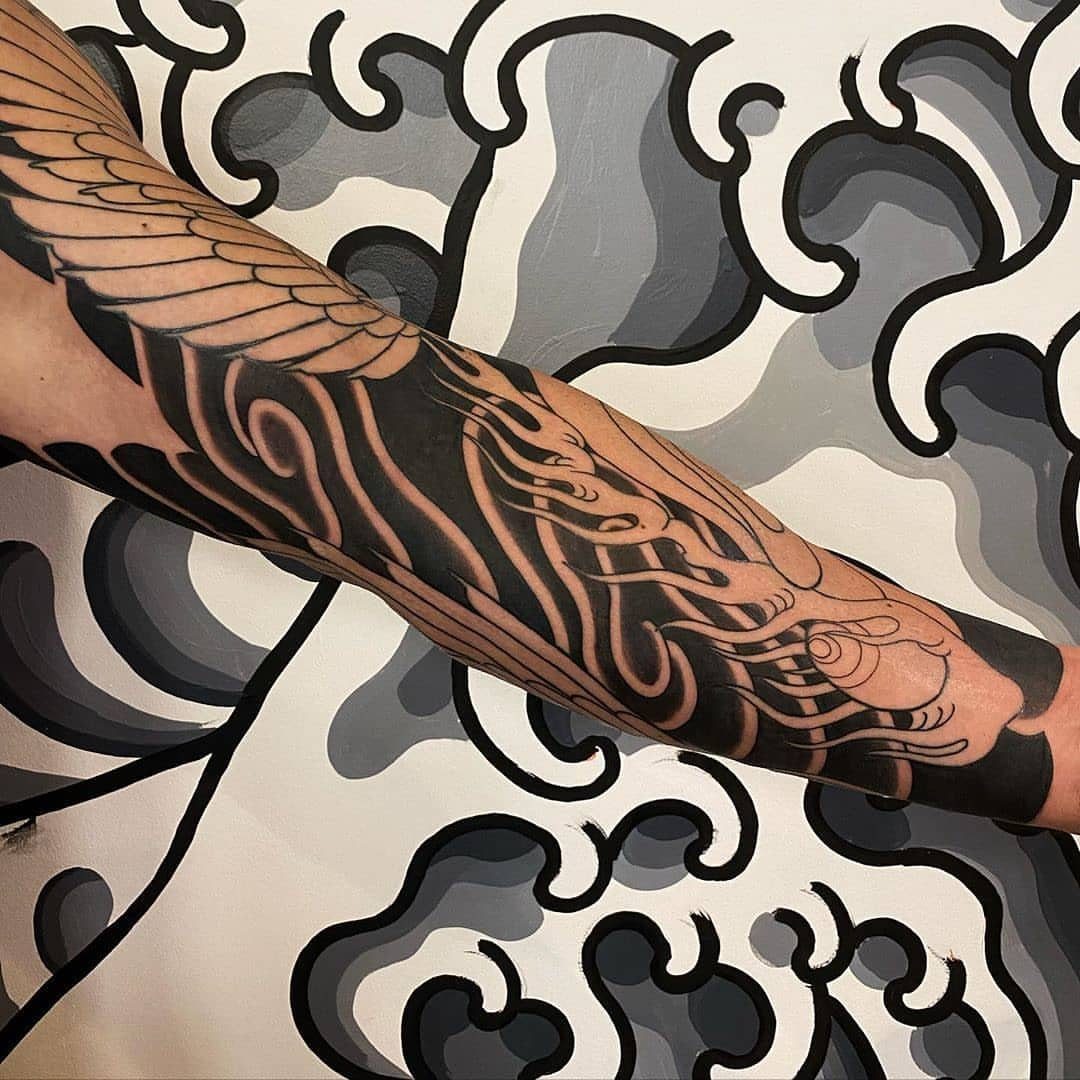
Wind bars are the black curved shapes that represent air currents in Japanese tattooing, and they fill negative space without competing with the main subject.
The bars here wrap around the forearm with a wing, which keeps the design light and open rather than packed with detail.
Change and impermanence are the traditional meanings, though wind bars often work as a way to tie other elements together when you extend a sleeve.
Monochrome shading keeps the focus on the flow rather than on color, and the style ages cleanly because the lines are bold and the shapes are simple.
13. Japanese Crane Tattoo
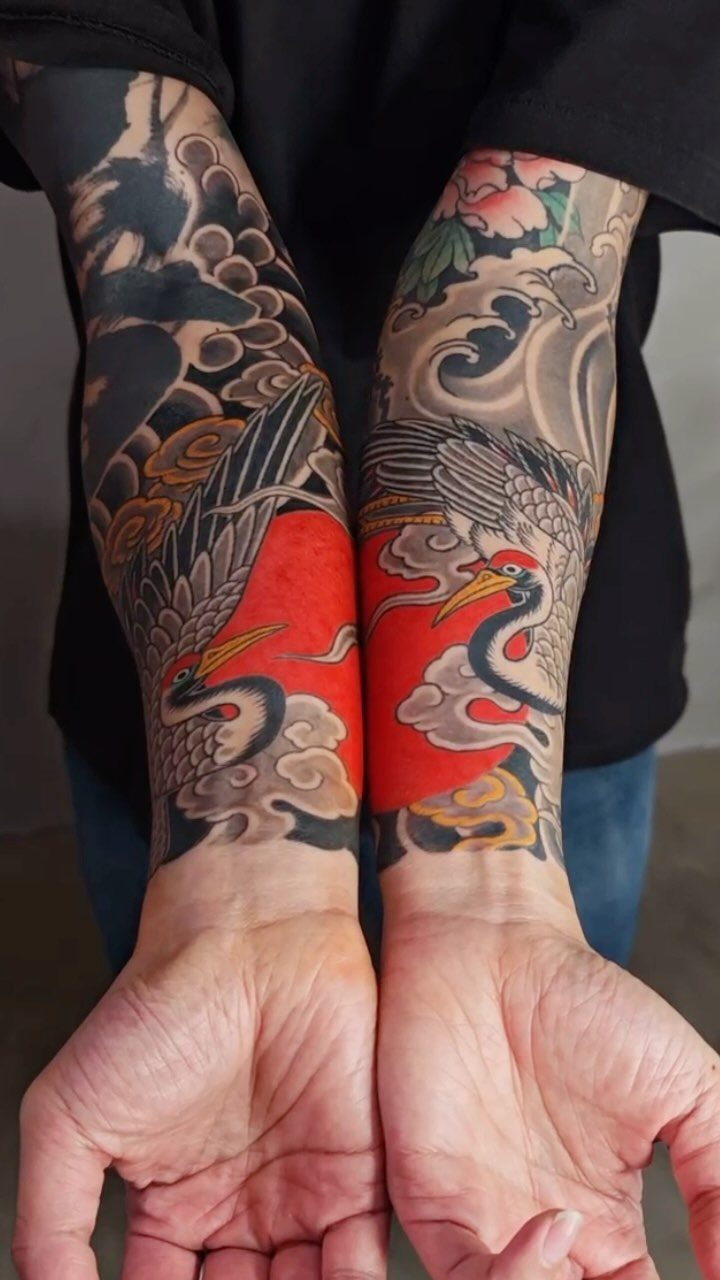
Cranes on both forearms let you build a mirrored composition, and the red background holds contrast better than pastels as ink ages. The red panels keep the birds visible without overwhelming the detail in the wings and the neck.
Forearm placement works well for cranes because the long neck and legs follow the shape of the arm naturally. The matching layout is a bold choice that commits both arms at once.
14. Japanese Demon Tattoo
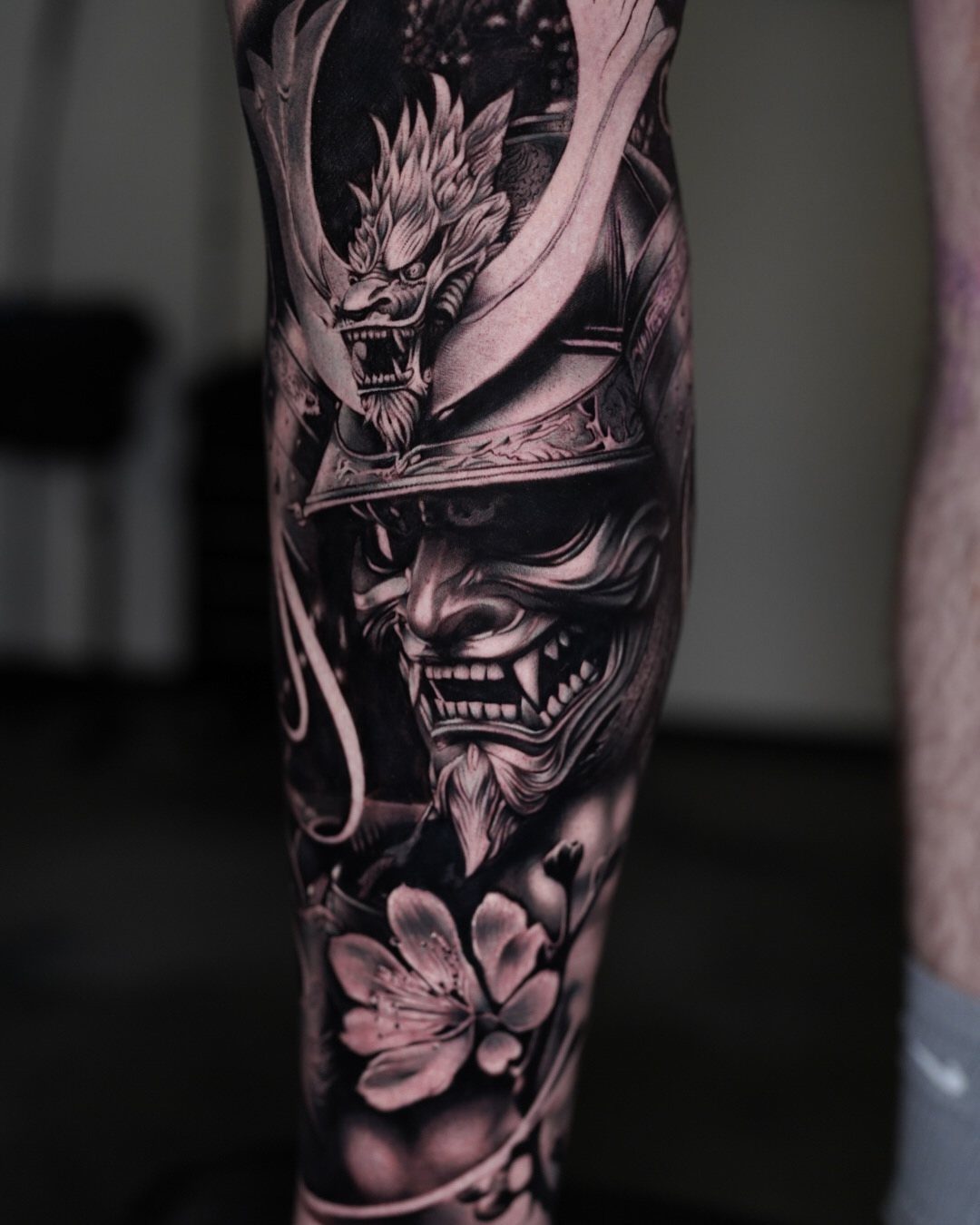
A demon mask wearing a samurai helmet combines two traditional subjects into one piece, with the helmet adding structure to the wild expression underneath.
Mischief and protection are the meanings, and the pairing of helmet and mask balances aggression with discipline. Cherry blossoms at the bottom soften the design without weakening it.
15. Japanese Skull Tattoo
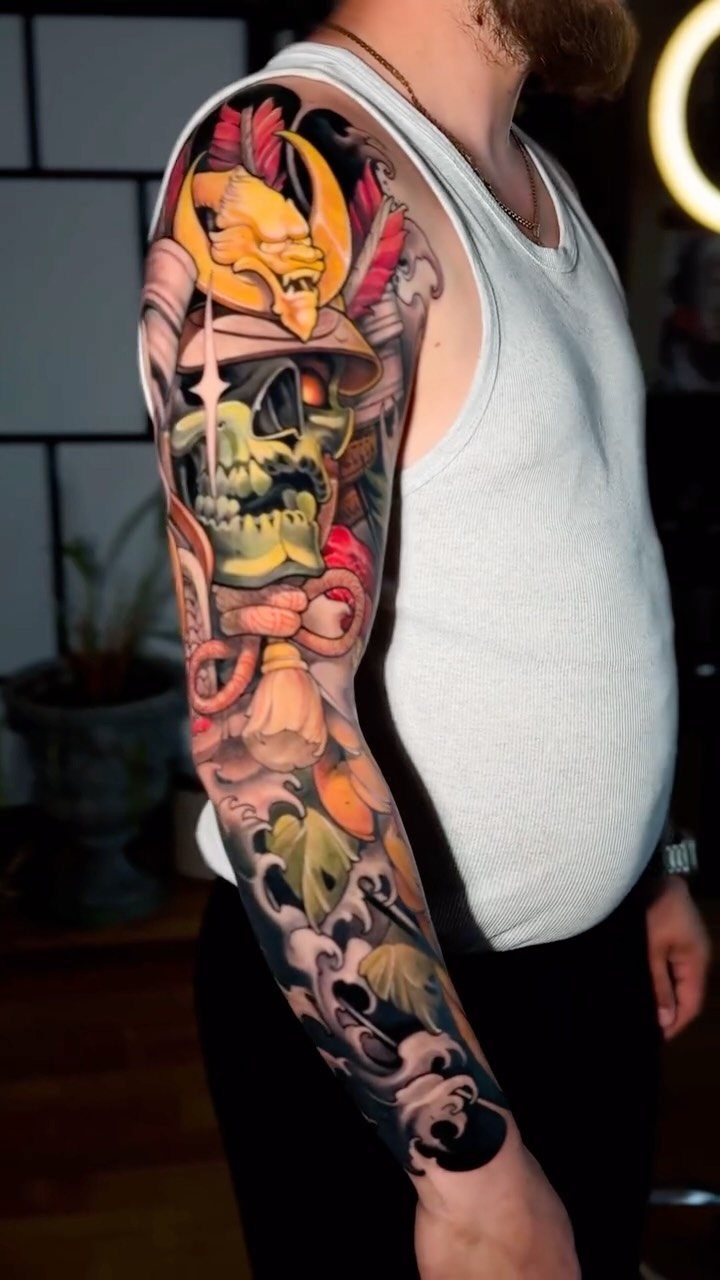
A green skull with a yellow demon mask and waves turns the usual mortality symbol into something more specific to Japanese tattooing.
The color contrast between the skull and the mask keeps both elements readable, and the waves tie the piece to traditional work.
Mortality and protection are the meanings, though the skull here reads more as a guardian than a warning.
16. Japanese Cat Tattoo
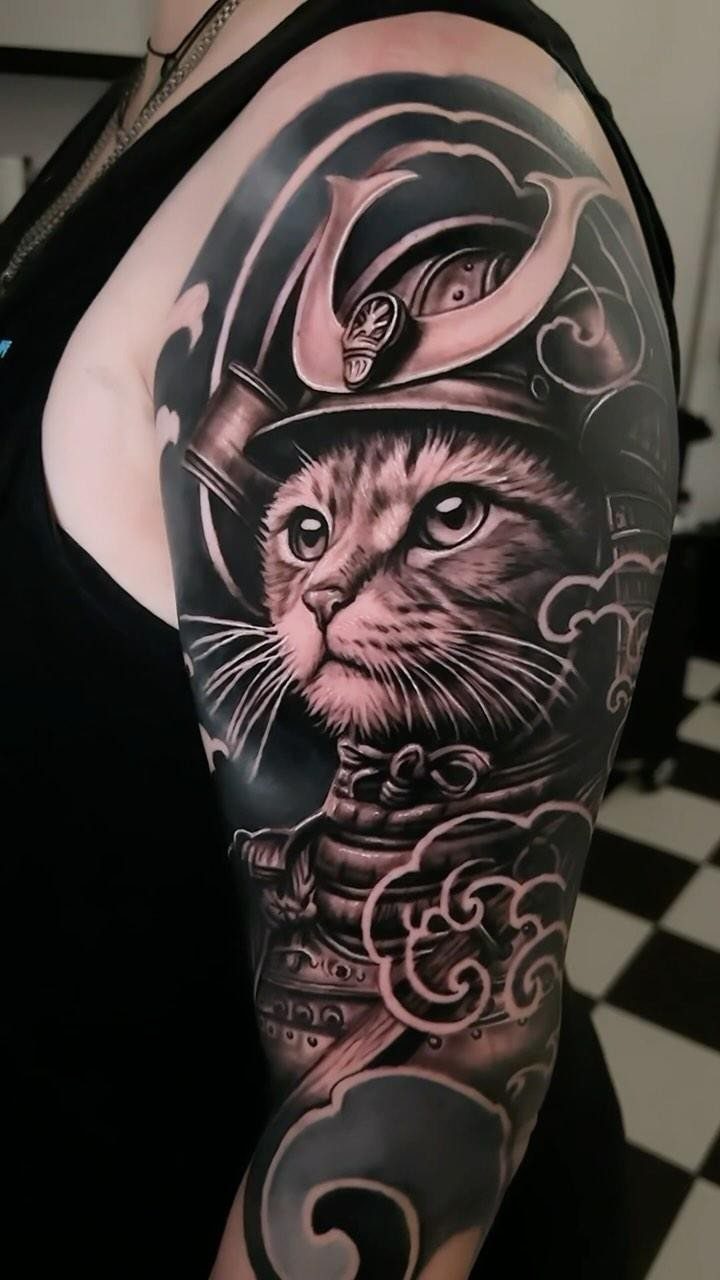
A cat in samurai armor is a design that brings good luck without relying on the usual dragon or koi.
Good fortune is the traditional meaning, and the armor adds protection to the symbolism. Upper arm placement works because the cat sits upright naturally, and the rounded shape fits the shoulder better than a long subject would.
17. Small Japanese Sun Tattoo
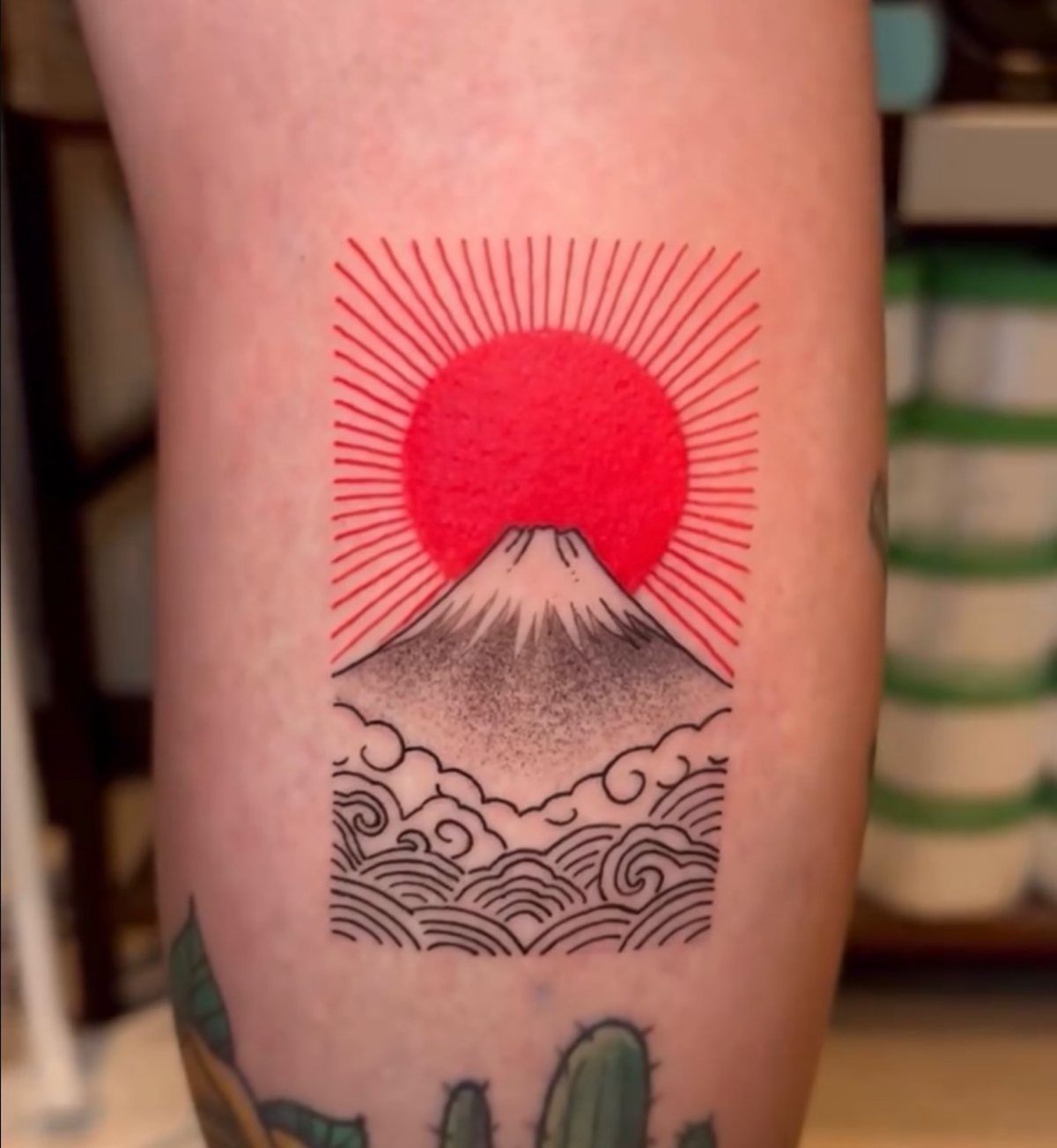
A red sun over Mount Fuji with waves below packs traditional Japanese elements into a small forearm piece that reads clearly from any angle.
The red circle anchors the design, and the mountain gives it a horizon line that keeps the composition balanced.
Small Japanese work like this finishes in one session and heals faster than a full sleeve, which makes it a practical choice if you want something finished quickly.
The compact size leaves room to add more later without locking you into a full arm commitment.
18. Japanese Hikae Chest Tattoo
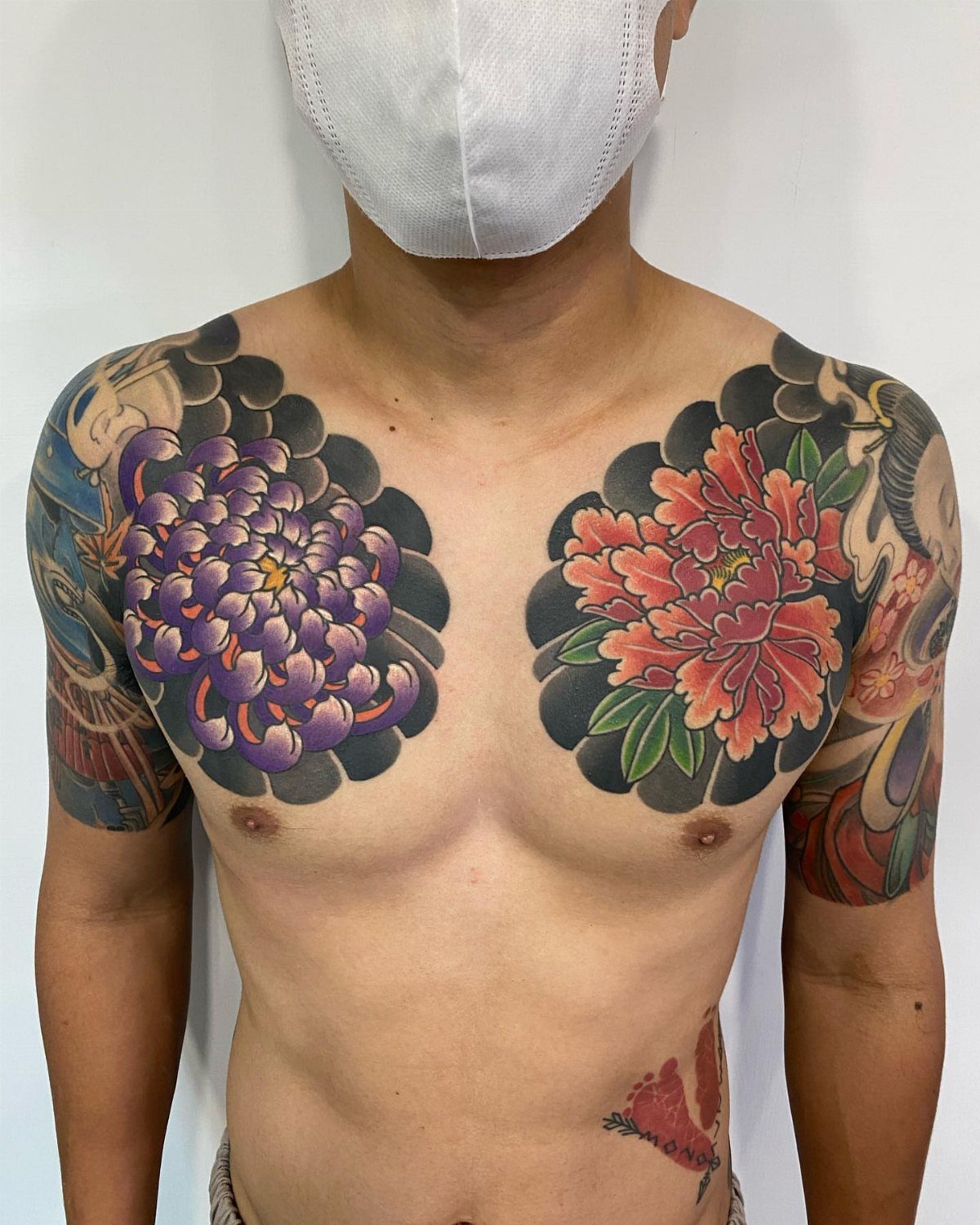
Purple and red flowers covering the shoulders and chest in the hikae style give you a large piece that stops short of the neck and the sternum, leaving both areas open.
The color saturation here is high, which means multiple sessions and careful healing to keep the petals sharp.
Hikae work traditionally stops at specific lines on the body, and that restraint is part of the style.
Chest placement like this is visible in a tank top but covered by a regular shirt, which gives you control over when the tattoo shows.
19. Japanese Cloud Tattoo
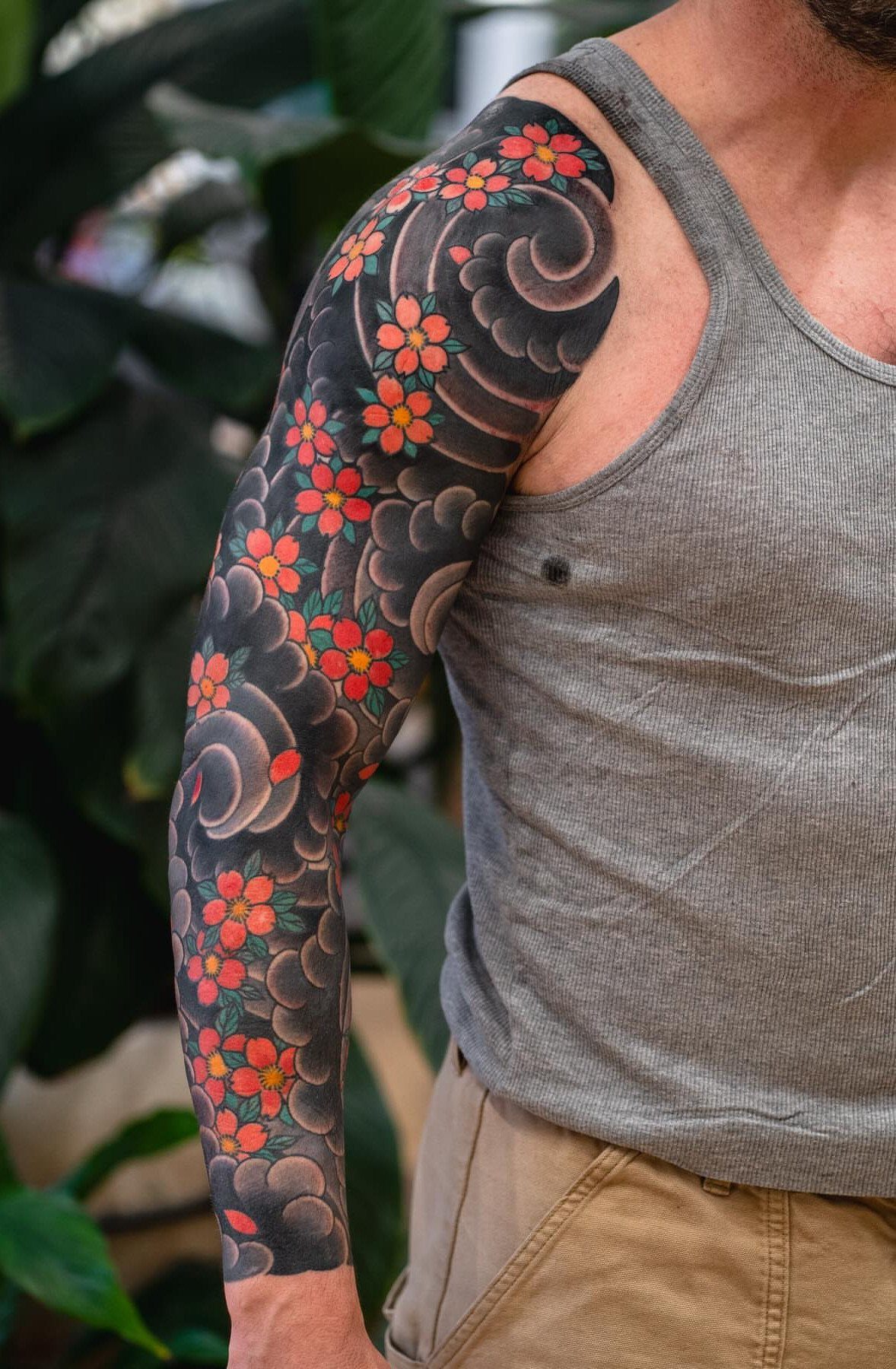
Clouds fill space between the main subjects in a Japanese sleeve without adding another figure, and grey shading gives depth without fighting the focal point.
The clouds sit behind the flowers the way weather belongs in the background, and the pairing keeps a full sleeve from reading as too busy.
Forearm placement lets the clouds wrap around the arm naturally, and the monochrome shading ages cleanly because there is no color to fade. If you add more elements later, the clouds adapt to whatever you bring in.
20. Japanese Foo Dog Tattoo
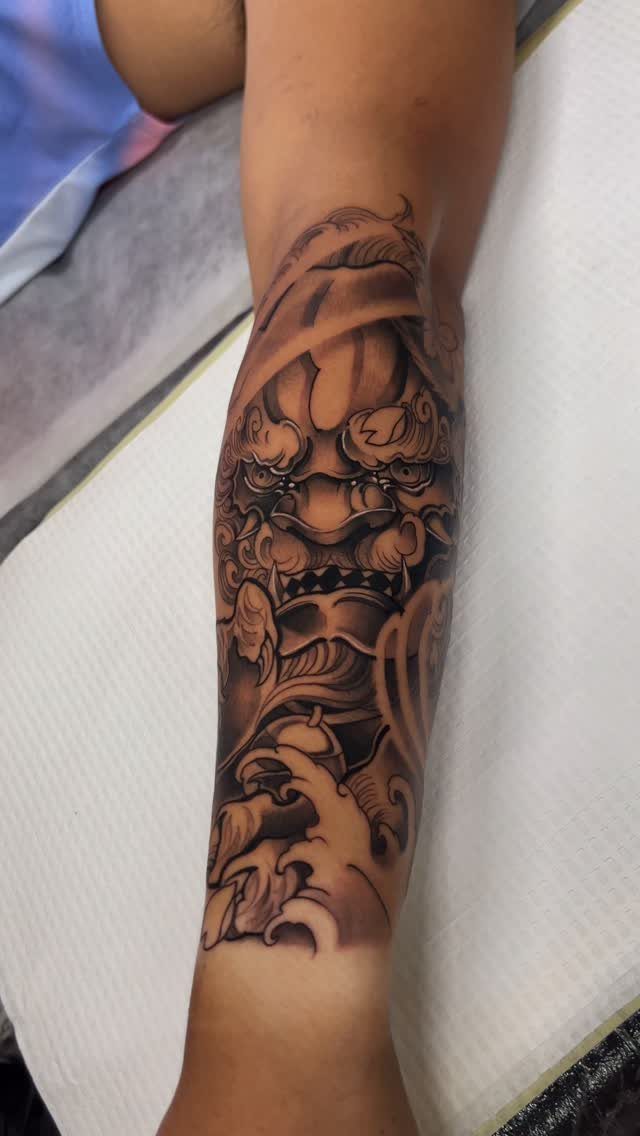
A foo dog on the lower leg in black and grey keeps the guardian symbolism without committing the arm or chest.
The monochrome shading gives you all the detail in the face and the mane without color maintenance, and the leg placement works because the dog sits upright naturally.
Lower leg work like this finishes in one or two sessions depending on size, and it stays covered in pants when you need it to.
21. Japanese Bamboo Tattoo
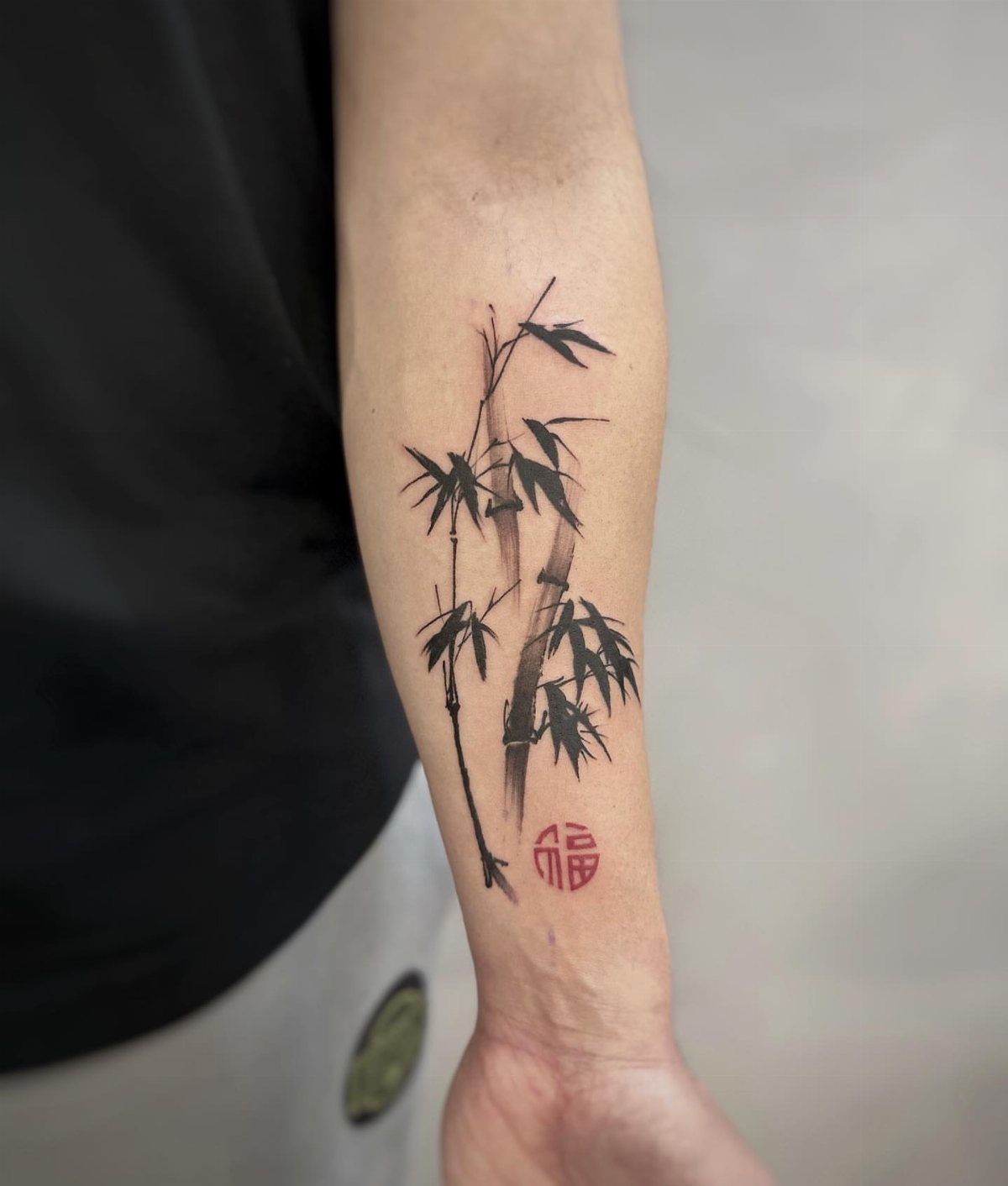
Bamboo runs vertically along the forearm in a way that follows the bone line, and the red seal adds a traditional stamp without requiring color everywhere else.
Resilience is the meaning, and bamboo’s straight lines make it one of the simpler Japanese subjects to place on a narrow area.
Cultural Significance of Tattoos
Tattoos in Japan carry a history tied to criminal organizations, particularly the Yakuza, whose members wore full-body suits called horimono as symbols of strength and loyalty.
The government outlawed tattooing around 1870 during the Meiji period, and the association with organized crime stuck.
Many public baths and hot springs still ban people with visible tattoos, and mainstream Japanese culture views the art with suspicion despite its popularity elsewhere.
The stigma applies broadly to visible tattoos, though the elaborate myth and folklore designs became most closely tied to Yakuza identity.
If you’re planning a large Japanese piece, that context matters. The style grew from a culture that saw the pain and commitment of a full suit as something earned, not decorative.
Placement Strategies for Tattoos
A full back, called kame-no-koh, gives you room for a central figure with supporting elements spreading symmetrically when you move. Position the main figure along the spine so it spreads symmetrically as the lats move.
Sleeves work best when the design progresses along the arm’s natural segments. A koi climbing the forearm can become a dragon at the shoulder, letting the body’s contour carry the narrative.
Ask your artist to leave negative space or wind bars in those joints instead of packing them with color. The design will age better and the movement will still read clearly.
Traditional Tattooing Methods
Traditional Japanese tattoos were applied by hand with a bamboo needle bar, a technique called tebori. The artist punctured the skin once per stroke, while a modern machine strikes about 100 times a second.
Hand tattooing took longer and hurt more, and clients saw the pain as part of earning the piece. A few artists still offer tabori, though most use machines now.
A full back piece with a modern machine typically takes several 5-hour sessions. Hand work adds hours to every session, but clients who want tebori choose it for the visible texture and the ritual, not just the look.
Frequently Asked Questions
Can foreigners get Japanese tattoos?
Yes, foreigners can get Japanese tattoos, though understanding the cultural weight matters if you’re planning a large traditional piece. The designs themselves are available to anyone, but the context is part of what you’re wearing.
What are Japanese tattoo rules?
Traditional Japanese tattooing follows composition rules like leaving negative space at body joints and positioning central figures along the spine so they spread symmetrically.
Traditional pieces like hikae also follow strict border rules, stopping before the neck and sternum rather than covering everything.
Many public spaces in Japan still require people with tattoos to cover them or stay out, a policy rooted in the association between elaborate traditional designs and criminal organizations.
What is the most common Japanese tattoo?
Dragons remain the most tattooed subject for men because the serpentine body wraps shoulder to bicep in a way almost nothing else does. The coiling shape fills space with motion and suggests strength even in black ink alone.





