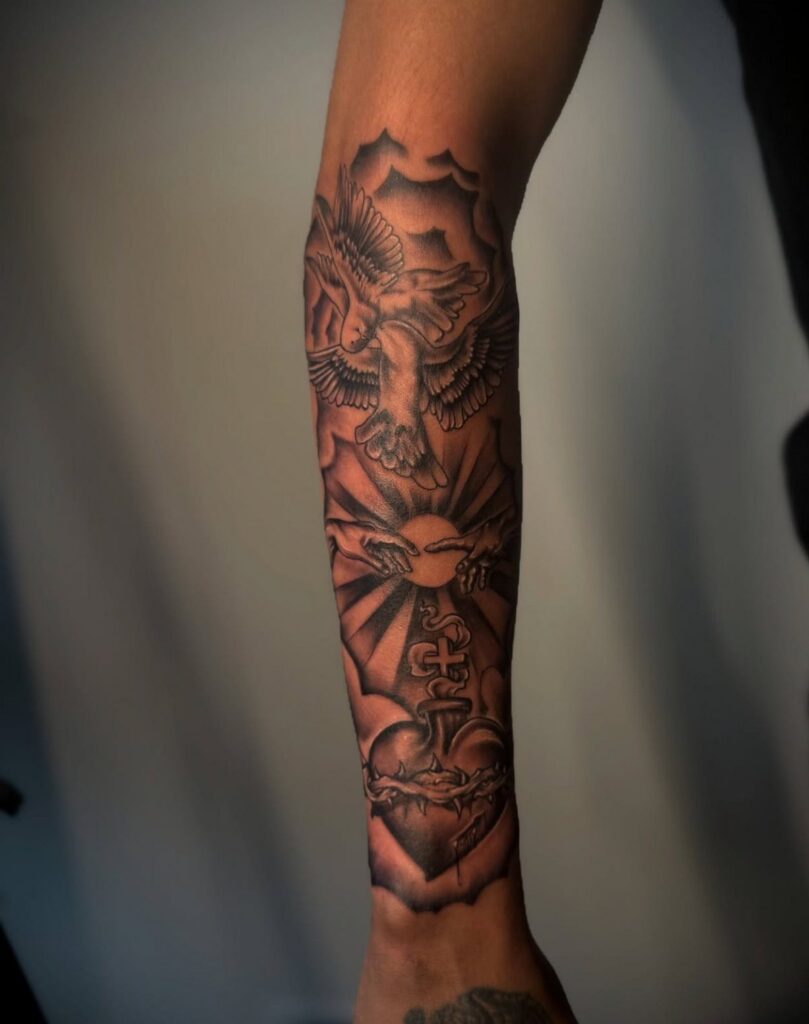
A quarter sleeve covers roughly shoulder to mid-bicep or mid-forearm to wrist, giving you enough canvas for a single subject or a layered composition without the commitment of a full sleeve.
Carbon particles in black ink hold their position longer than most color pigments, so the solid blacks and graded greys in these designs keep their contrast through years of sun and cell turnover.
1. Quarter Sleeve Tattoo
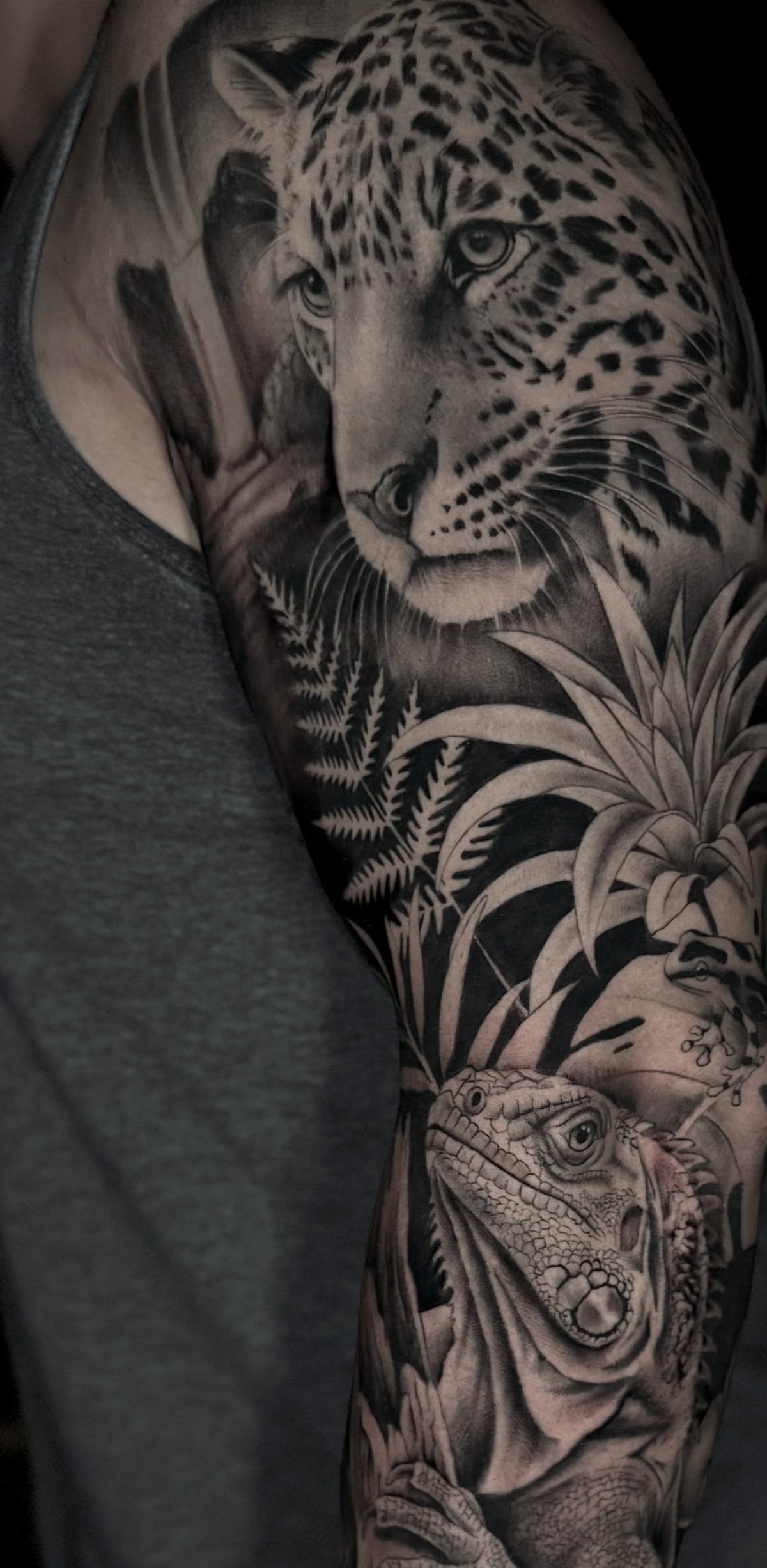
The quarter sleeve runs from your shoulder down to mid-bicep or the elbow, giving you enough space for a single focal point or a layered scene like this leopard and iguana composition.
Black and grey shading keeps the piece readable without overwhelming the arm, and the vertical format follows the natural taper of your upper arm.
If you work somewhere that requires short sleeves, this placement sits high enough that a standard tee will cover most of it.
Healing takes about 2 weeks for the outer layers, and you’ll want to keep the arm out of direct sun while the ink settles.
2. Lion Tattoo
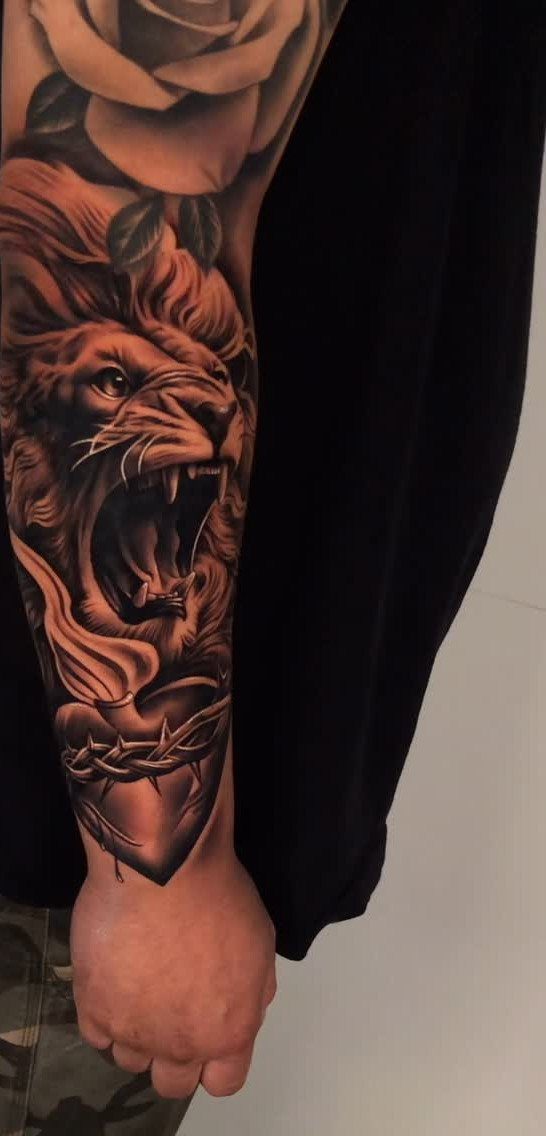
A roaring lion reads immediately, even from across a room, and the open mouth gives the artist room to show detail in the teeth and mane.
Pairing it with softer elements like the rose and crowned heart here balances the aggression without losing the central image.
Lions work well in black and grey because the shading defines the muscle and fur texture.
The forearm gives you a flatter canvas than the shoulder, so fine lines in the crown and thorns stay crisp. Budget around 3–4 hours for a piece this size, longer if you want deep contrast in the shading.
3. Geometric Mandalas
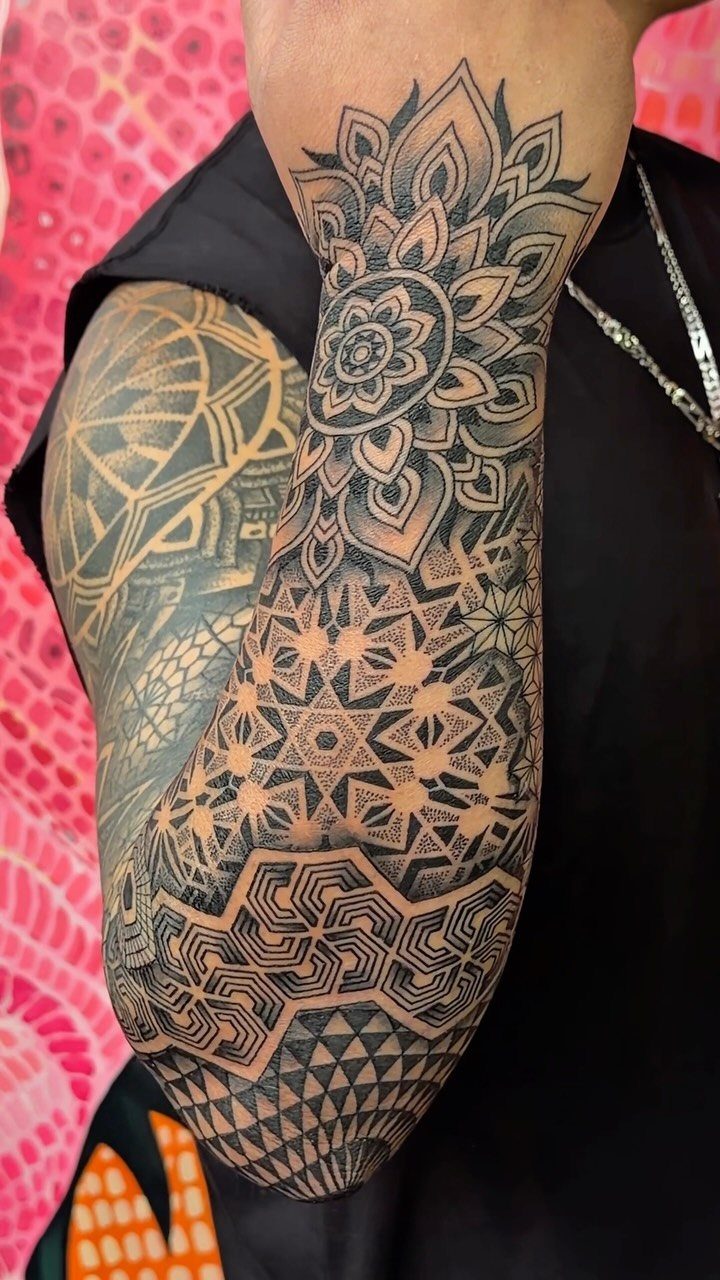
Mandala designs rely on symmetry, so they need clean lines and consistent spacing to hold up over time.
The stacked geometric patterns here wrap the arm and create a sleeve effect without needing full coverage, which keeps the session shorter and the cost lower.
Black ink alone is enough if the linework is tight.
Some artists will use dotwork to fill sections, which softens the overall look but adds time to the appointment. A quarter sleeve mandala usually runs 4–6 hours depending on how much detail you pack into the outer rings.
4. Script Tattoos
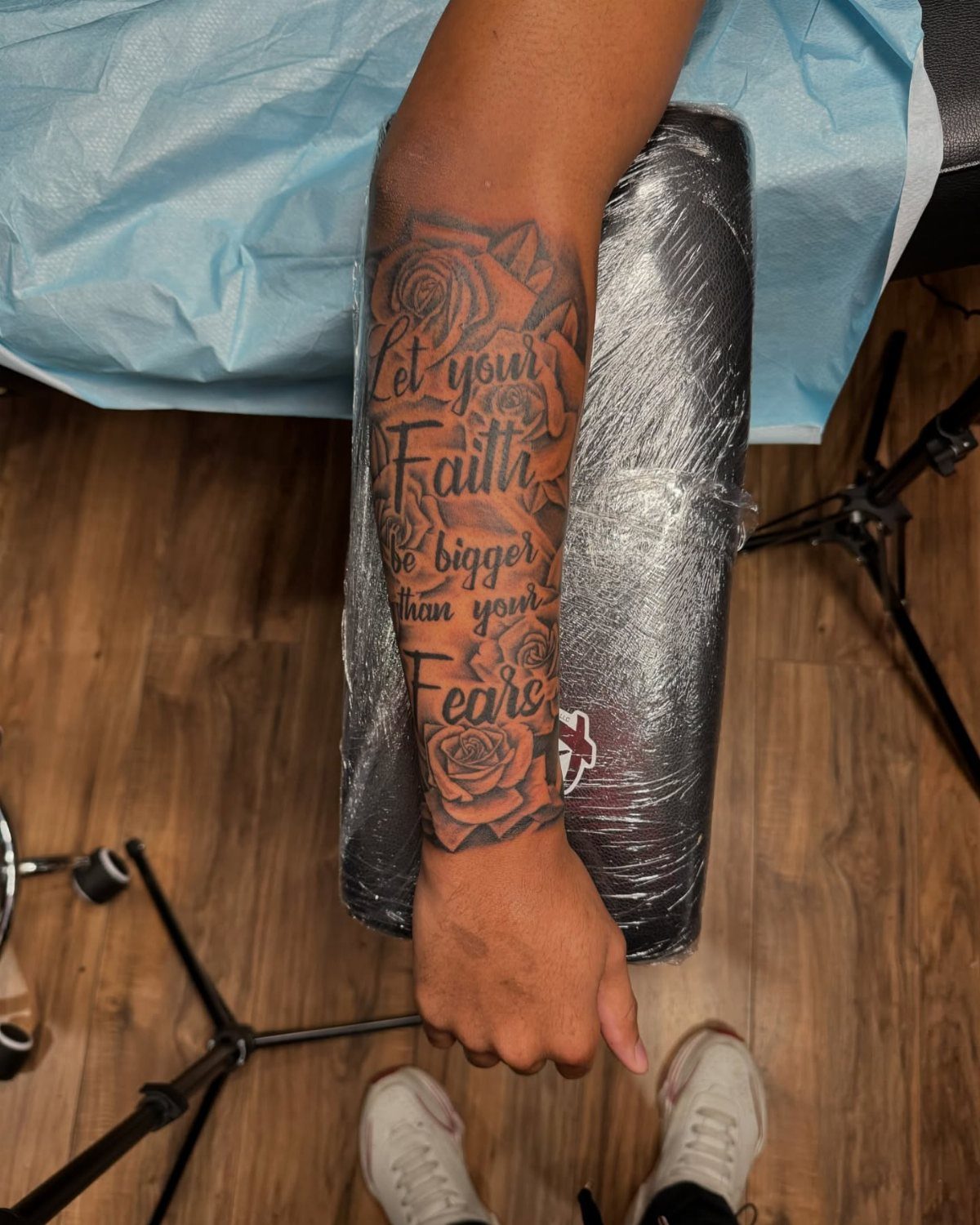
Text gives you a direct way to carry a message, and roses or other imagery around it keeps the design from looking like pure typography. Script that curves slightly with the arm reads cleanly no matter how your forearm rotates.
Font choice matters more than you’d think. Script fonts like this one stay legible at smaller sizes, while heavy lettering can blur together after a few years.
I’d keep the text to one or two lines; anything longer starts to look like a paragraph, and that’s hard to read on skin. Text with supporting florals fills a quarter sleeve in a single sitting.
5. Cohesive Design Flow
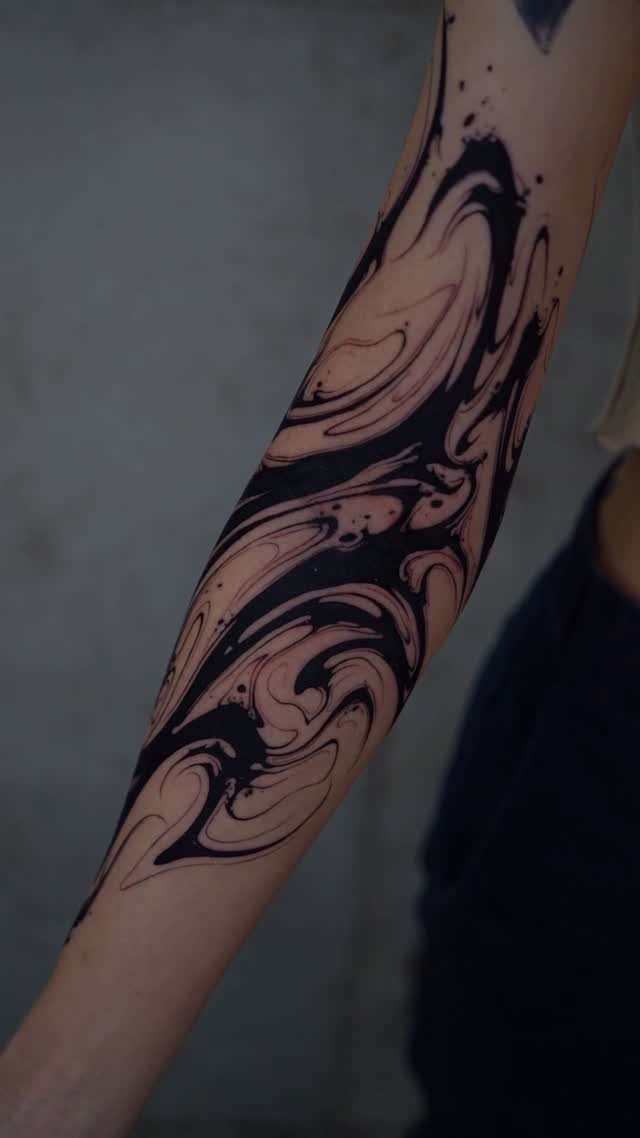
A design that wraps the arm like these swirling organic shapes reads as one piece instead of random patches. The black ink follows the muscle contour, so when you move your arm the design moves with it.
This approach works best if you plan the full quarter sleeve before the first session.
Abstract shapes give the artist freedom to adjust the flow as they go, but once the first section is done, the rest has to match the line weight and spacing.
Budget for 2–3 sessions if you’re layering shapes this dense; trying to finish it in one sitting usually means the later hours get sloppy.
6. Polynesian Tribal Upper Arm Tattoo
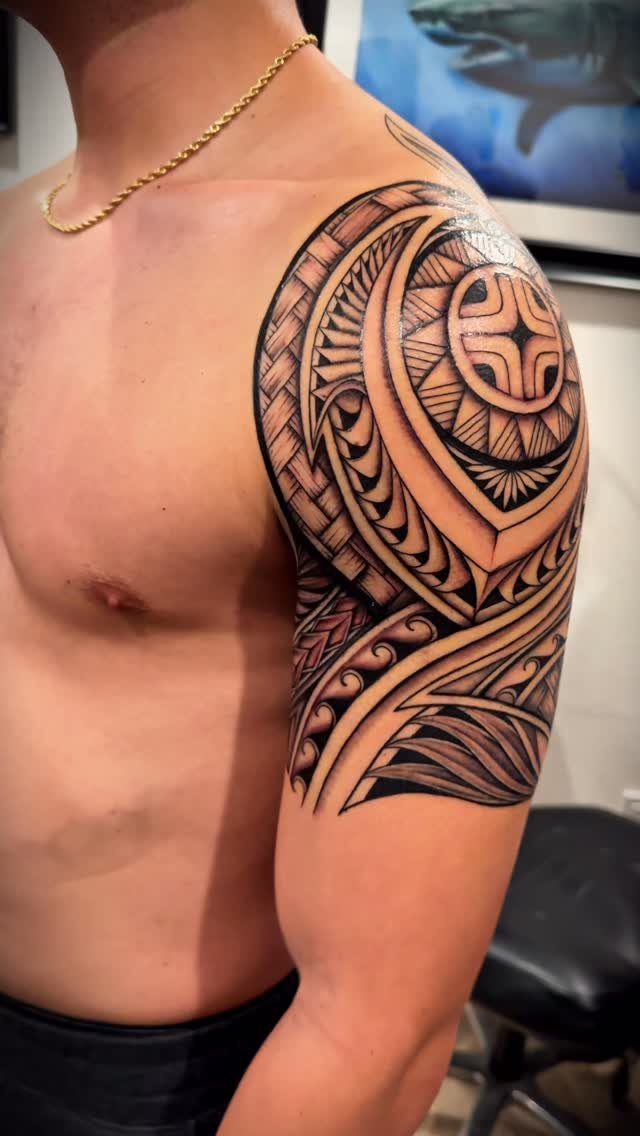
Polynesian designs use curves and repeated geometric blocks to fill space, and the bold black ink holds up well on the rounded shoulder and upper arm.
The patterns here wrap the deltoid and follow the natural break where your shoulder meets your bicep.
Tribal work needs solid black saturation, so expect a longer session than you would for linework alone. The shoulder has less nerve density than the inner arm, which keeps the pain manageable.
How long this takes depends on how much of the shoulder cap you cover. If you want to extend it later, Polynesian patterns connect easily into a half sleeve without looking forced.
7. Snarling Leopard Realism Tattoo
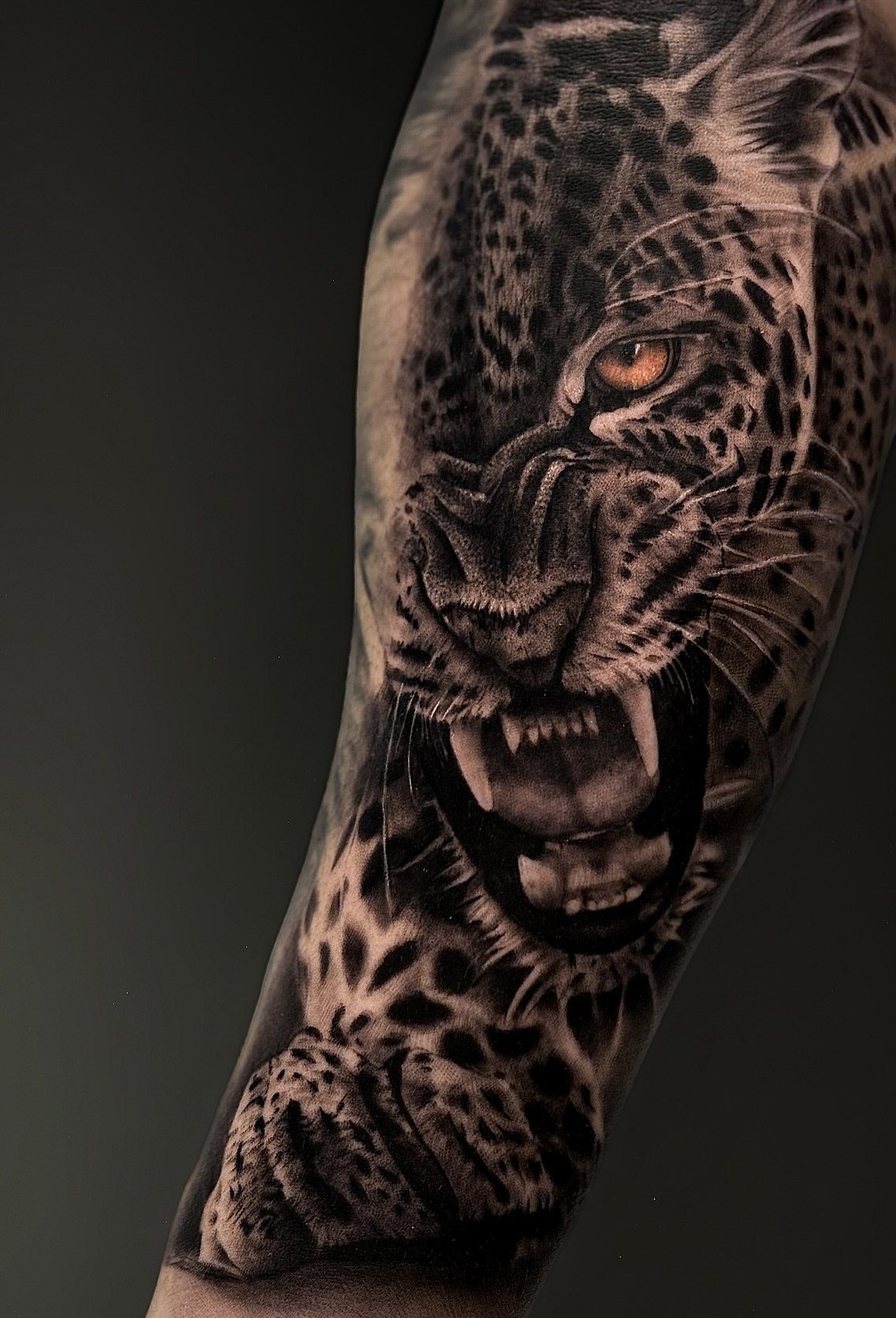
Realism work lives or dies on the contrast between light and dark fur, and adding one color like an orange eye pulls focus without turning the piece into a full color sleeve.
The snarl gives you sharp teeth and tensed muscle, which reads clearly from any angle.
Black and grey realism takes longer than bold linework because the artist is building depth with overlapping layers of shading.
The inner arm has more nerve endings than the outer bicep, so placement affects how much sitting still you’ll need to do.
8. Pocket Watch and Banner Tattoo
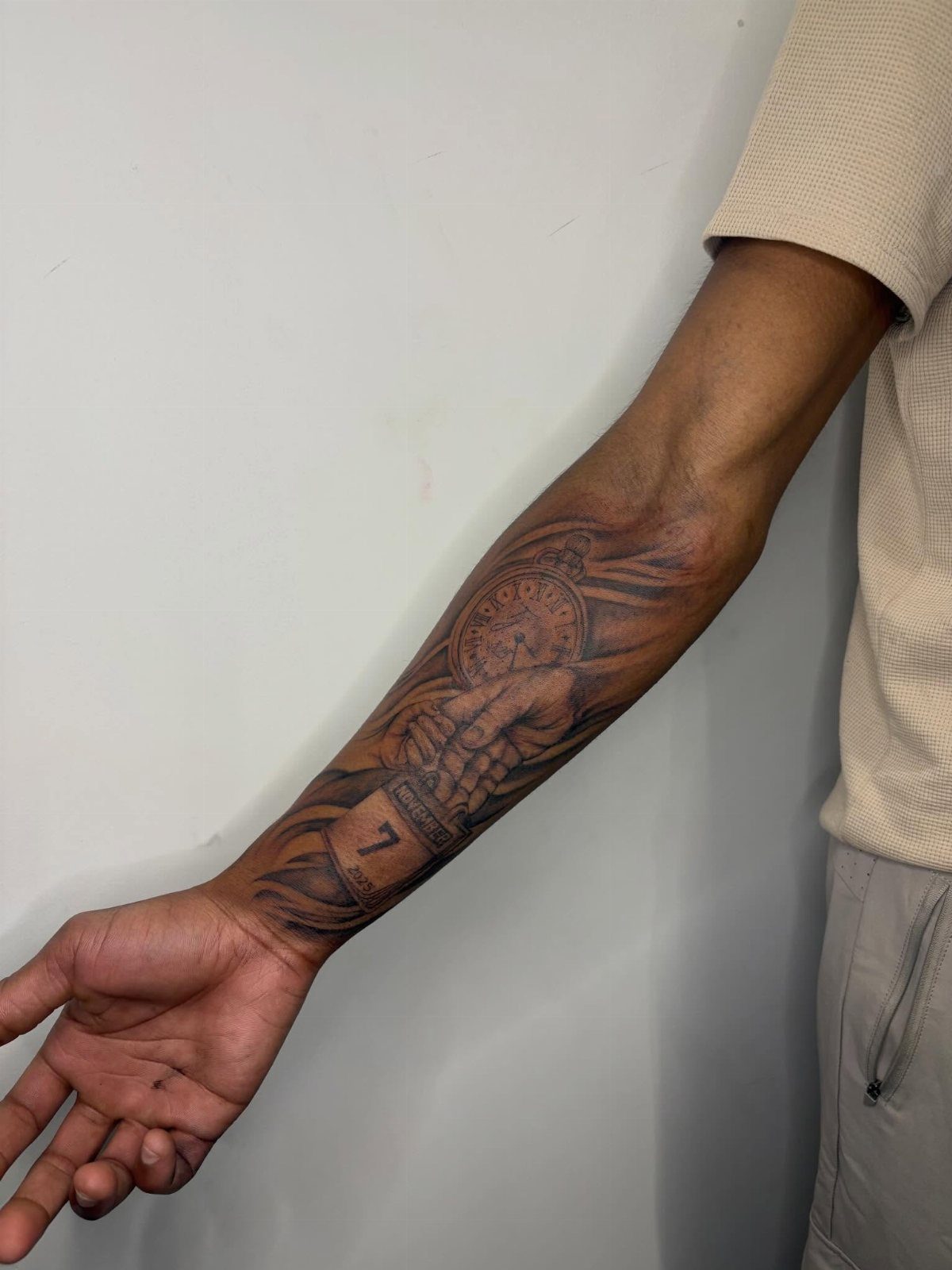
A hand holding a pocket watch gives you 2 levels of detail: the realistic skin and knuckles in the hand, and the mechanical face of the watch itself.
The banner with a specific date turns it into a memorial or milestone piece without needing a portrait.
Black and grey keeps the focus on the objects instead of the background.
Roman numerals on the watch face stay readable longer than intricate filigree, which can blur as the ink settles. This fits a forearm in one sitting, around 4–5 hours depending on how much shading you want in the hand.
Tattoo Placement Considerations
Stopping right at the sleeve hem is the fastest way to make a quarter sleeve look accidental. Lift your arm and that shirt edge climbs with it, leaving a stripe of bare skin that breaks the whole composition.
Cramming a story with 12 elements into 6 vertical inches is a recipe for a muddy mess. Ink spreads over time, and fine details turn into grey smudges after a few years if the design is too tight.
Tattoo Cost and Time
Top artists in cities like New York or Los Angeles sit around $150–$300 an hour.
If someone offers to do the whole piece for $400, walk away. You’re paying for sterilization, equipment, and the experience that keeps your tattoo from turning into one of the mistakes I’ve been describing.
Session length depends on detail density. A geometric mandala or a realism piece with layered shading will push you toward the higher end of that time range.
Simpler bold linework finishes faster, but cutting corners on artist quality usually shows up as uneven saturation or wobbly lines that can’t be fixed later.
Tattoo Longevity and Maintenance
Black holds best because the carbon particles are bigger and your body’s immune cells can’t clear them as easily. A piece needs solid black, skin gaps, and mid-tones to hold its structure as it ages.
A design built entirely on mid-tone gray will flatten out and lose dimension fast. Those deep black anchors keep the composition readable after years of sun exposure and natural fading.
Lighter colors fade faster and may shift in tone, which is why black and grey realism holds up better than full color work on the arm.
Over time, fine lines blur slightly as the ink settles into the dermis, so designs with strong contrast and clean negative space age better than pieces that rely on tight detail alone.
Frequently Asked Questions
What are some good themes for quarter sleeve tattoos for men?
Animals like lions and leopards, geometric mandalas, Polynesian tribal patterns, and script with supporting imagery all work well.
These themes give you enough visual weight to fill the upper arm without needing full coverage, and they hold up clearly as the ink ages.
How much does a quarter sleeve tattoo usually cost?
Expect to pay $150–$300 per hour with a top artist in a major city. A full quarter sleeve usually takes longer if you’re layering realism or heavy shading, so total cost depends on the design complexity and your location.





