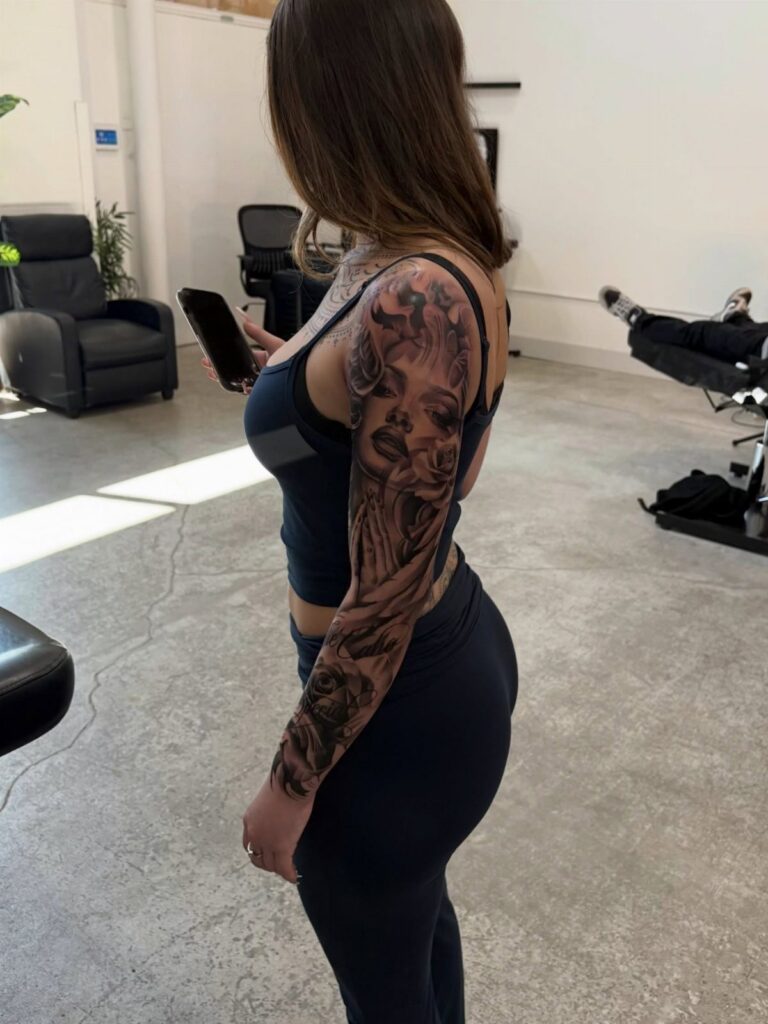
A sleeve tattoo covers the full arm from shoulder to wrist and takes anywhere from 10 to 30 hours split across multiple sessions, depending on whether you choose fine line dotwork, watercolor washes or dense black and grey shading.
1. Flowers Sleeve Tattoos for Women
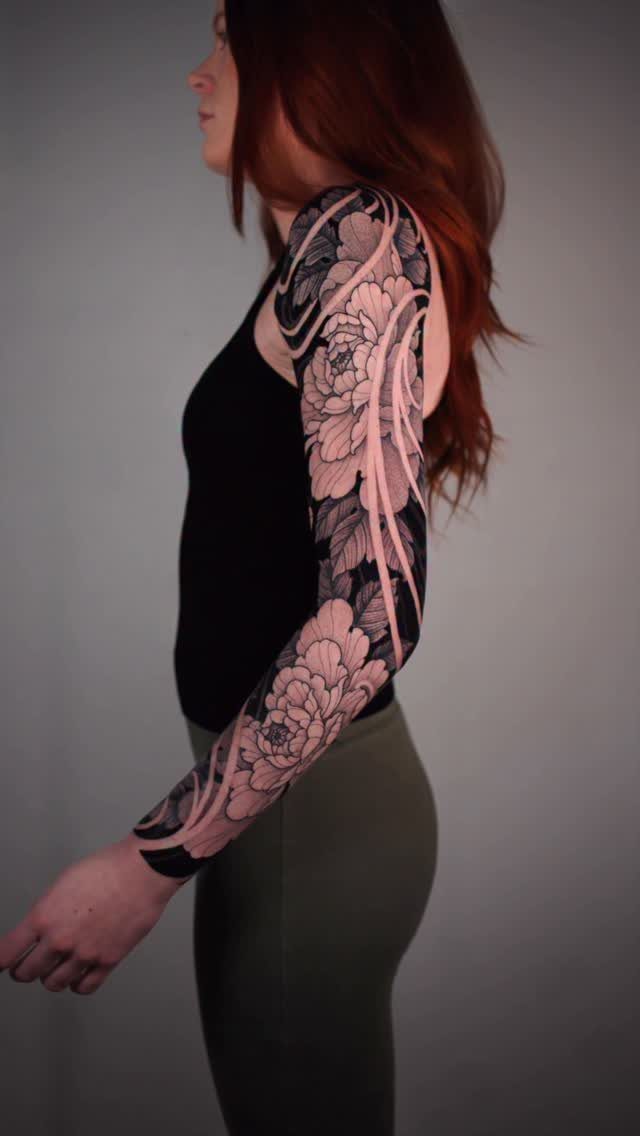
A full floral sleeve pulls together roses, peonies, leaves and stems into one flowing composition that covers the entire arm. The design works because flowers scale to any width and fill irregular spaces without awkward gaps.
Color work takes longer and usually splits across multiple sessions.
Black and grey cuts that time roughly in half. Either version stays legible at a distance, which matters when the piece covers this much skin.
Placement on the outer arm handles fading better than the inner bicep, where friction from clothing wears ink faster.
Plan the layout so the largest blooms sit where the arm has the most muscle, and smaller stems taper toward the wrist.
Sleeve tattoos, whether you’re covering a quarter, half, or all of your arm, are for people who aren’t afraid of commitment. These pieces require patience, money, and an artist that can showcase their talent, while managing your vision.
2. Watercolor Tattoos
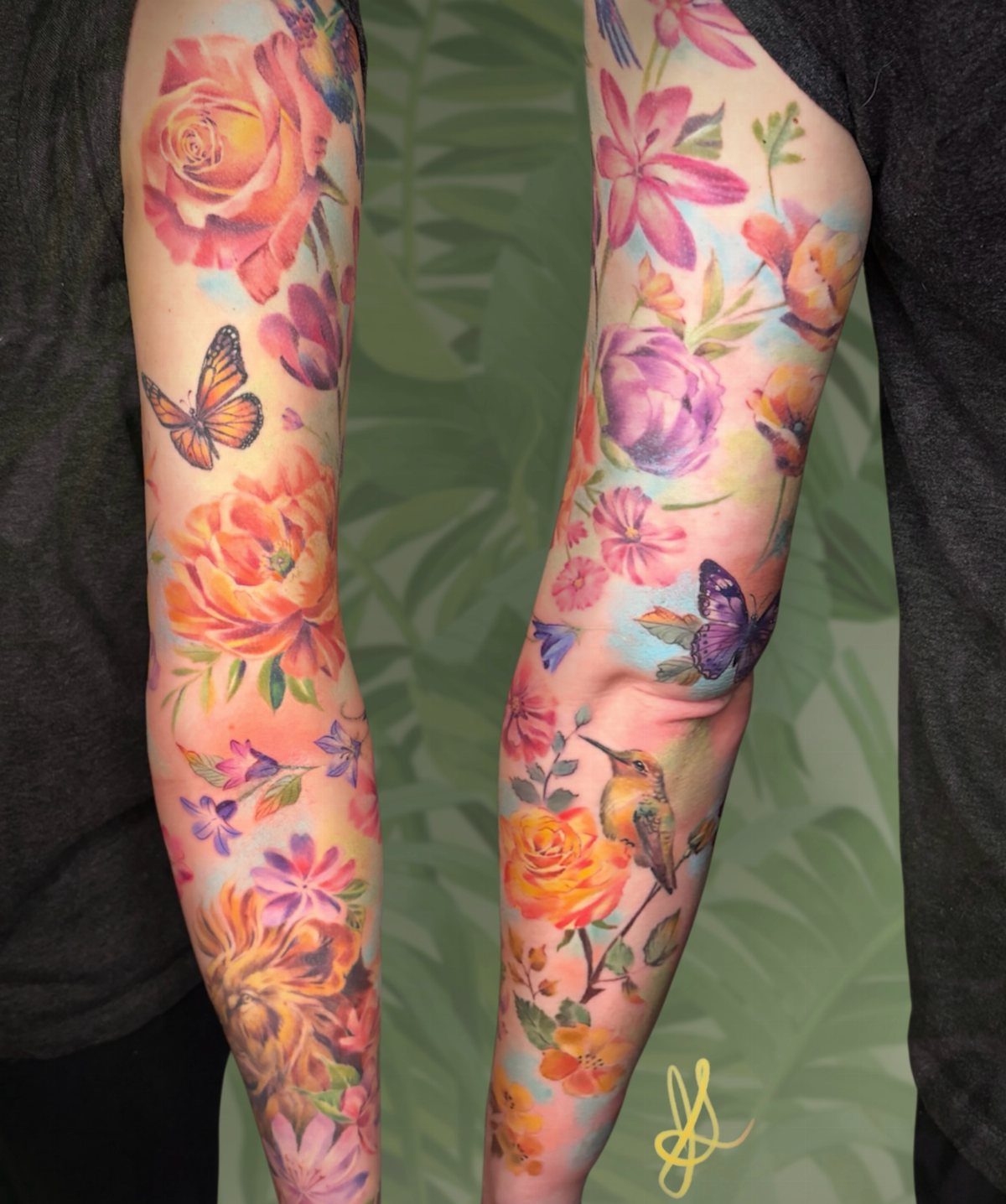
Watercolor sleeves layer soft washes of color that bleed into each other the way wet pigment spreads on paper. The look relies on gradient blending rather than hard outlines, so flowers and wings blur at the edges.
This style loses color faster because it skips the black outline that locks ink in place.
Plan on periodic touch-ups to keep the colors from turning muddy. Sunscreen slows the fade, but placement on the inner arm, where sun hits less often, helps more.
The technique suits designs with overlapping elements, like petals, butterflies and birds, because the blurred edges let each piece flow into the next without harsh stops.
3. Geometric Designs
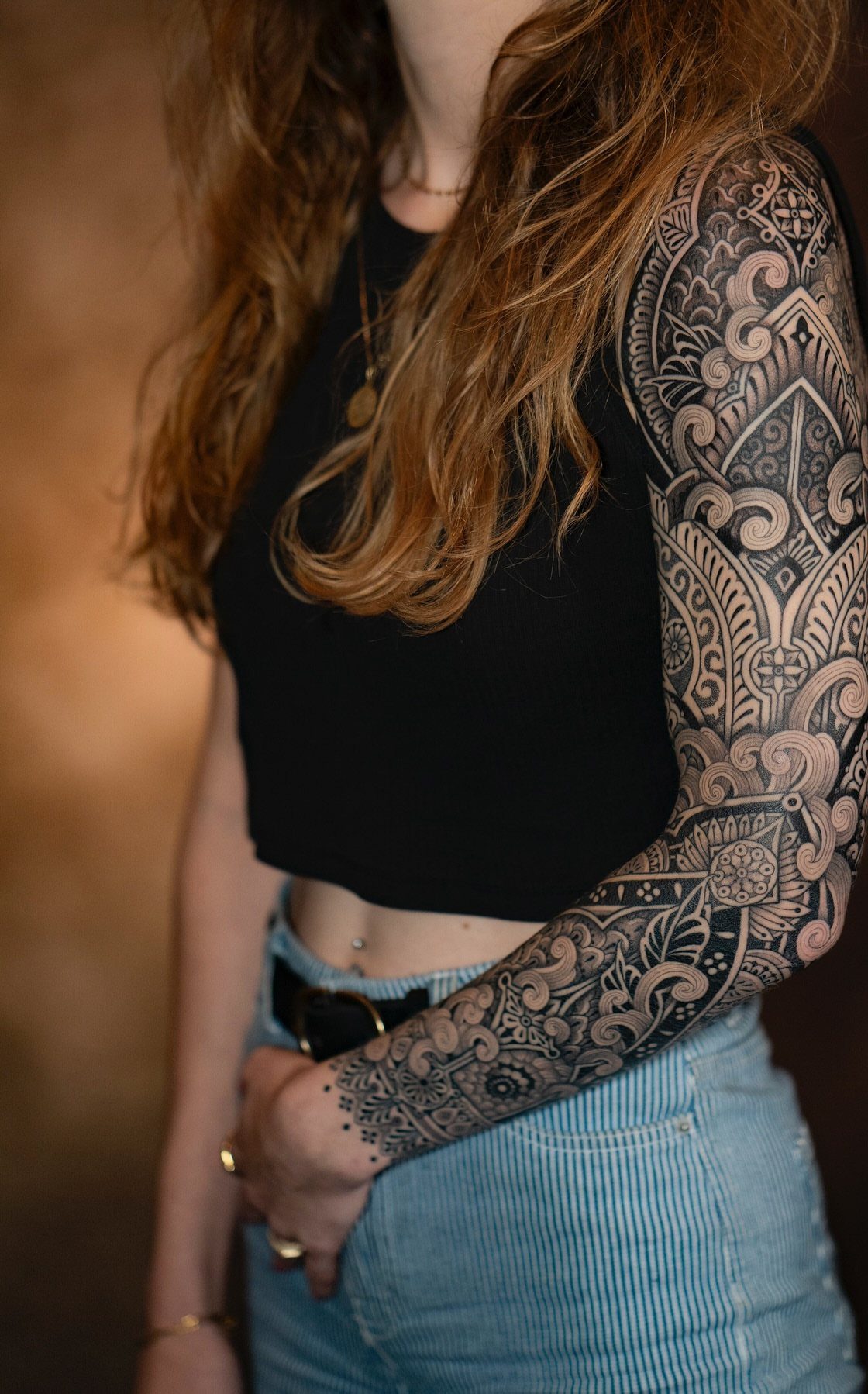
Geometric sleeves build repeating patterns from mandalas, dotwork and straight lines that lock together like architectural drawings.
The precision matters: a circle that wobbles or a line that drifts off-angle shows more on geometric work than it does on organic designs.
Black ink keeps these patterns sharp because the eye catches every break in a line. Placement on the forearm and upper arm gives the artist flat, stable surfaces to work on, which keeps lines crisp.
Sessions run long because dotwork and fine line shading move slowly.
Plan on serious chair time for a piece that wraps the whole arm. The result is a design that ages cleanly, since straight lines and dots blur into shading rather than into unreadable smudges.
4. Abstract Art
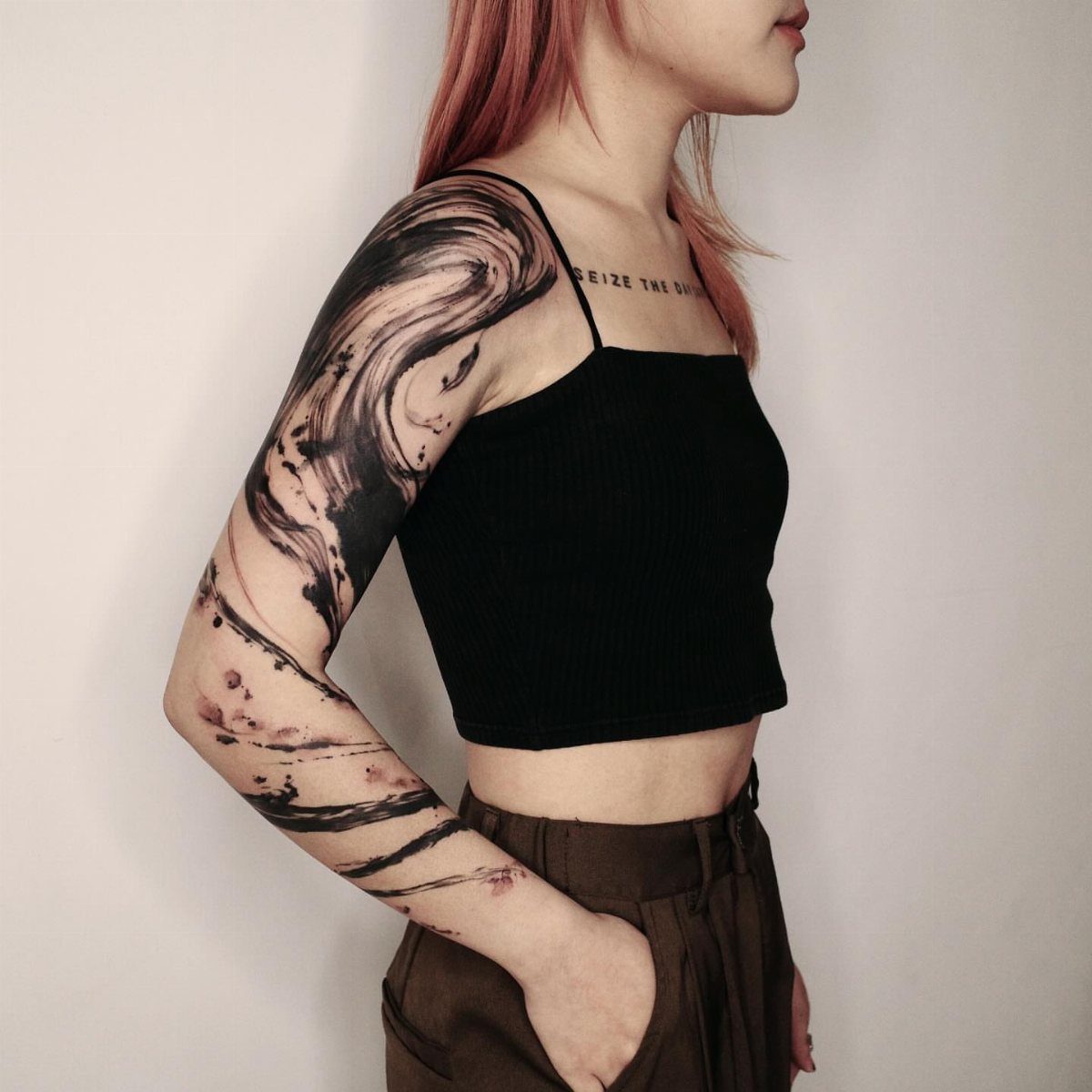
Abstract sleeves use bold brushstrokes, splatters and negative space to create a design that feels spontaneous rather than planned. The style skips literal images in favor of shapes and textures that suggest movement.
Black ink dominates most abstract work because it reads as contrast rather than as an object trying to look like something.
Placement along the outer arm shows the design when your arm hangs naturally, which matters when the composition depends on large, sweeping lines.
This approach suits people who want a sleeve that does not tie them to one fixed meaning. The design shifts with your viewing angle, and that openness outlasts a literal image that might feel dated later.
5. Phoenix Sleeve Tattoo
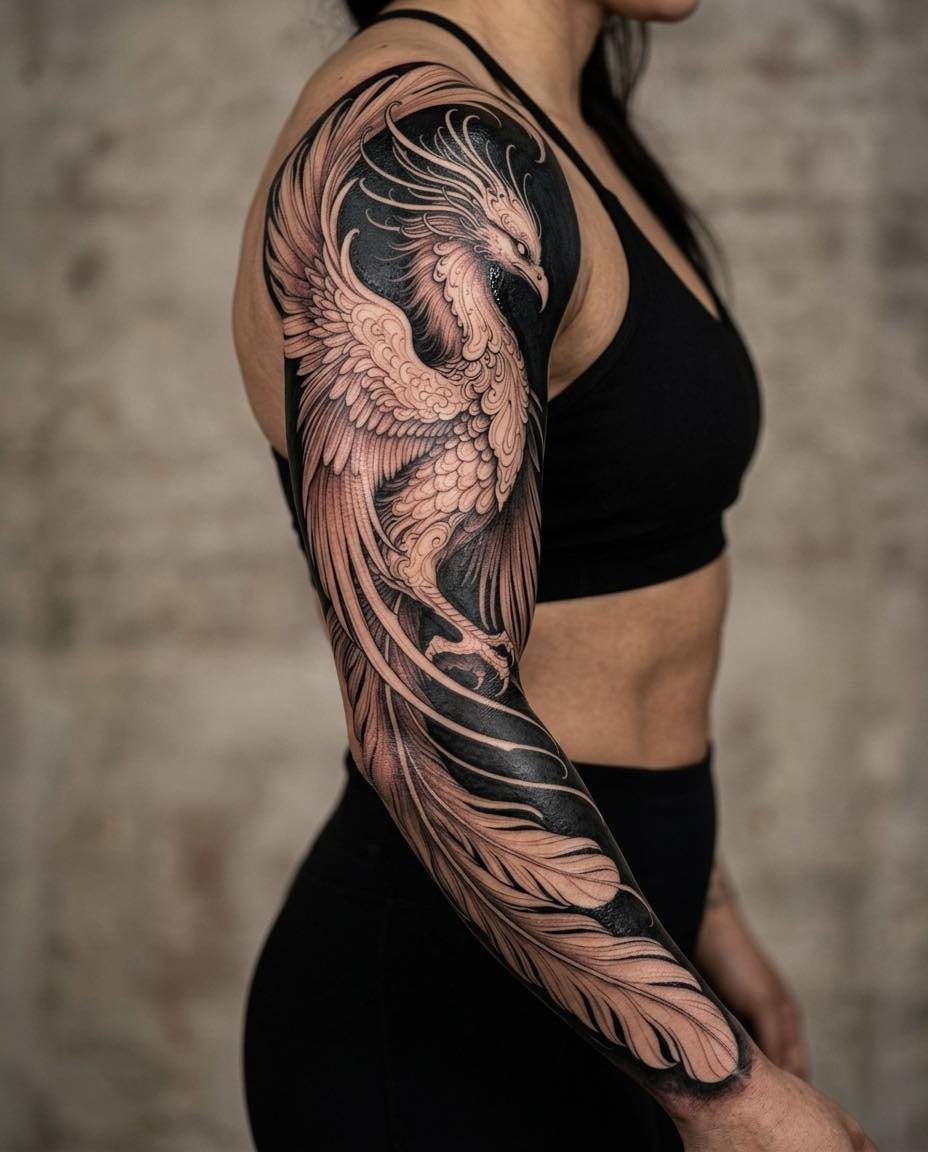
A phoenix sleeve centers the bird across the shoulder or upper arm, with wings and tail feathers fanning out to fill the remaining space down to the wrist.
The design works in black and grey because shading defines the layers of plumage without needing color to separate them.
The bird’s head usually sits on the shoulder, where the deltoid gives the most surface area for detail, and the tail wraps around the forearm in a spiral that follows the arm’s natural taper.
Healing takes a few weeks, and the shoulder section will feel tender longer because clothing rubs against it. Plan sessions around your work schedule if you need to keep the area covered while it heals.
6. Woman Face and Snake Sleeve
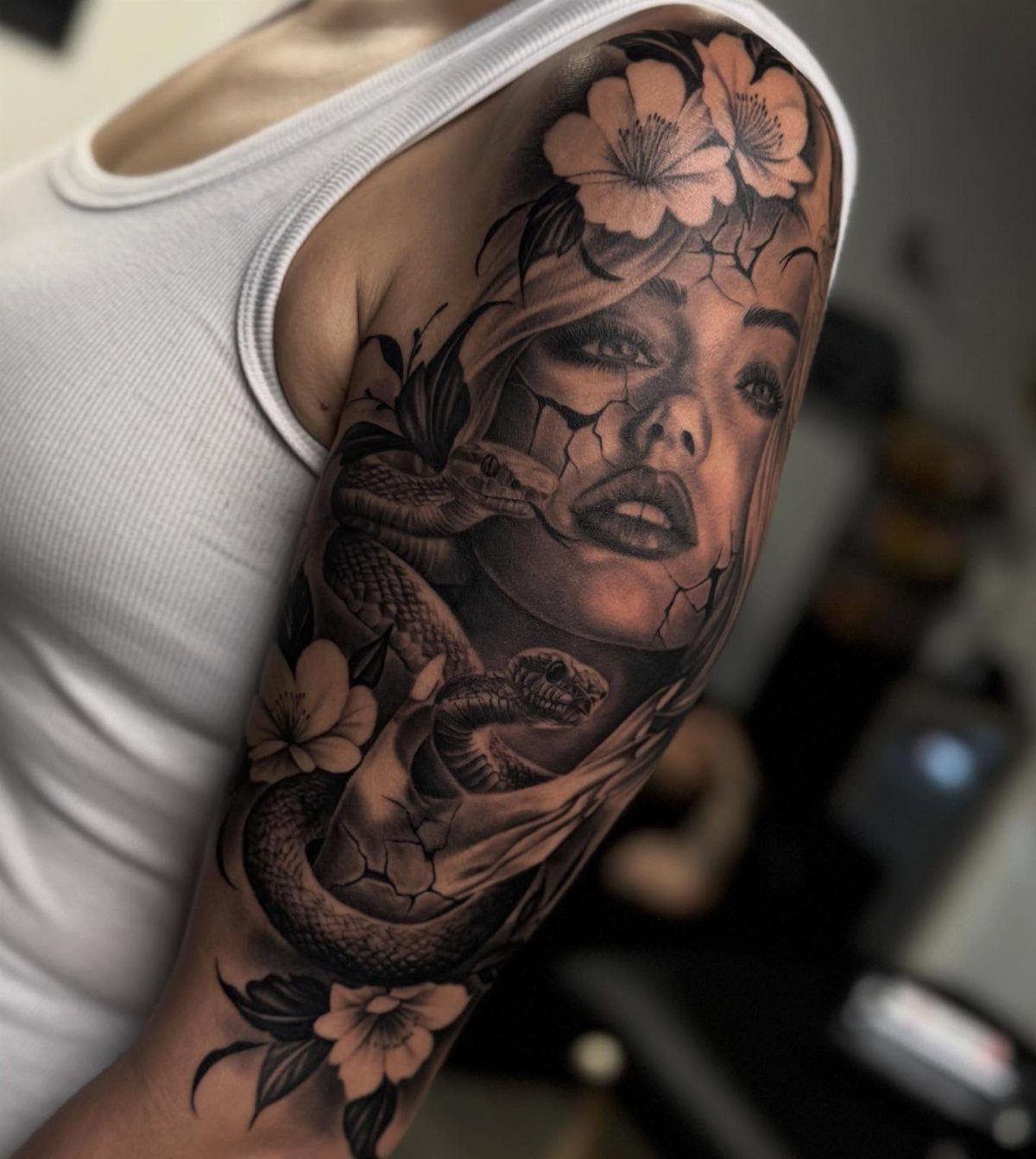
This sleeve combines a woman’s portrait with cracked, textured skin, flowers tucked into the composition, and a snake winding through the empty spaces.
The cracked skin effect uses fine line shading to mimic dried earth or shattered porcelain, which adds depth without color.
Black and grey suits this style because the shading defines the cracks and scales without competing with the portrait.
The woman’s face sits on the upper arm or shoulder, where there is room for detail in the eyes and expression, and the snake wraps downward to fill the forearm.
The portrait work goes slowest because facial proportions need precision, and any distortion shows immediately. Choose an artist who posts portrait work regularly, since this design relies on getting the face right.
7. Koi Fish Sleeve
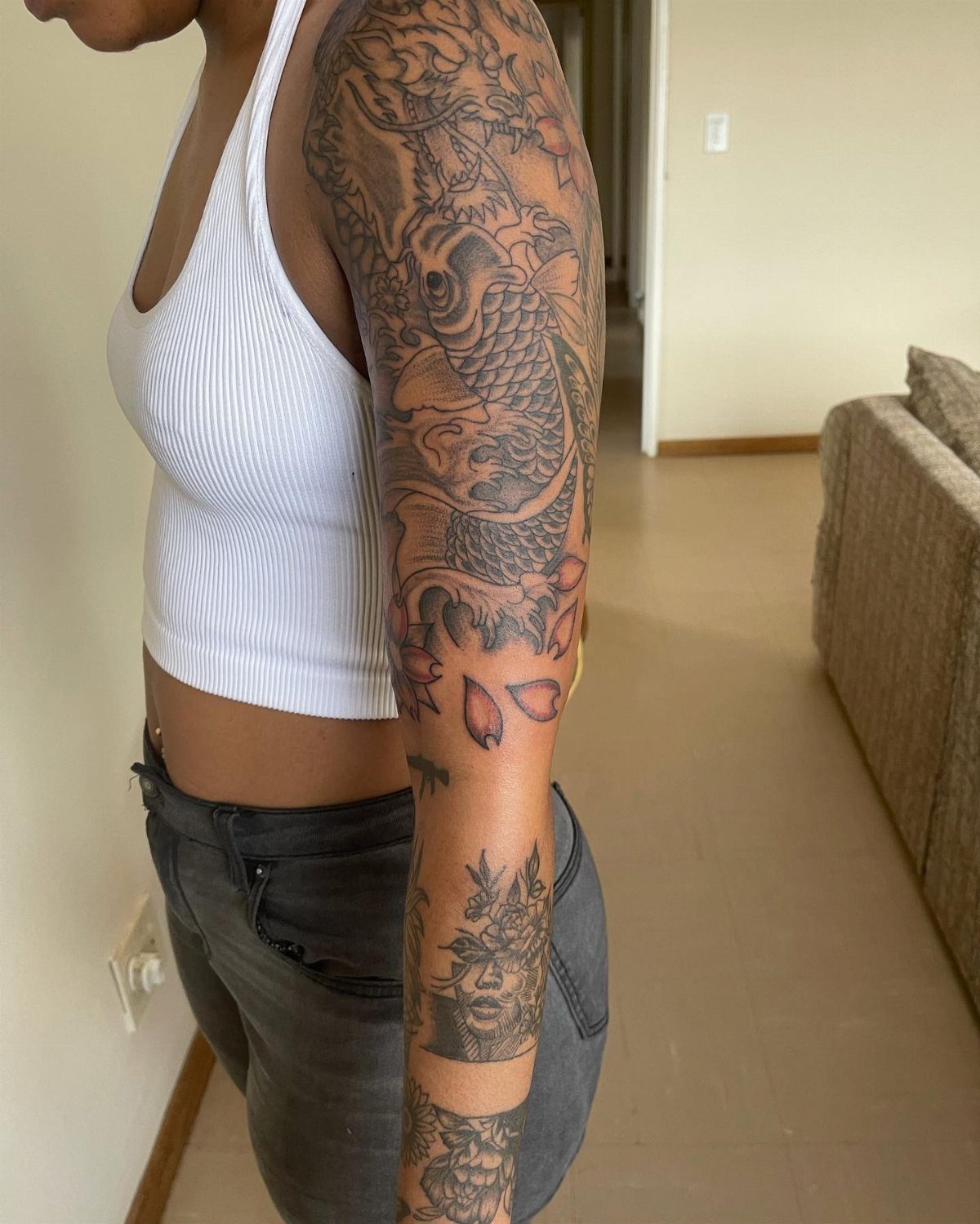
Koi fish sleeves wrap the arm with a single large fish swimming through water, waves or lotus flowers, often paired with a portrait or florals to fill the remaining space.
The fish scales take the most time because each one needs individual shading to look dimensional rather than flat.
Orange and red koi hold color better than yellow or white, which fade faster and need more frequent touch-ups. Black and grey versions skip that maintenance entirely and rely on shading to define the scales and water.
The fish’s body curves to follow the arm’s natural shape, so placement starts at the shoulder and spirals down to the wrist.
Artists who specialize in Japanese-style work understand how to position the fish so it reads correctly from multiple angles.
Researching Tattoo Sleeve Ideas
Instagram gives you finished work from artists around the world, filtered by style or by the shop closest to you.
Pinterest boards collect designs by theme, which helps when you know you want florals but have not settled on a specific layout yet.
Artist portfolios matter more than either. Look at the work someone has already done, not just the designs they say they can do.
A portfolio shows whether an artist can handle the detail level you want and whether their line weight matches what you have in mind.
Size changes how a design reads. Save images at the scale you are considering, not just the subject.
Finding the Perfect Artist
Start with artists whose finished work matches the style you want. If you are after geometric dotwork, an artist who posts mostly realism will not give you the precision those patterns need, even if they say they can do it.
Check how recently they posted. An artist whose last upload was a while back might have moved shops or stopped taking clients.
Reviews tell you whether they show up on time, whether the shop keeps the space clean, and whether they listen when you explain what you do not want.
Book a consultation before you commit to the first session.
A sleeve takes multiple sittings, and you will spend hours in the chair with this person. If the conversation feels rushed or they brush off your questions, that will not improve once the needle is running.
Caring for Your Tattoo Sleeve
Clean the area a few times daily with unscented soap, pat dry, and keep a thin coat of whatever aftercare ointment your artist handed you. Thick layers trap moisture and slow healing.
Keep the sleeve out of direct sun for the first 2 weeks.
UV exposure pulls color out of fresh ink faster than it does from healed work. Once the skin has closed, sunscreen with SPF 30 or higher keeps the colors from fading over time.
Clothing that rubs against the tattoo will irritate it while it heals.
Loose sleeves or no sleeves work better than anything tight. Skip soaking the area in baths, pools or the ocean until the skin has fully healed.
Frequently Asked Questions
What to wear for a full sleeve tattoo?
Wear something that lets the artist reach your entire arm without fabric bunching or getting in the way.
A tank top or a shirt you can roll up and pin back works best, since sessions run several hours and anything tight will need constant adjusting. Loose clothing also keeps friction off the fresh ink when you leave.
How expensive is a full sleeve tattoo?
Cost depends on the design’s complexity and how much time the artist needs to finish it.
A full sleeve splits across multiple sessions, and intricate styles like geometric dotwork or portrait work take longer than simpler designs. Expect the price to climb with the detail level and the artist’s rate per hour.





