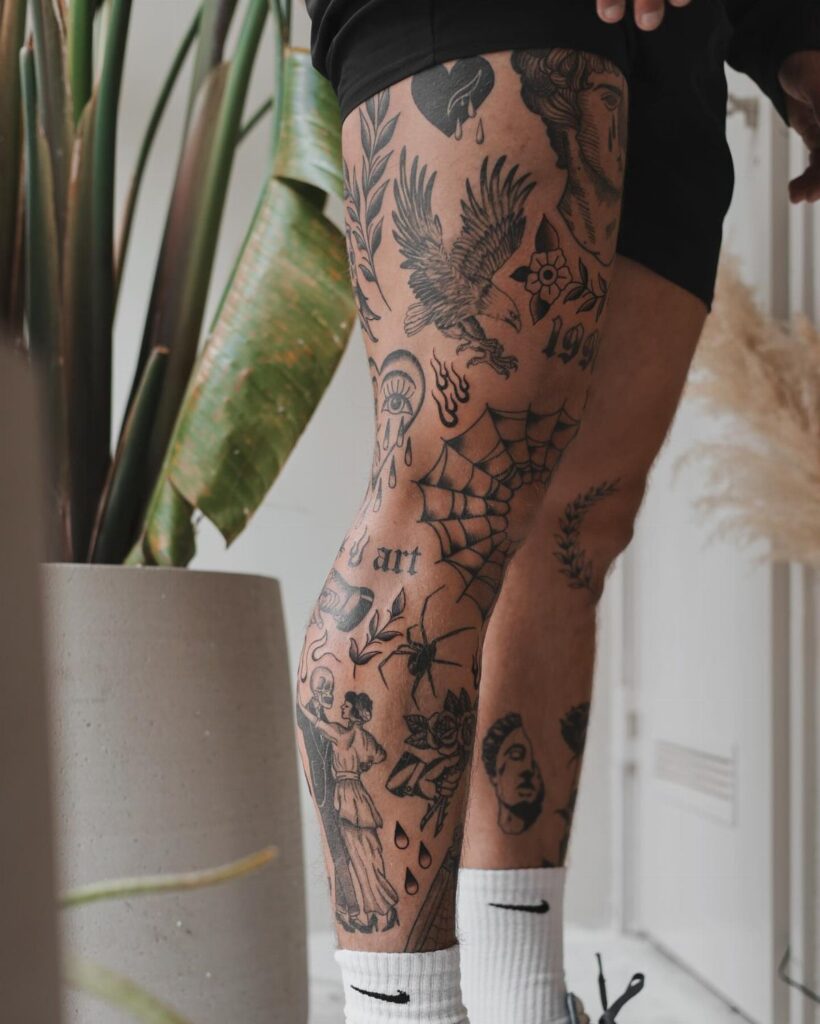
A full leg sleeve can take 30 to 60 hours of work spread across several months, while a half sleeve or single motif like a snake or animal portrait wraps up faster.
You can commit the entire leg to one continuous design, split the work between upper and lower zones, or collect separate pieces that share a thread.
1. Full Leg Sleeve Tattoo
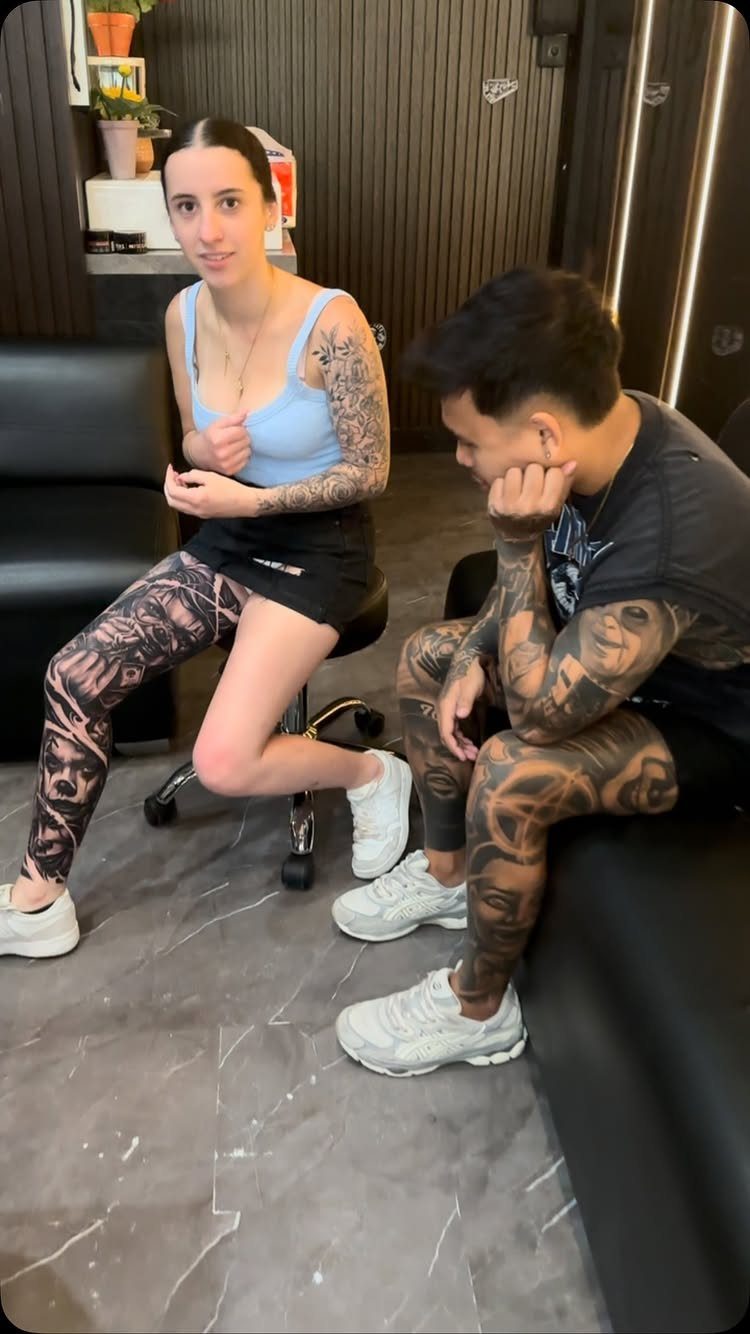
A full leg sleeve runs from the top of the thigh all the way down to the ankle, turning the entire leg into one continuous canvas.
The coverage gives you room to build out a single large scene or connect multiple elements without worrying about gaps.
Sessions usually span several months, and you should budget accordingly. Pain tolerance matters most around the knee and shin, where bone sits close to the surface.
The payoff is a piece that reads clearly from across a room and holds detail up close.
2. Half Leg Sleeve Tattoo
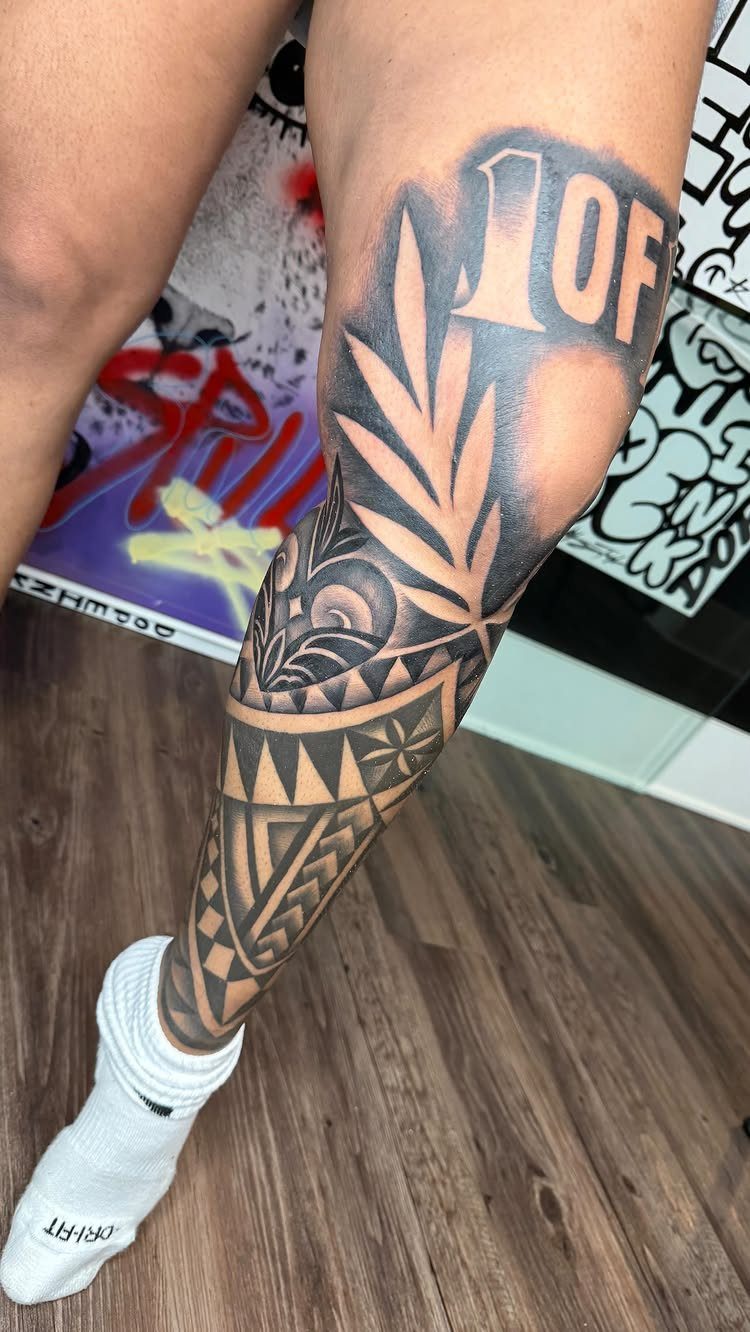
Half sleeves split the leg at the knee, covering either the thigh or the lower leg.
Lower leg placement keeps the piece visible in shorts and skirts. Upper thigh coverage, by contrast, hides more easily but offers a larger, flatter working area that can hold bigger images without wrapping around curves as much.
Sessions run shorter than a full leg piece.
3. Fine Line Botanical Half Sleeve
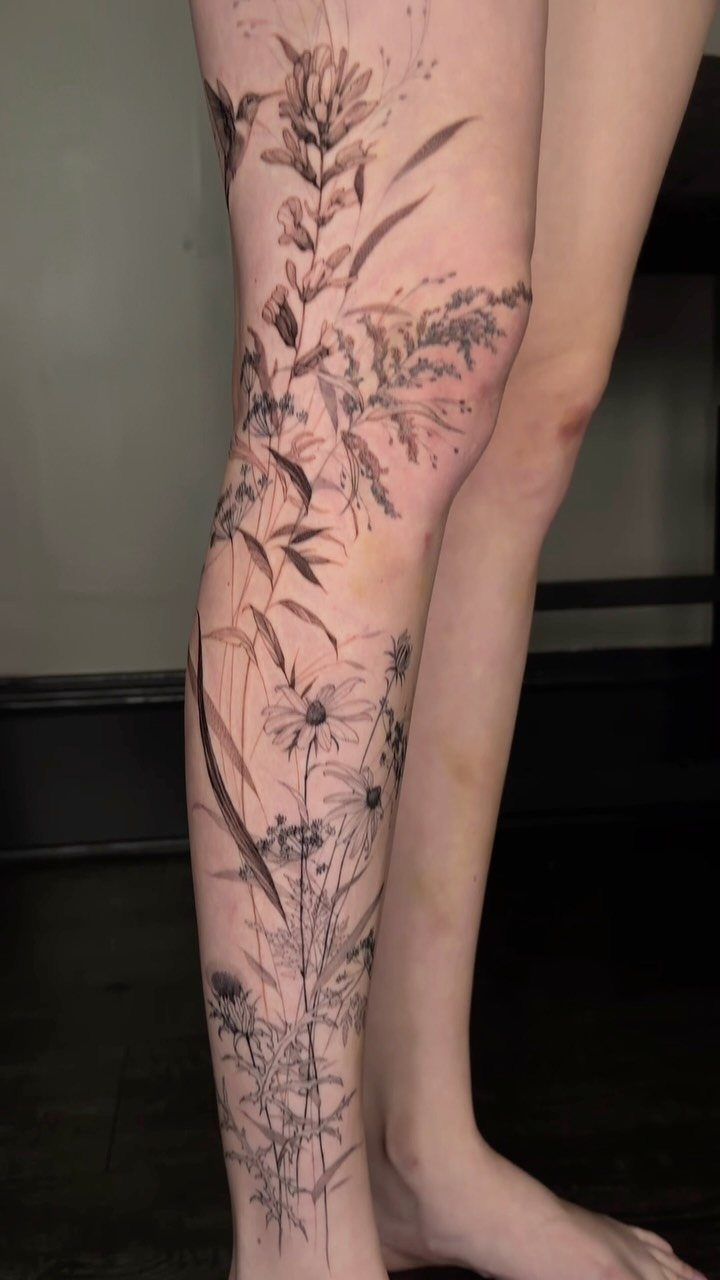
Fine line botanical work keeps the ink light and the linework thin, usually around 1 to 3 needles.
This approach works well for a piece that reads more like illustration than bold tattoo flash. Healing is straightforward, but fine lines can blur slightly over time, so choosing an artist experienced in this style matters.
The airy composition suits people who prefer subtlety over heavy saturation.
4. Patchwork Leg Sleeve
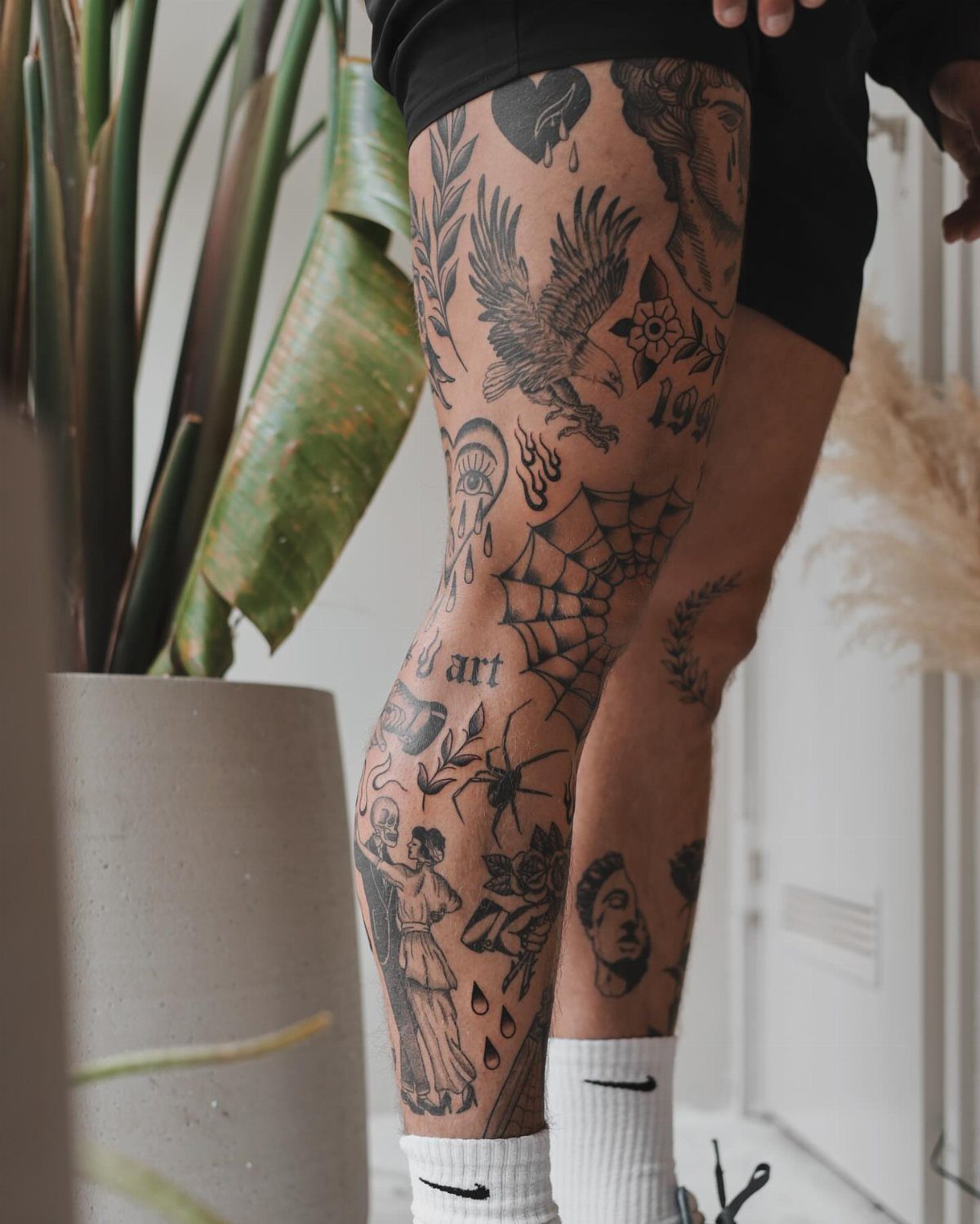
Patchwork sleeves grow over time. Instead of planning one unified design, you fill the leg with separate tattoos that sit close together, each one a standalone image.
This method lets you add pieces as your budget and schedule allow, and each session can focus on a single tattoo.
The result is less cohesion, but many people prefer the collected look, especially if each piece carries its own meaning.
Spacing between images can tighten over time as you fill gaps.
5. Geometric Leg Sleeve
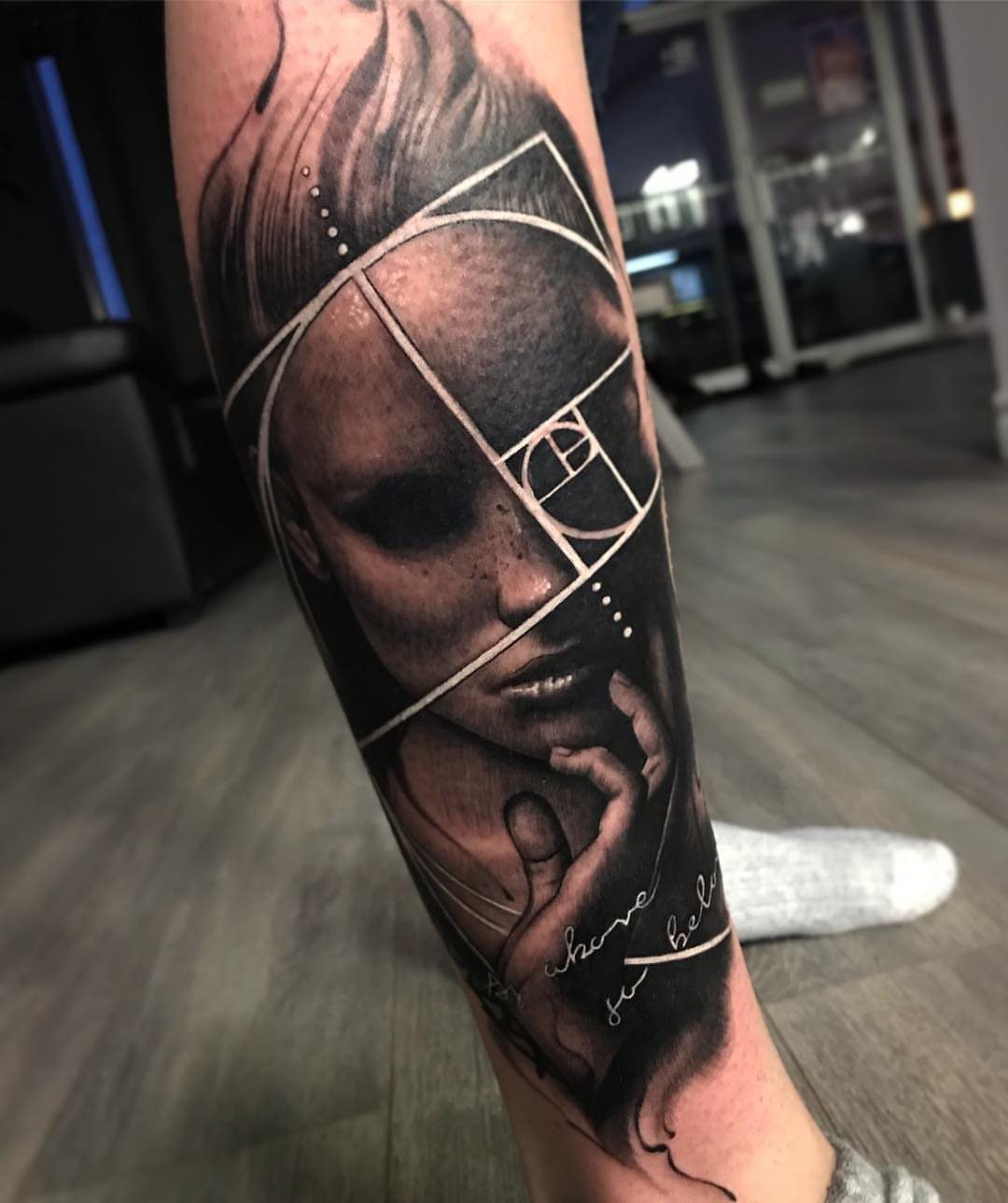
Geometric sleeves layer shapes, lines and patterns over or around other imagery. Here, a realist portrait of a woman’s face sits beneath a grid of intersecting lines and script, anchoring the composition while the geometry frames and activates the space.
The precision required means stencil placement and needle control matter more than in softer styles. Lines that should meet but don’t, or curves that wobble, stand out immediately.
This style pairs well with realism, dotwork or blackwork, and the contrast between organic and structural elements gives the piece visual tension.
6. American Traditional Leg Sleeve
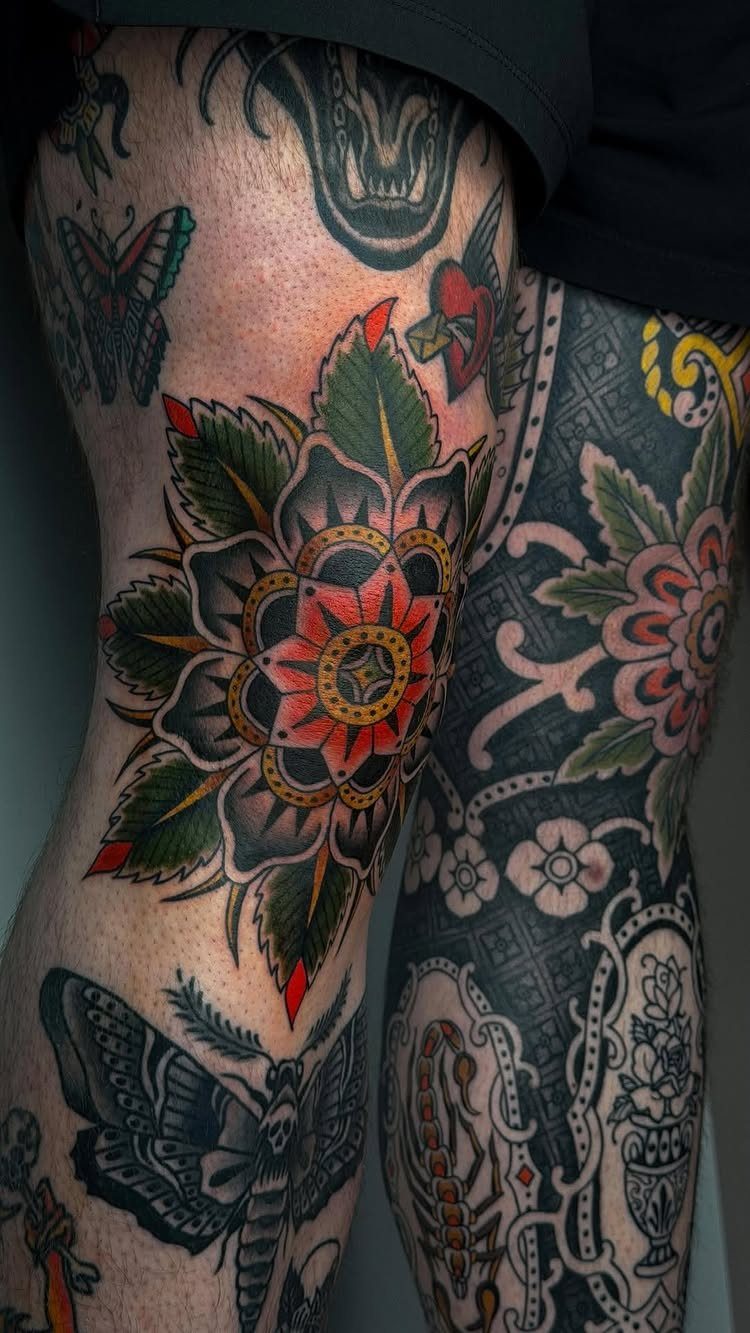
American traditional uses bold black outlines, solid color fills and classic imagery like roses, moths, snakes and daggers.
The style ages well because the heavy outlines hold their shape and the saturated colors stay readable even as the tattoo settles. Sessions move faster than fine detail work since the designs rely on clean shapes rather than soft shading.
This approach suits anyone drawn to vintage flash and tattoo history, and the motifs carry decades of symbolic weight.
7. Biomechanical Leg Sleeve
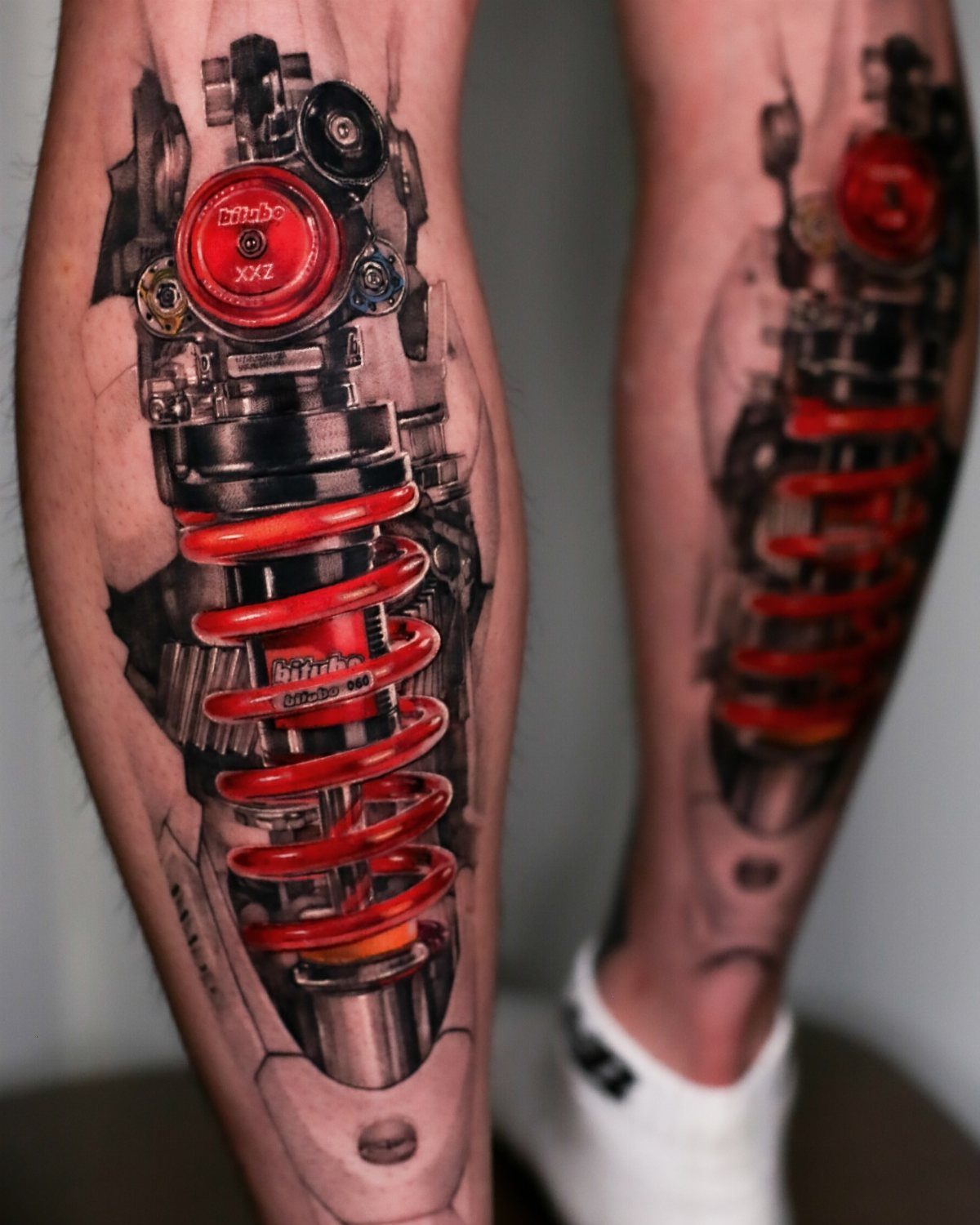
Biomechanical tattoos layer mechanical components like pistons, gears and suspension springs beneath torn skin, creating the illusion that your leg is part machine.
The style depends on realistic shading to sell the depth, so black and grey gradients do most of the work.
Color can highlight specific parts, the way the red shock absorber here draws the eye, but too much flattens the effect.
Placement on the calf works well because the muscle’s natural curve helps the 3D illusion read from multiple angles.
8. Anime Leg Sleeve Tattoo
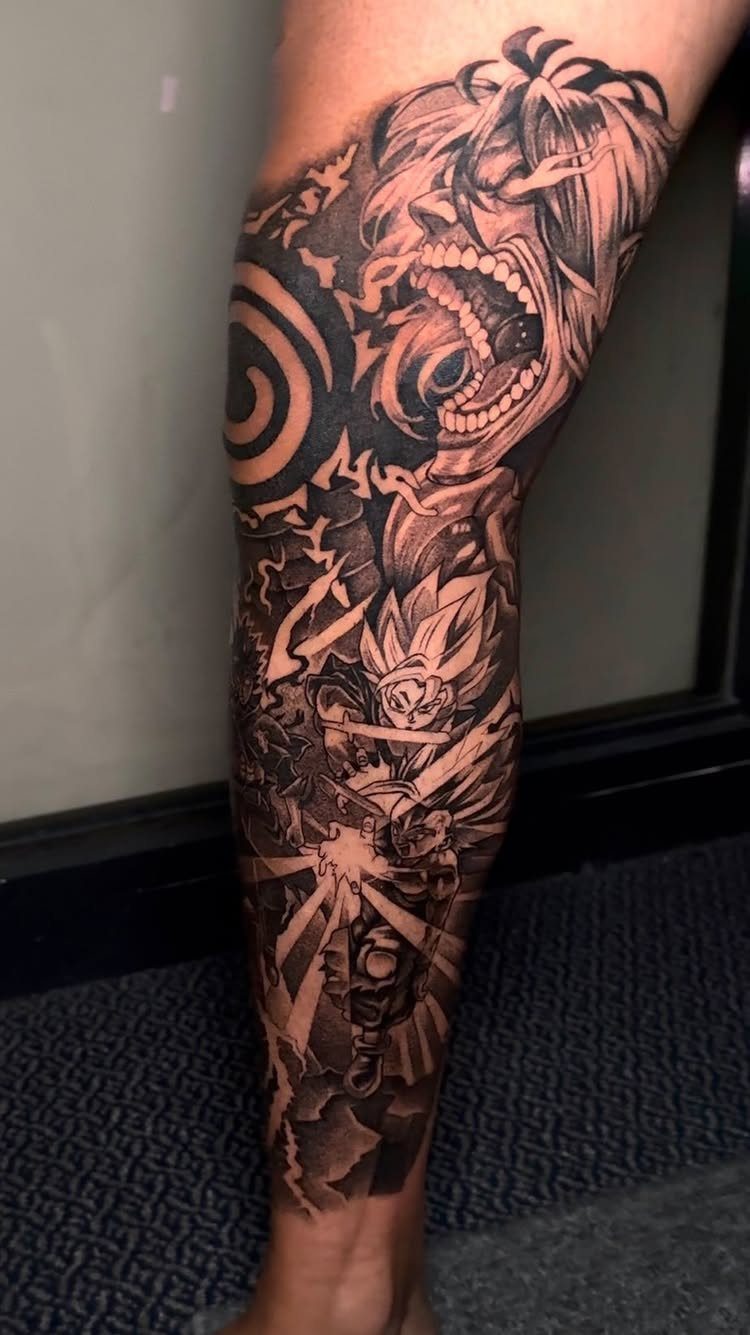
Anime sleeves pull characters from manga and television series, often mixing multiple shows or sticking to one franchise depending on how you want the piece to read.
Black and grey keeps the focus on linework and shading rather than competing color palettes, especially when you stack several characters with different costumes and backgrounds.
The challenge is finding an artist who can translate 2D animation into tattoo form without losing the proportions or expression that make the character recognizable in the first place.
9. Snake Leg Tattoo
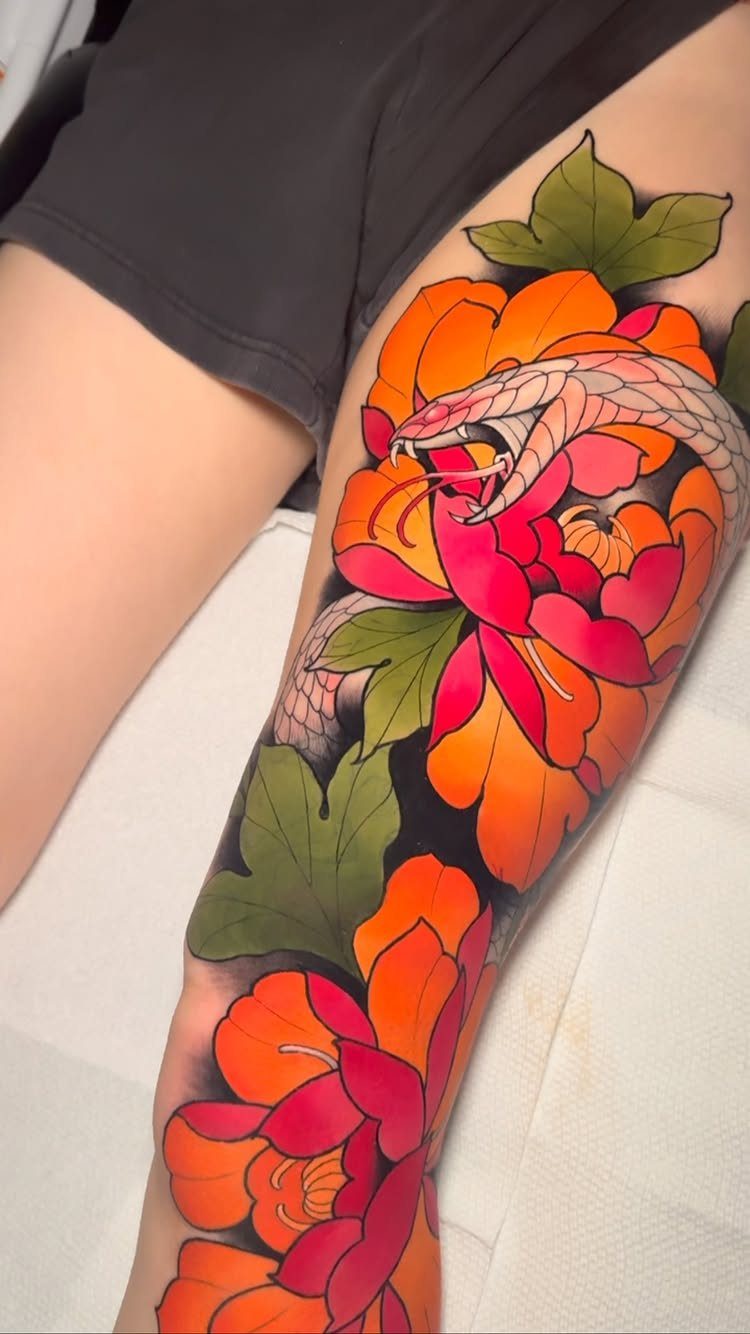
Snakes follow the leg’s contour naturally, winding up from the ankle or wrapping around the thigh in a way that uses the muscle’s shape.
Flowers like peonies or roses often fill the space around the snake’s body, softening the composition and adding color contrast. This piece took 10 hours across 2 days and covered an older tattoo underneath.
Bold scales and clear outlines hold up better over time than soft shading alone, especially on a design that moves with the leg.
10. Dragon Leg Tattoo
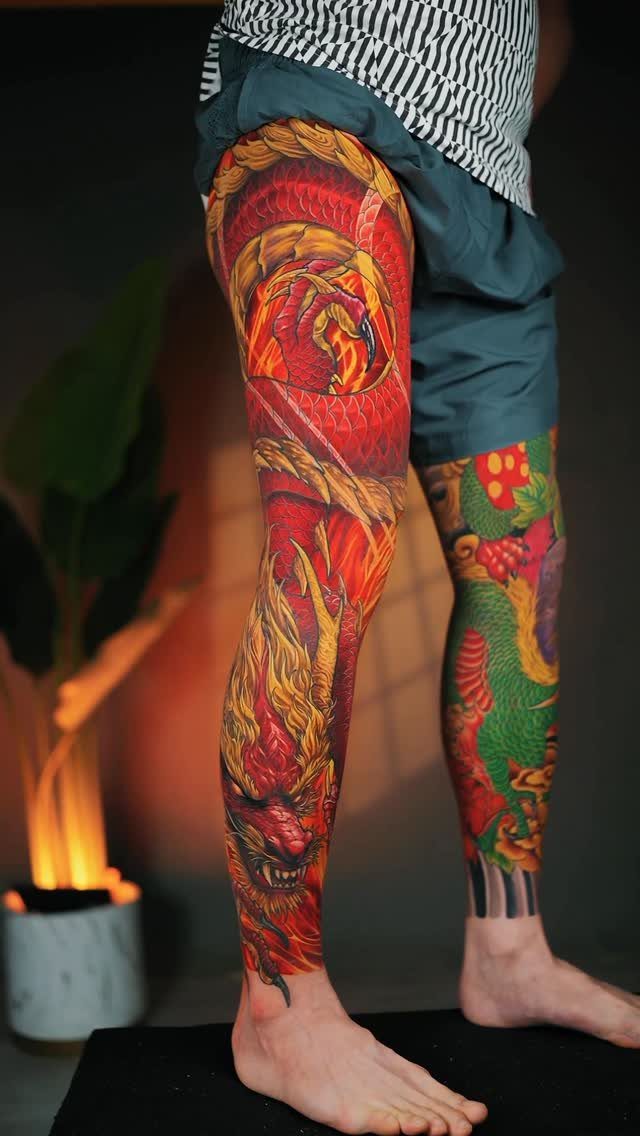
Dragons scale up or down depending on whether you want a single creature dominating the leg or smaller ones worked into a larger scene.
Japanese-style dragons wrap around the limb in an S-curve, following the muscle, while Western dragons often sit straighter and fill more vertical space.
Color saturation matters. Red and gold read clearly from a distance, but a full palette can turn muddy if the artist doesn’t leave enough contrast between the dragon and its background.
11. Ocean and Wave Leg Sleeve
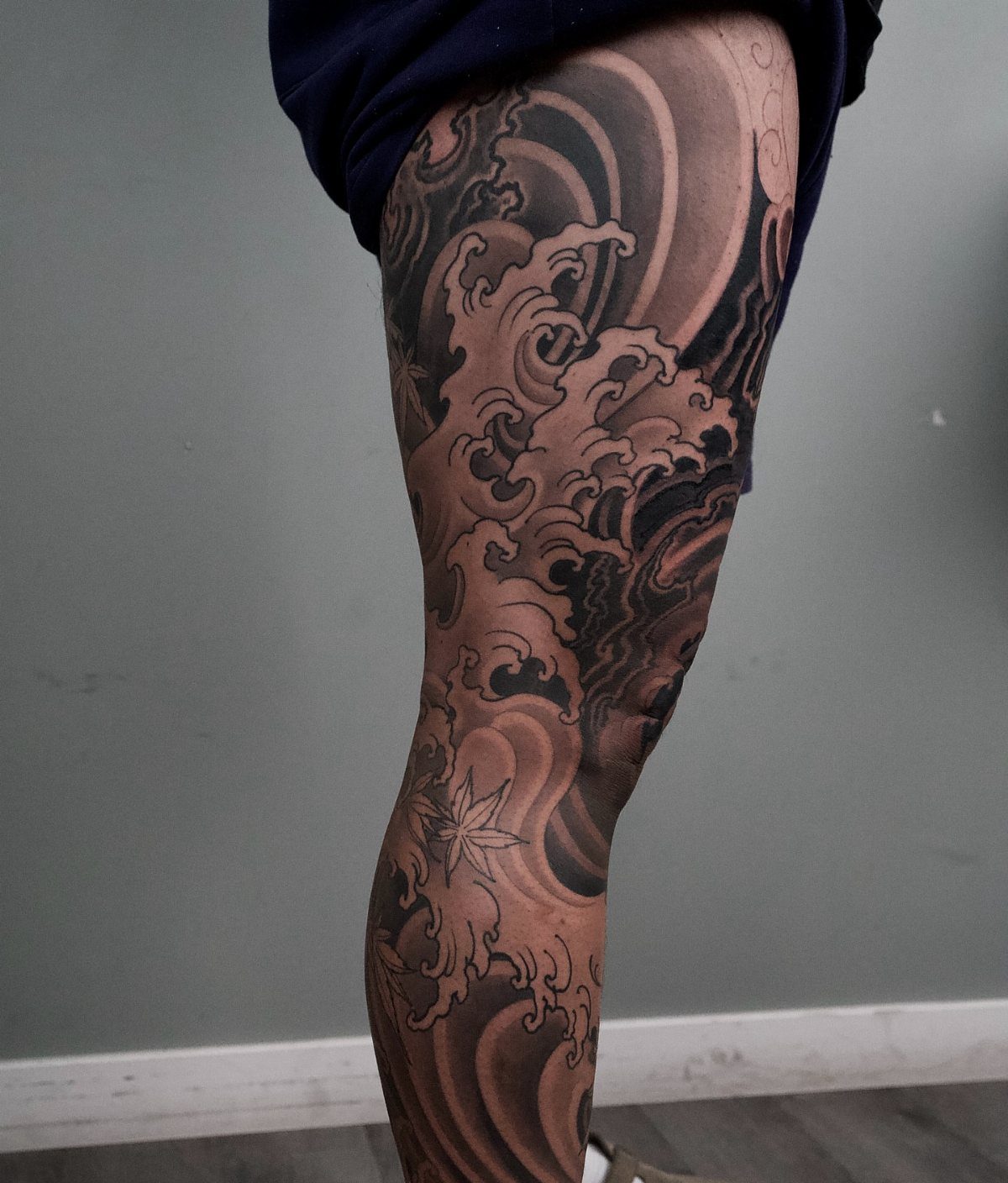
Ocean waves wrap the leg in horizontal bands that follow the calf’s curve, giving the design natural movement even when you’re standing still.
Japanese wave motifs work especially well here because the foam and curl patterns are designed to repeat and connect, letting the artist build a full sleeve without forcing one big central image.
Black and grey keeps the focus on the texture and flow of the water rather than splitting attention across too many colors.
12. Animal Face Leg Tattoo
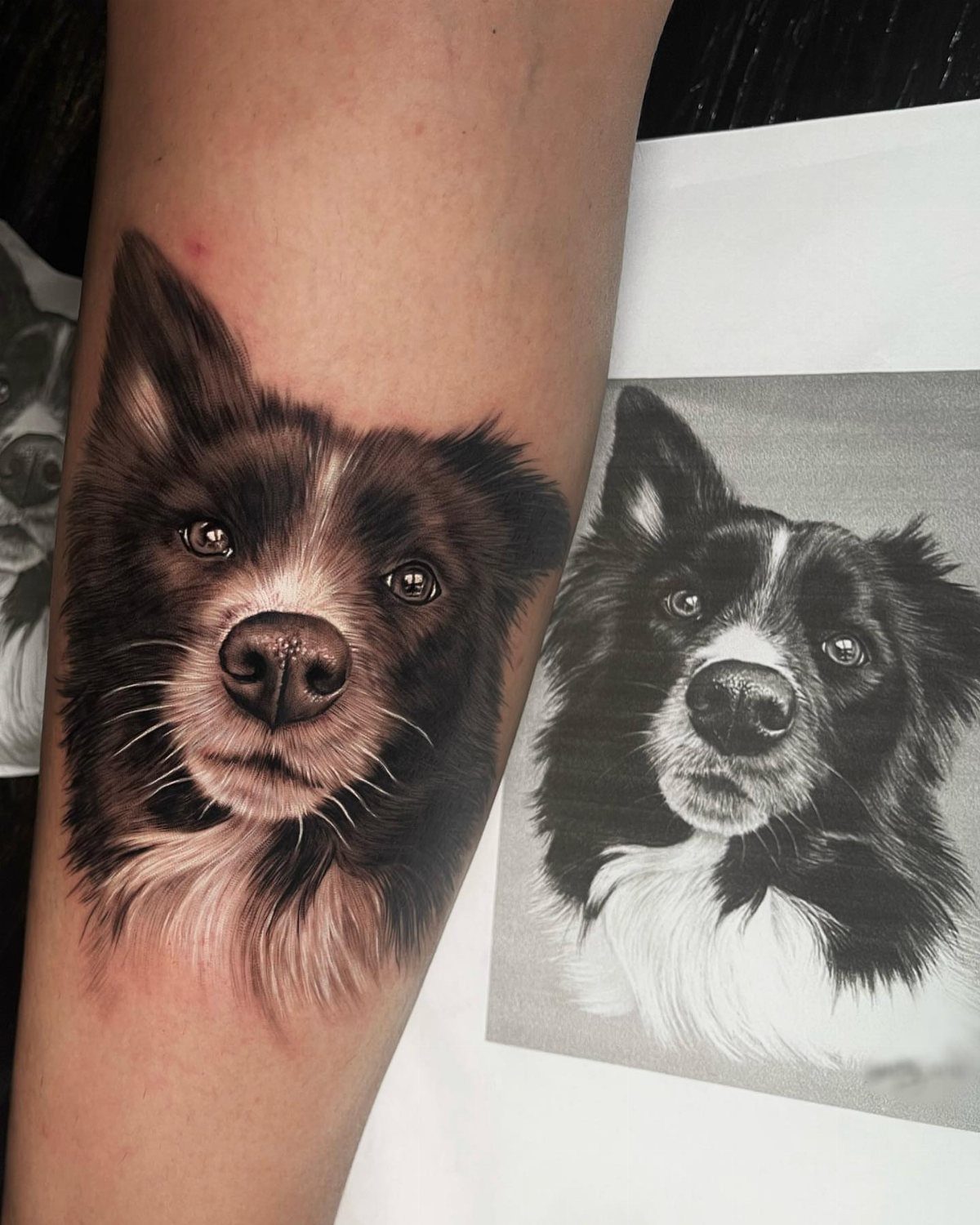
Animal portraits sit best on the calf or thigh, where you have enough flat surface to hold the face without distortion.
Realism demands precise reference photos and an artist who can translate fur texture and eye detail into skin. The tighter the likeness, the more the tattoo functions as a memorial or tribute rather than decorative work.
Placement matters if you want the face to read right-side-up when you’re standing. On the outer calf, the animal looks out; on the inner thigh, it faces you.
Considerations Before Getting a Leg Tattoo
A full leg sleeve ranks among the biggest tattoo projects available, often requiring 30 to 60 hours of work spread across several months.
Wardrobe control is straightforward. Pants, long skirts and boots hide the piece when you need them to, and shorts or cropped trousers show it when you want.
Fat and muscle cushion the upper outer thigh, and nerve endings run sparse, so pain stays low there. The ankle, shin and knee sit at the opposite end, with bone close to the surface and very little cushion.
Summer healing means keeping the tattoo covered and out of direct sun until it fully closes.
Pain Levels for Leg Tattoos
Pain on the leg follows a clear pattern. Muscle and fat over the outer calf and front thigh keep pain moderate, usually landing between 3 and 5 on a 10-point scale.
Bone proximity decides most of it. Where the tibia or patella sits directly under the skin, every pass of the needle registers sharply.
The back of the knee adds thin, mobile skin and a tight concentration of nerves, which makes long sessions there harder to push through.
If you’re planning a full leg sleeve, expect the pain to shift as the artist moves between zones. Sessions that cover only the calf or thigh stay more manageable than those that cross onto the shin or wrap the knee.
Cost and Time for Leg Sleeve Tattoos
A lower leg sleeve usually costs $2,000 to $5,000, and a full leg sleeve usually costs $4,000 to $10,000 or more.
A lower leg sleeve costs $2,000 to $5,000, and you’ll sit through multiple sessions to finish it.
A full leg sleeve can take 30 to 60 hours or more, depending on how much detail you’re packing in and whether the design includes heavy shading, realism or intricate linework.
Realism and Japanese designs run up both the hourly rate and the total clock time compared to straightforward traditional patchwork.
If you’re building a patchwork sleeve over several years, you can spread the cost, but each session still adds up once you factor in the tip.
Frequently Asked Questions
What do you call a leg tattoo?
When one design or a set of connected images covers most of your leg, that’s a leg sleeve.
Lower leg sleeves run from knee to ankle, upper leg sleeves cover the thigh, and full leg sleeves go from hip to ankle.
What not to do after getting a leg tattoo?
Avoid swimming, baths and sun exposure until the tattoo heals.
Swelling hits hardest around the ankle, so prop your leg up for the first 48 hours. Stick to loose pants, wash gently twice a day and apply a thin layer of unscented lotion.





